
When a new drug hits the market, the work doesn’t end with approval. In fact, the real test of safety begins after patients start using it in the real world-where people have multiple conditions, take other medications, are older, pregnant, or have genetic differences that never showed up in clinical trials. Tracking post-marketing studies for drug safety isn’t optional. It’s a legal requirement, a moral duty, and the only way to catch hidden risks before they hurt thousands.
Why Post-Marketing Surveillance Matters
Pre-approval clinical trials involve a few thousand carefully selected patients, often under ideal conditions. They rarely include people over 75, pregnant women, or those with three or more chronic illnesses. Yet, these are the exact people who will take the drug once it’s sold. That’s why post-marketing surveillance (PMS) exists: to find side effects that only show up when millions of real people use the drug over years. The FDA’s own data shows that 28% of serious adverse reactions identified after approval wouldn’t have been seen in trials-mostly because older adults were underrepresented. One drug approved in 2019 caused liver damage in patients over 65. That risk wasn’t clear until 18 months after launch, when FAERS reports started piling up. Without PMS, that drug might have kept being prescribed to vulnerable patients for years.The Three Core Systems for Tracking Drug Safety
There are three main systems used globally to track drug safety after approval. Each plays a different role, and smart teams use all three together. FAERS (FDA Adverse Event Reporting System) is the oldest and most widely used. It’s a database with over 30 million reports from doctors, pharmacists, patients, and drug makers. Anyone can submit a report-even if they’re not sure the drug caused the problem. FAERS doesn’t prove causation, but it flags patterns. In 2022, 63% of all safety actions by the FDA started with a FAERS signal. That’s why every drug company has a team monitoring FAERS daily. The Sentinel System is the FDA’s modern upgrade. Instead of waiting for reports, Sentinel actively mines data from over 300 million Americans. It pulls from insurance claims, electronic health records, and lab results. It can spot trends like a sudden spike in kidney injuries among users of a new diabetes drug-within weeks. Sentinel’s big advantage? It can link drugs to actual health outcomes, not just symptoms reported by patients. Post-Marketing Studies (PMS Studies) are formal, regulated studies companies must run after approval. These aren’t optional. If the FDA requires a study, you have to complete it. They might look at long-term cancer risk, effects on children, or interactions with common over-the-counter meds. The problem? Only 28% of these studies finish on time. The average delay is over two years. Tracking them requires more than a spreadsheet-it needs a dedicated system.How to Set Up a Tracking System for PMS Studies
If your company has a drug on the market, you need a system that doesn’t rely on emails, Excel files, or memory. Here’s how to build one:- Start with a master registry. List every required study by name, sponsor, FDA mandate date, due date, and status. Include who’s responsible and what data you’re collecting.
- Assign ownership. Each study needs a lead-usually a pharmacovigilance specialist. Best practice: one specialist per $500 million in annual sales. For a $2 billion drug, that’s four dedicated people.
- Automate alerts. Set up calendar triggers for milestones: patient enrollment deadlines, data lock dates, report submissions. Missing one deadline can trigger an FDA warning letter.
- Integrate with FAERS and Sentinel. Your tracking system should pull in safety signals from both. If FAERS shows a new pattern linked to your drug, your PMS study might need to be adjusted or accelerated.
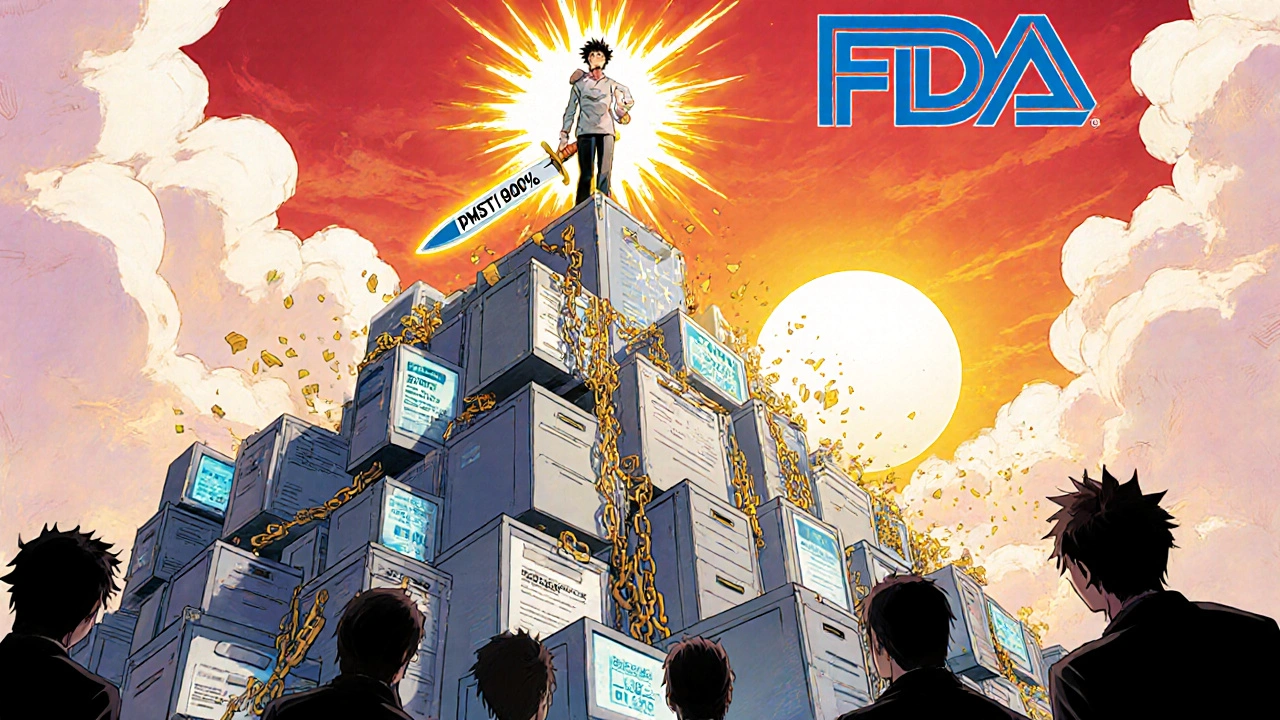
- Track the PMSTI. That’s the Post-Marketing Study Timeliness Index. It’s the percentage of studies completed on time. Aim for 90% or higher. Anything below 70% puts you at risk for regulatory action.

Common Pitfalls and How to Avoid Them
Most companies fail at PMS tracking-not because they don’t care, but because they underestimate the complexity. Pitfall 1: Waiting for the FDA to remind you. The FDA doesn’t call to say, “Hey, your study is due in 30 days.” They send a letter when you’re already late. Set internal deadlines 60 days before the official one. Pitfall 2: Assuming data from insurance claims is enough. Sentinel uses claims data, but it often lacks lab values, vital signs, or detailed diagnoses. That’s why some signals are missed. Pair Sentinel with direct EHR access where possible. Pitfall 3: Ignoring international data. If your drug is sold in Europe, Canada, or Japan, you’re missing half the picture. The UK’s Yellow Card system got 76,000 reports in 2022. Canada’s Vigilance Program added 28,000. Combine these with FAERS, and you get a global view. Pitfall 4: Not using technology. Manual tracking is a time bomb. Companies using AI tools to scan EHRs for adverse events cut signal detection time by 42%. Even basic text-mining tools can pull safety signals from clinical notes faster than humans.What Happens When You Find a Problem?
Finding a safety signal is just the start. What you do next matters more. The FDA’s signal management process has five steps:- Identify. Is this a real pattern? Or just noise? Use statistical tools to filter false positives. In 2018, 34% of signals turned out to be false. By 2023, that dropped to 19% thanks to better algorithms.
- Triage. How many people are affected? How severe are the outcomes? A drug causing 500 cases of mild rash? Low priority. A drug linked to 50 sudden deaths? Immediate action.
- Evaluate. Look at all data: FAERS, Sentinel, published literature, your own PMS studies.
- Act. Most actions (87%) are labeling updates-adding a warning about liver damage, for example. Some require a REMS (Risk Evaluation and Mitigation Strategy), like restricting distribution or requiring doctor training. Market withdrawals happen in less than 1% of cases.
- Communicate. The FDA issues Drug Safety Communications publicly. Your company must respond with updated prescribing guides, patient cards, and training for reps.
The Future of Drug Safety Tracking
The system is changing fast. By 2026, the FDA’s Sentinel Common Data Model Plus will include genomic data for 50 million patients. That means we’ll soon know if a patient’s DNA makes them more likely to have a bad reaction. The EU is launching an AI-powered system in 2025 that can predict safety signals before they’re even reported. And the WHO is building a global network to share data across 100 countries-so a rare side effect in Brazil shows up in Japan within days. For companies, the message is clear: the old way of tracking-spreadsheets, quarterly meetings, and last-minute rushes-isn’t enough anymore. You need automation, integration, and a culture that treats safety tracking like a core business function, not a compliance chore.Frequently Asked Questions
What’s the difference between FAERS and Sentinel?
FAERS collects voluntary reports from doctors, patients, and companies. It’s great for spotting unusual patterns but can’t prove cause. Sentinel actively analyzes real-world data from insurance claims and electronic health records for over 300 million Americans. It can link drugs to specific health outcomes, like hospitalizations or lab changes, making it more reliable for detecting true risks.
How long do post-marketing studies usually take?
The FDA typically gives companies three years to complete mandated studies. But in reality, the median completion time is 5.3 years. Delays happen because of slow patient recruitment, complex data collection across multiple hospitals, and lack of dedicated staff. Companies that use distributed data networks and automated enrollment tools cut initiation time from 14 months to under 9 months.
What happens if I miss a PMS study deadline?
Missing a deadline can trigger an FDA warning letter, which goes public. It can delay new drug approvals for your company, lead to fines, or force you to add stricter warnings to your product label. In extreme cases, the FDA can require a Risk Evaluation and Mitigation Strategy (REMS) or even restrict sales. The best defense? Internal deadlines set 60 days before the official one.
Can AI help track drug safety?
Yes. AI tools can scan unstructured data in electronic health records-like doctor’s notes-to find safety signals 42% faster than traditional methods. But they’re not perfect. Early AI models generated 23% more false positives than human reviewers. The key is using AI as a filter, not a replacement. Human experts still need to review flagged signals.
Do I need to track safety data outside the U.S.?
Absolutely. If your drug is sold in Europe, Canada, Japan, or Australia, you’re missing critical data if you only look at FAERS. The UK’s Yellow Card system and Canada’s Vigilance Program report thousands of adverse events each year. Some signals appear first overseas. Global monitoring isn’t optional-it’s essential for patient safety and regulatory compliance.
Next Steps for Your Team
If you’re responsible for drug safety tracking, start here:- Map all your post-marketing studies. Are they in one place? Are deadlines tracked?
- Assign a pharmacovigilance lead for each study. No more “someone will handle it.”
- Connect your system to FAERS and Sentinel alerts. Set up daily email digests.
- Run a PMSTI audit. What percentage of your studies are on time?
- Talk to your IT team about AI tools that scan clinical notes. Even basic text mining can save weeks of manual review.

Write a comment
Your email address will not be published.
Recent Posts
-
 How to Buy Cheap Generic Atenolol Online Safely September 27, 2025
 -
 Burning Sensation in the Joints: Causes and Treatment October 6, 2025


8 Comments
This is so needed! 🙌 I’ve seen teams ignore PMS until the FDA knocks on their door. Time to get organized! 💪
Of course it’s a moral duty. But let’s be honest-pharma cares more about lawsuits than lives. This guide is just damage control dressed up as ethics.
FAERS is a dumpster fire with a fancy acronym. Sentinel’s the only thing that doesn’t make me want to quit my job. And yet-still 19% false positives? Pathetic.
I appreciate the practical breakdown. Many companies treat this like a box to check, but safety isn’t a task-it’s a commitment. Simple systems, clear ownership, and regular reviews make all the difference.
While the framework outlined is commendable, it is imperative to emphasize the necessity of cross-functional governance. Pharmacovigilance cannot operate in silos; integration with regulatory affairs, medical affairs, and data science is non-negotiable for operational efficacy.
They’re not tracking safety-they’re tracking liability. You think Sentinel is about patients? Nah. It’s about covering their asses before Congress hears about another dead grandma. And don’t get me started on AI-they’re training it on biased data so it ignores Black and Brown patients. You think they care? They’re just trying to avoid fines.
Great guide! I’ve worked in several African markets where post-marketing surveillance is almost nonexistent, and the consequences are devastating. Patients with diabetes, hypertension, or HIV are getting drugs without proper follow-up. The tools you mention-FAERS, Sentinel, PMSTI-are not luxuries; they’re lifelines. I urge every company with global reach to extend their tracking systems beyond the US and EU. Local health ministries need support, not just data dumps. If you can automate alerts for your own team, you can build partnerships to do the same in Lagos, Nairobi, or Accra. Safety isn’t a privilege of wealthy nations-it’s a human right.
Yeah, sure. Another 12-page PDF no one will read. I’ve seen this movie before. By the time the system’s set up, the drug’s already off the market-or the team’s been laid off.