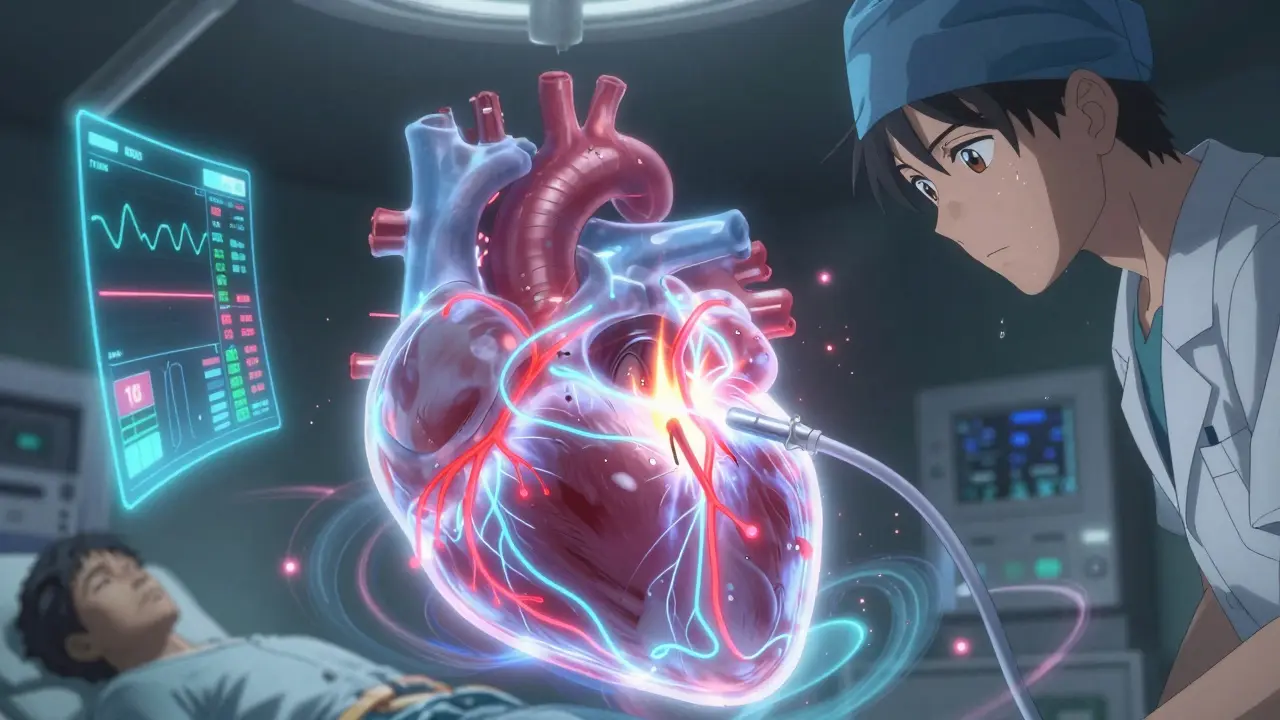
When your heart skips, races, or flutters without reason, it’s not just annoying-it can be dangerous. Arrhythmias, or irregular heartbeats, affect millions worldwide, and for many, medications alone aren’t enough. That’s where catheter ablation and device therapy come in-two proven, life-changing options that go beyond pills to fix the root problem.
What Is Catheter Ablation?
Catheter ablation is a minimally invasive procedure that targets the exact spots in your heart causing the irregular rhythm. A thin, flexible tube (a catheter) is threaded through a vein in your leg or arm up to your heart. Once in place, the doctor uses energy-either heat (radiofrequency) or cold (cryoablation)-to destroy tiny areas of tissue that are sending out faulty electrical signals. This isn’t guesswork. Modern systems use 3D mapping to build a detailed picture of your heart’s electrical activity. The goal? To create precise scars-called lesions-that block abnormal pathways without harming healthy tissue. The most common target is the pulmonary veins, where abnormal signals often start in atrial fibrillation (AFib). By isolating these veins, doctors stop the chaos before it spreads.Radiofrequency vs. Cryoablation: Which Is Better?
There are two main types of ablation used today, each with strengths. Radiofrequency ablation uses controlled heat (around 50-70°C) to burn tissue. It’s been the gold standard since the 1990s. Newer versions, like the THERMOCOOL SMARTTOUCH Catheter, include contact force sensing. This means the catheter tells the doctor exactly how hard it’s pressing against the heart wall. Too little pressure? The lesion won’t stick. Too much? You risk damaging tissue. This tech improves success rates by 12-15% and cuts procedure time by about 25 minutes. Cryoablation uses freezing instead. A balloon inflated inside the pulmonary vein delivers nitrous oxide cooled to -55°C to -65°C. It freezes the tissue all around the vein in one go. This is faster-often under two hours-and easier for doctors to learn. It’s especially popular for paroxysmal AFib, where the irregular rhythm comes and goes. But it carries a small risk of injuring the phrenic nerve, which controls the diaphragm. That’s why doctors monitor nerve function during the procedure. A newer option, pulsed field ablation (PFA), uses short bursts of electrical energy to kill heart cells without heat or cold. It’s faster (under 80 minutes), safer for nearby structures like the esophagus, and has shown 85.9% success at one year in recent trials. The Farapulse system got FDA approval in 2023, and it’s already being used in top centers.Success Rates and Real Results
How well does it work? Better than most people think. For paroxysmal AFib (episodes that stop on their own), about 70-80% of patients are free from arrhythmia after one procedure. With contact force-guided radiofrequency ablation using the Ablation Index-a smart scoring system that combines pressure, time, and power-success jumps to 71% at 12 months. That’s higher than cryoablation (65%) and older radiofrequency tools (58-65%). But the real win isn’t just rhythm control-it’s survival. For patients with heart failure and reduced pumping power (HFrEF), ablation cuts the risk of death by nearly half. One 2019 meta-analysis of over 700 patients found a 48% lower risk of dying after ablation compared to medication alone. These patients also saw better heart function, walked farther in tests, and reported less fatigue. Even mental health improves. A 2023 JAMA study showed people who had ablation had far less anxiety and depression. Why? Because they stopped living in fear of the next flutter or skip. One patient on Reddit said, “I went from daily palpitations to zero episodes in nine months. The mental relief is as valuable as the physical.”When Device Therapy Makes Sense
Not everyone is a candidate for ablation. Some have persistent or long-standing AFib that’s harder to fix. Others have heart failure with very weak pumping ability. For them, device therapy is the next step. The most common device is the implantable cardioverter-defibrillator (ICD). It monitors your heart constantly. If it detects a dangerous rhythm-like ventricular tachycardia or fibrillation-it delivers a shock to reset it. ICDs save lives in people at high risk of sudden cardiac arrest. Then there’s the cardiac resynchronization therapy (CRT) device. It’s a pacemaker with an extra lead that helps both sides of the heart beat in sync. This improves pumping efficiency in heart failure patients. Many CRT devices now also include defibrillator function (CRT-D), combining both benefits. These aren’t cures. They’re safeguards. But for many, they mean the difference between living with fear and living with confidence.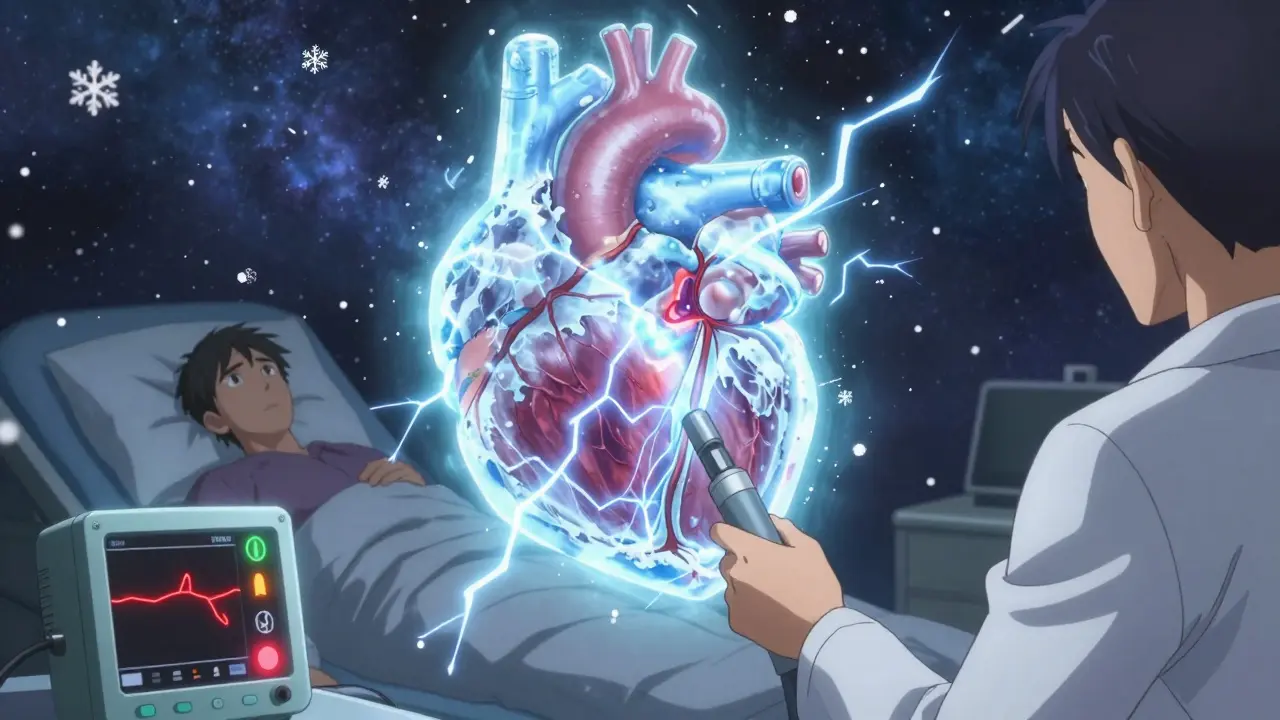
Who Gets These Procedures?
Guidelines are clear: if you have symptomatic AFib and one antiarrhythmic drug didn’t help, ablation is now a first-line option. That’s a big shift from just a decade ago, when doctors waited until medications failed completely. The European Society of Cardiology gives catheter ablation a Class I recommendation for paroxysmal AFib after one failed drug. For persistent AFib, it’s Class IIa-still strongly supported, but with more careful patient selection. You’re a good candidate if:- You have symptoms like fatigue, dizziness, or shortness of breath
- Your AFib isn’t controlled by medication
- You don’t have severe lung disease or blood clotting disorders
- You’re willing to follow up with your electrophysiologist
What Are the Risks?
No procedure is risk-free. About 8% of patients have a major complication. The most serious is cardiac tamponade-bleeding around the heart-which happens in about 1.2% of cases. It’s rare but needs immediate treatment. Other risks include:- Damage to blood vessels at the insertion site
- Phrenic nerve injury (with cryoablation)
- Esophageal injury (very rare with PFA, slightly higher with radiofrequency)
- Need for a permanent pacemaker (less than 2% with modern techniques)
Cost and Access
Ablation isn’t cheap. In the U.S., the average cost is $16,300-$21,300. Medicare reimburses about $18,500. In Europe, it’s €12,000-€15,000. But here’s the twist: over time, it saves money. After 3-8 years, ablation becomes cost-saving. Why? Fewer hospital visits, fewer ER trips, less need for expensive drugs. One study found patients saved $4,000 per year in medication costs alone. But access is uneven. Urban centers have plenty of trained electrophysiologists. Rural areas? Only 40% as many. If you live outside a major city, you might need to travel. That’s a real barrier.
The Future: AI, PFA, and Better Tools
The field is moving fast. Pulsed field ablation is already changing the game. It’s faster, safer, and works better in complex cases. By 2025, Medtronic’s AI Path software will help doctors predict lesion quality in real time-like a GPS for heart tissue. The Heart Rhythm Society predicts ablation will become first-line for all symptomatic AFib patients by 2030. That’s not hype-it’s based on data. More centers are adopting contact force tech. More patients are getting better outcomes. More insurance companies are covering it early.What Patients Say
John, 58, had persistent AFib for six years. He tried three drugs. None worked. He was tired all the time. After cryoablation in March 2022, he was AFib-free by week four. He stopped all meds. By June, he was back on his bike-racing again. Another patient, on a heart support forum, wrote: “I used to check my pulse every hour. Now I don’t think about it. That’s freedom.” But not everyone has perfect results. About 20% need a second procedure. Some feel discomfort for weeks. A few get scar tissue that causes new rhythms. That’s why follow-up is key.Bottom Line
Catheter ablation and device therapy aren’t last resorts anymore. They’re powerful, proven tools that can restore rhythm, improve survival, and bring back quality of life. If you’ve been told you need to live with your arrhythmia, ask if ablation is right for you. If you have heart failure, ask if you’re a candidate for device therapy. The science is clear. The tools are better than ever. And for many, the best treatment isn’t a pill-it’s a procedure that fixes the problem at its source.Is catheter ablation a cure for atrial fibrillation?
It’s not always a permanent cure, but for many, it’s a long-term solution. About 70-80% of people with paroxysmal AFib stay free of arrhythmia after one procedure. For persistent AFib, success is lower, around 60-70%, and some need a second ablation. Even if the rhythm returns, many still have fewer symptoms and less need for medication. The goal isn’t always perfection-it’s better control and better life.
How long does it take to recover from catheter ablation?
Most people go home the same day or the next day. You’ll feel sore at the catheter insertion site for a few days. Light walking is fine after 2-3 days. Avoid heavy lifting, strenuous exercise, or anything that raises your heart rate for two weeks. Full recovery takes about 4-6 weeks. Some people feel better within days; others take longer as the heart heals. Follow-up appointments are critical to check for recurrence.
Can I stop taking blood thinners after ablation?
Not right away. Even if your rhythm is normal, you may still need blood thinners for at least 2-3 months after ablation because the heart tissue is healing and can form clots. Your doctor will monitor your risk of stroke and decide when it’s safe to stop. Some patients, especially those with other stroke risk factors, may need to stay on them long-term.
What’s the difference between an ICD and a pacemaker?
A pacemaker helps slow or irregular heartbeats by sending small electrical pulses to keep the heart beating regularly. An ICD does that too, but it can also deliver a strong shock if it detects a life-threatening rhythm like ventricular fibrillation. Many modern devices combine both functions (CRT-D). If you have heart failure and are at risk of sudden arrest, an ICD is often recommended.
Are there alternatives to ablation for AFib?
Yes-medications like beta-blockers, calcium channel blockers, and antiarrhythmics can control rhythm or rate. But they often come with side effects and don’t fix the root cause. For some, a surgical maze procedure is an option, but it’s more invasive. Ablation is now preferred because it’s less invasive, has better success, and improves survival in high-risk patients. It’s no longer just a backup-it’s a frontline choice.
How do I know if I’m a good candidate for ablation?
If you have symptoms like palpitations, fatigue, or shortness of breath from AFib, and one antiarrhythmic drug didn’t work, you’re likely a candidate. If you also have heart failure, ablation may improve your survival. Your doctor will check your heart structure, age, other health conditions, and how much your symptoms affect your life. If you’re active and want to get off meds, ablation is worth serious consideration.

Write a comment
Your email address will not be published.
Recent Posts
-
 Adverse Drug Events: Definition, Types, and Prevention Strategies February 24, 2026
 -
 Burning Sensation in the Joints: Causes and Treatment October 6, 2025

9 Comments
Catheter ablation's moved from Hail Mary to first-line for a reason. Contact force sensing? Game-changer. The Ablation Index isn't just fancy math-it's predictive analytics for cardiac tissue. Radiofrequency with real-time feedback reduces recurrence by like 15% compared to old-school blind ablation. And PFA? That’s the future. No thermal damage, no phrenic nerve drama. Just clean, targeted cell death. It’s like laser surgery but for your heart’s wiring. FDA approved in '23 and already outpacing cryo in real-world outcomes. If your EP isn’t offering PFA, ask why.
Let’s be real-this whole field is just fancy magic with wires. We’re zapping tiny bits of heart tissue like it’s a video game level and the boss is atrial fibrillation. But hey, if it gets you back on your bike racing at 58 like John, then I’m all for it. Still, the cost? $20k in the US and you’re lucky if your insurance doesn’t make you jump through ten hoops. Meanwhile, in India, most people can’t even get a decent ECG. Tech like this shouldn’t be a luxury. It should be a right.
Been following this stuff since the early 2010s. Back then, ablation was a last resort and success rates were shaky. Now? It’s legit. The data’s solid-especially for HFrEF patients. That 48% drop in mortality? That’s not stats, that’s lives. I’ve seen patients go from oxygen dependence to hiking trails. And yeah, there’s risk-tamponade’s no joke-but modern mapping and contact force tech have cut complications by half. Just make sure your doc uses a 3D system. Old-school fluoroscopy? Don’t bother.
so i had afib and got ablated and now i feel like a robot with wires in my chest. but hey at least i dont feel my heart skipping anymore. also my wife says i snore less now. weird.
One cannot help but observe the alarming commodification of cardiac intervention in the modern American healthcare apparatus. The elevation of catheter ablation to first-line status-while clinically sound-is emblematic of a broader pathological trend: the prioritization of technological intervention over holistic, preventative, and culturally grounded care. One must ask: Is this progress, or merely the aesthetic of progress? The human heart, a sacred organ of rhythm and spirit, reduced to a circuit board to be debugged with radiofrequency and cryogenic probes. The irony is palpable: we cure the arrhythmia, yet we have lost the soul of medicine.
Okay but can we just take a moment to appreciate how much mental health improves after ablation? Like, I didn’t realize how much anxiety I was carrying until it was gone. The constant pulse-checking, the midnight ER visits, the fear that the next flutter might be the one that kills you-it’s exhausting. After my PFA procedure, I stopped checking my Fitbit every 10 minutes. I started sleeping through the night. I even went to a concert without my ECG monitor. That’s not just physical healing-that’s emotional liberation. And the fact that JAMA published a study on this? Huge. We need to talk more about the psychological toll of arrhythmias. It’s not just ‘heart issues,’ it’s trauma.
They spent 20 years telling us to live with AFib. Then they invented a way to fix it. And now we’re debating whether it’s worth $20K? Bro. If your heart’s doing the cha-cha when you’re trying to sleep, and you’ve tried 3 drugs that made you feel like a zombie, this isn’t a luxury-it’s your damn birthright. I’m not crying, you’re crying. And yes, I’m still wearing my old ‘I Survived Ablation’ t-shirt. It’s my new badge of honor.
Just moved from India to the US and wow, the difference in care is insane. In my village, they gave me beta-blockers and said ‘pray more.’ Here, they mapped my heart in 3D, used PFA, and I was home the same day. My cousin in Delhi still waits 6 months for an echo. Access is everything. We need global equity in cardiac tech-not just for the rich. Also, I brought my mom to her first ablation consult yesterday. She’s 72. She’s gonna do it. No excuses. 💪❤️
I’m so glad someone finally explained this clearly. My brother had ablation last year and I didn’t understand half of what the doctors said. Now I get why they used cold instead of heat. And the part about blood thinners after-so important. I told him to keep taking them even if he felt fine. He listened. Thank you for writing this.