When you pick up a prescription, do you ever wonder why your pill looks different this time? Maybe it’s a different color, shape, or has a weird logo on it. If you’ve ever asked, "Is this the same as my old medicine?" - you’re not alone. Nearly half of all Americans believe generic drugs are less effective than brand-name ones. But here’s the truth: generic drugs are just as safe, just as strong, and work in exactly the same way. The problem isn’t the medicine. It’s the message.
What Are Generic Drugs, Really?
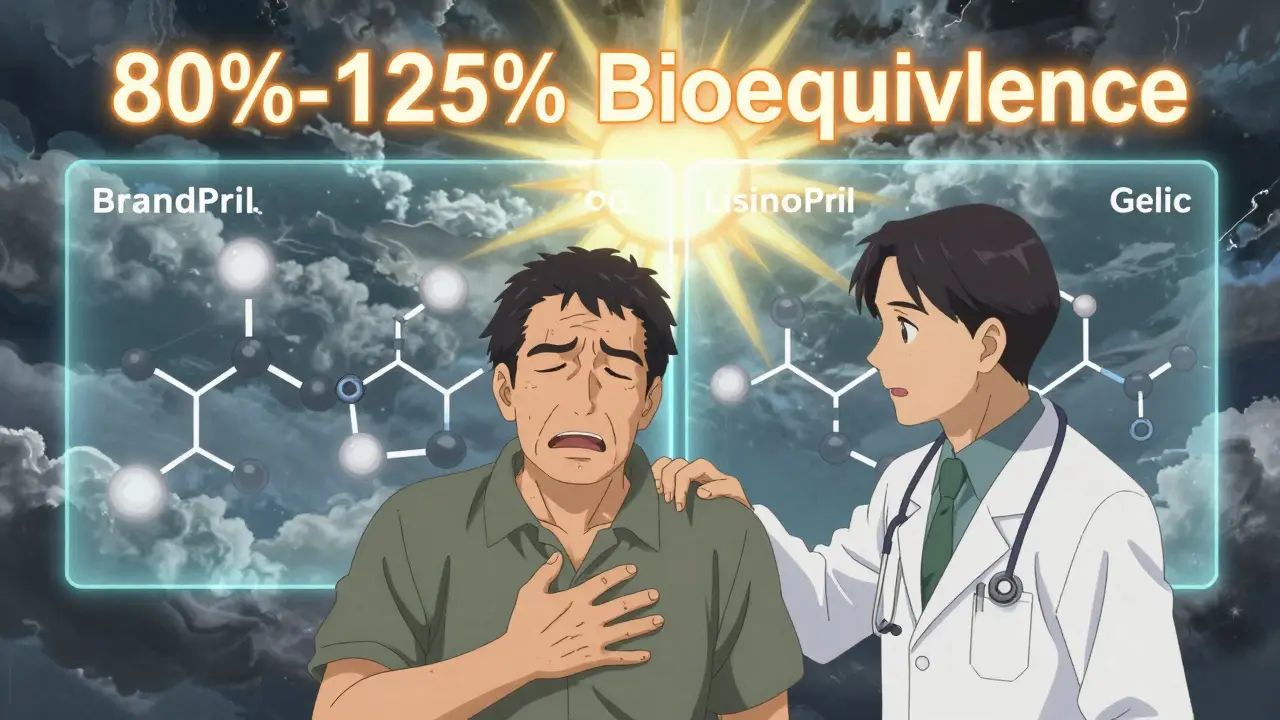
A generic drug is not a copy. It’s not a knockoff. It’s the exact same medicine, approved by the U.S. Food and Drug Administration (FDA) to have the same active ingredient, strength, dosage form, and route of administration as the brand-name version. That means if your brand-name pill has 10 mg of lisinopril, the generic has 10 mg of lisinopril - no more, no less. The FDA doesn’t just trust the manufacturer’s word. They require every generic to pass a strict test called bioequivalence. This means the drug must deliver 80% to 125% of the active ingredient into your bloodstream compared to the brand-name version. That’s not a guess. It’s science.
And here’s the kicker: 90.8% of all prescriptions filled in the U.S. are for generics. That’s over 6.8 billion prescriptions a year. Yet many people still hesitate. Why? Because they’ve been told, or they’ve assumed, that if it costs less, it must be worse. But the truth is, generics cost 80% to 85% less than brand-name drugs. In 2022 alone, they saved the U.S. healthcare system $377 billion. That’s money that stays in people’s pockets, not just in corporate profits.
Why Do People Doubt Generics?
The biggest barrier isn’t science - it’s perception. A 2022 University of Michigan survey of 1,247 patients found that 23% questioned whether a generic was safe just because it looked different. Color, shape, size - these are just packaging changes. The FDA allows different inactive ingredients (like dyes or fillers) to avoid trademark conflicts. But the active ingredient? Identical.
Another big issue is the nocebo effect. When patients are told they’re switching to a generic, some report side effects they never had before - even though the medicine is the same. A 2021 study in Annals of Internal Medicine showed that people were 18.7% more likely to stop taking a generic simply because they knew it was generic. That’s not the drug failing. That’s fear working.
Then there’s the prescriber factor. A 2022 JAMA Internal Medicine study found that when doctors simply said, "This generic is just as good," patient acceptance jumped from 52% to 89%. When they didn’t mention it? Only half trusted it. That’s how powerful clear communication is.
What Do Experts Say?
The science is unanimous. The FDA, the American Medical Association, the Academy of Managed Care Pharmacy, and the European Medicines Agency all agree: generics are equivalent. The FDA reviews about 1,000 generic applications every year. Each one must prove it works the same way. The American Pharmacists Association found that 97% of pharmacists have full confidence in generics. Yet, patients still don’t trust them.
There are rare exceptions. A 2023 study in Epilepsy & Behavior noted a slightly higher seizure recurrence rate when switching antiepileptic generics. But the American Academy of Neurology calls this an outlier - not a rule. For 99% of medications - antibiotics, blood pressure pills, diabetes drugs, antidepressants - the difference is zero.
How Community Health Presentations Help
Community health centers across the U.S. are using tools from the FDA’s Generic Drugs Stakeholder Toolkit to change minds. One center in Burlington, Vermont, trained staff to use the "Teach-Back" method: instead of saying, "This is a generic," they ask, "Can you tell me what you understand about this medicine?" Then they correct misunderstandings - gently, clearly.
Within six months, patient acceptance of generics rose by 37%. Why? Because people weren’t just handed a pamphlet. They were given a conversation. They were told: "The FDA requires this medicine to have the same active ingredient, strength, and dosage form as the brand. It’s tested. It’s safe. It’s been used by millions."
These presentations don’t just teach facts. They build trust. They answer the unspoken fear: "Will this hurt me?" The answer is no. And when you say it in a way that makes sense - with examples, with visuals, with real stories - people believe it.
Who Benefits Most?
Low-income patients benefit the most from generics. A 2021 study tracking 3.2 million patients found that switching to generics improved medication adherence by 22%. Why? Because when a $300 brand-name pill becomes a $15 generic, people don’t skip doses. They don’t split pills. They don’t go without.
That’s why the National Association of Community Health Centers now requires all patient counseling sessions to include a simple, standardized message about generics - starting January 2024. It’s not optional anymore. It’s part of care.
And it’s not just the U.S. The European Medicines Agency, Health Canada, Australia’s TGA, and 34 other regulatory bodies all use the same bioequivalence standards. If a generic passes FDA review, it’s just as reliable as one approved in London or Tokyo.
What’s Changing Now?
In 2023, the FDA launched "Generics 101," a video series aimed at Medicare beneficiaries. Early results? Viewers aged 65+ improved their knowledge retention by 31%. That’s huge. Older adults are the heaviest users of medications - and the most likely to be confused by pill changes.
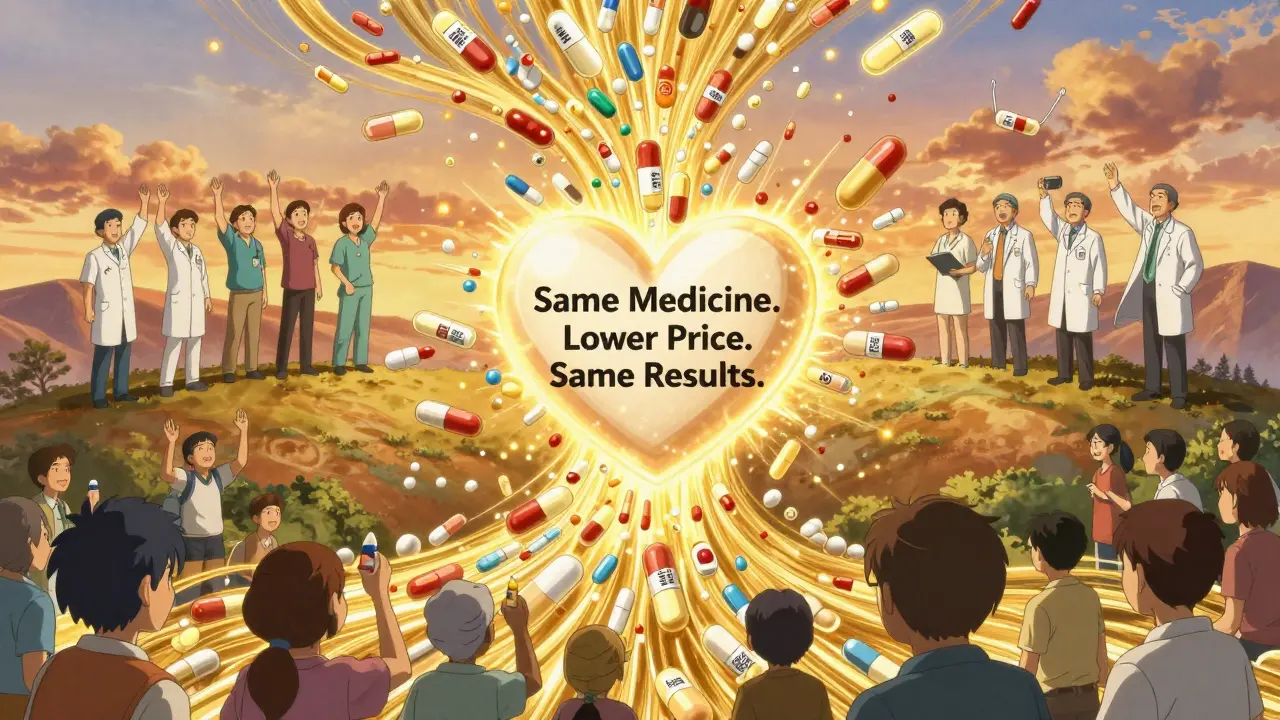
Also in 2023, the Association for Accessible Medicines distributed 2.7 million educational brochures through 14,300 community health centers. These aren’t fancy brochures. They’re simple. One page. Big font. Clear language: "Same medicine. Lower price. Same results."
And starting January 1, 2025, all Medicare Part D plans will be required to give standardized generic education materials to every beneficiary. No more silence. No more assumptions.
What’s Next?
The next wave of generics isn’t pills. It’s inhalers, creams, injectables - complex products that are harder to copy. These are trickier to explain. A 2023 FDA survey found 40% higher confusion rates with these types. That’s why community health workers need better tools. More training. More visuals. More time.
And here’s the real opportunity: as 287 brand-name drugs lose patent protection between 2023 and 2028, the number of generic options will explode. If we don’t educate people now, we’ll face a new wave of fear - about new medicines, new forms, new delivery systems.
That’s why community health presentations matter. Not because they’re a nice add-on. Because they’re a lifeline. They turn confusion into confidence. They turn cost savings into better health.
What You Can Do
If you’re a patient: Ask your pharmacist. Ask your doctor. "Is there a generic for this? Is it safe? Why does it look different?" Don’t assume. Ask.
If you’re a community health worker: Use the FDA’s toolkit. Use the "Teach-Back" method. Don’t just hand out flyers. Talk. Listen. Repeat. Clarify.
If you’re a prescriber: Say it out loud. "I’m prescribing this generic because it’s just as good, and it will save you money." That one sentence changes everything.
Generics aren’t a compromise. They’re a smart choice. And when we get the message right, everyone wins - patients, providers, and the system.

Write a comment
Your email address will not be published.
Recent Posts
-
 The Science Behind Cholestyramine: How It Works and Why It's Effective November 18, 2025
 -
 Anticoagulants for Seniors: Why Stroke Prevention Beats Fall Risk January 18, 2026



11 Comments
I used to refuse generics until my pharmacist sat me down and said, "Your blood pressure isn’t going to know the difference between the blue pill and the white one." I thought he was lying. Turns out, I was the one who was wrong. The FDA doesn’t play games. Neither should we. This isn’t about saving money-it’s about trusting science over superstition.
I appreciate the detailed breakdown of bioequivalence standards. It's important to remember that inactive ingredients can vary, but the active component is rigorously tested. Many patients are unaware that generics undergo the same manufacturing inspections as brand-name drugs. Transparency in labeling could help reduce fear-driven non-adherence.
Let’s be real-people don’t distrust generics because they’re stupid. They distrust them because pharmaceutical companies spent decades convincing them that price = quality. You think a $300 pill works better? That’s not science. That’s marketing. And now we’re stuck with a generation of patients who think a pill’s worth is determined by its logo. Wake up. The FDA doesn’t care about your brand loyalty.
So let me get this straight-we’ve got a system where the same medicine costs 85% less if it doesn’t have a fancy name on it? And people still panic because the pill is oval instead of round? I’m not shocked. I’m just really, really bored.
There is a deeper truth here-our fear of generics mirrors our fear of simplicity. We live in a world that equates complexity with value. But medicine? Medicine is not a luxury. It is a necessity. The soul of healing is not in the packaging. It is in the molecule. And that molecule does not care about your brand loyalty or your Instagram aesthetic. It only cares if it reaches your bloodstream. And it does. Every time.
I switched to generics after my insurance stopped covering the brand. Thought I’d feel weird or weak. Didn’t. Felt like I saved $200 a month. Now I tell everyone. The only difference? My wallet. And my peace of mind. Seriously, if your doctor says it’s the same, just take it. No drama.
In India, generics are the backbone of healthcare. We don’t have the luxury of brand-name delusions. Our people live on generics. And yet, Americans act like they’re taking a risk? That’s not bravery. That’s ignorance wrapped in privilege. If you can’t trust a pill that’s been tested by the FDA, then what can you trust? Your Facebook cousin’s opinion?
I used to think generics were risky. Then I started reading the FDA’s bioequivalence data. The numbers don’t lie. 80–125% absorption range? That’s tighter than most dietary supplements. I stopped worrying. Started saving. Started trusting. The system works. We just stopped listening.
You think this is about pills? No. This is about power. The pharmaceutical industry makes billions off fear. They create confusion so you’ll keep paying. They change pill colors so you’ll panic. They let doctors stay silent so you’ll doubt. This isn’t a health issue-it’s a financial one. And if you don’t push back, you’re part of the problem. Generics aren’t cheaper because they’re worse. They’re cheaper because they’re honest. And honesty? That’s the real threat.
The Teach-Back method works because it centers the patient. Not the pamphlet. Not the jargon. Not the profit margin. The human. When someone says, "Can you tell me what you understand?"-they’re not testing knowledge. They’re building dignity. That’s the real innovation here. Not the science. The humanity.
I just read that 18.7% more people stop taking generics because they know they’re generics. That’s not medicine failing. That’s fear winning. And we’re letting it win.