
Vitamin E & Warfarin Safety Calculator
This calculator shows the bleeding risk associated with your vitamin E intake while taking warfarin. Remember: Even if your INR is normal, high-dose vitamin E can increase bleeding risk by affecting platelets.
Enter your daily vitamin E intake to see the risk level.
When you're on warfarin, even small changes in your diet or supplements can throw your blood clotting off balance. It’s not just about leafy greens or alcohol anymore. One of the most overlooked dangers is vitamin E-a supplement many people take for its antioxidant benefits, thinking it’s harmless. But if you're on warfarin, high doses of vitamin E can increase your risk of dangerous bleeding, sometimes without warning.
How Vitamin E Interacts with Warfarin
Warfarin works by blocking vitamin K, which your body needs to make clotting factors. It’s a delicate balance. Too little, and you risk clots. Too much, and you bleed. Vitamin E doesn’t directly affect vitamin K like some other supplements do. Instead, it messes with platelets-the tiny blood cells that help stop bleeding by clumping together. This antiplatelet effect means your blood takes longer to clot, even if your INR looks fine.
Think of it like this: warfarin slows down your body’s clotting machinery, and vitamin E makes the parts that seal leaks less sticky. Together, they can push your system into dangerous territory. A 2013 study in the Journal of the American Heart Association followed over 1,000 people on warfarin and found that those with higher vitamin E levels in their blood had significantly more bleeding events-including brain bleeds. The risk jumped when serum vitamin E reached 4.49 μmol/mmol cholesterol, and spiked again above 5.56 μmol/mmol cholesterol. That’s not something you’d know from just checking your INR.
The Dosage Matters-A Lot
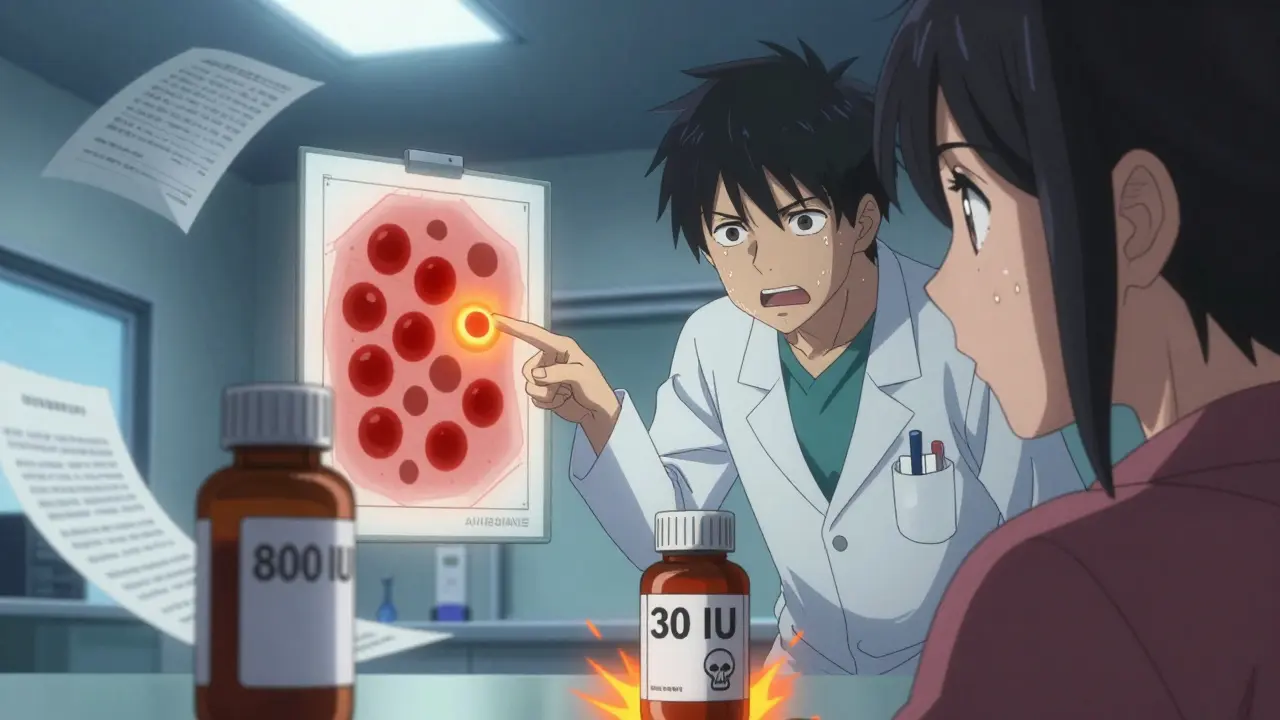
Not all vitamin E is the same. A daily 400 IU dose is where the danger zone begins. Studies show that at 800 IU or more, the risk of abnormal bleeding becomes real. One case report described a patient who took 800 IU daily for four weeks and had no INR changes until week five-then suddenly started bleeding internally. The delay made it look like a random event, not a supplement reaction.
But here’s the twist: a 1996 study from UC Davis found no effect on INR with vitamin E doses up to 1,200 IU. That study was short-term and small. Later research suggests it missed the real problem: bleeding isn’t always about INR. Platelet interference can happen quietly, without changing your blood test numbers. That’s why doctors now warn that INR alone isn’t enough to rule out risk.
What the Guidelines Say
Major medical groups don’t agree on everything, but they’re united on one thing: caution.
- The American College of Chest Physicians (2012) says avoid high-dose vitamin E if you’re on warfarin-graded as moderate evidence (2C).
- UC San Diego’s Anticoagulation Service explicitly advises against vitamin E supplements for warfarin patients due to antiplatelet effects.
- The European Society of Cardiology (2023) now recommends checking vitamin E levels in patients with unexplained bleeding while on warfarin.
- The American Heart Association (2009) warns that doses of 400 IU or higher may increase hemorrhagic stroke risk, especially with anticoagulants.
Even the Coumadin (warfarin) package insert says to be careful with herbal and botanical products-vitamin E is one of them. And while the Mayo Clinic doesn’t name vitamin E specifically, it does say that supplements can change how warfarin works in your body.
Who’s at Risk-and Why
This isn’t a one-size-fits-all problem. Some people can take 800 IU of vitamin E for months with no issues. Others bleed after just a few weeks at 400 IU. Why? Genetics. Variations in the CYP2C9 and VKORC1 genes affect how your body processes both warfarin and vitamin E. If you’re a slow metabolizer, even moderate doses can build up and increase bleeding risk.
Age matters too. Older adults often take more supplements and are more prone to falls. A minor bump can turn into a major bleed if platelets aren’t working right. And because vitamin E is fat-soluble, it builds up in your liver and fat tissue over time. That’s why short-term studies miss the danger-it takes weeks to accumulate.
What You Should Do
If you’re on warfarin and taking vitamin E, here’s what to do now:
- Stop taking high-dose vitamin E-anything over 400 IU daily. Most multivitamins contain 30-100 IU, which is generally safe. But standalone supplements often pack 400-1,200 IU.
- Talk to your doctor before starting or stopping any supplement. Don’t assume it’s “just a vitamin.”
- Get your vitamin E levels checked if you’ve had unexplained bleeding. This isn’t routine yet, but it’s becoming more common in anticoagulation clinics.
- Monitor INR more closely if you continue taking vitamin E. Weekly checks for the first month, then every two weeks. That’s 3-5 extra visits a year per patient, according to the Anticoagulation Forum.
- Check all your supplements. Vitamin E is often hidden in fish oil blends, multivitamins, and heart health formulas. Read labels carefully.

What About Other Supplements?
You’re not alone in taking vitamin E. It’s the third most popular single-ingredient supplement in the U.S., after vitamin D and fish oil. But it’s not the only one that interacts with warfarin. Other supplements with antiplatelet effects include:
- Fish oil (omega-3s)
- Garlic
- Ginger
- Ginkgo biloba
- Turmeric (curcumin)
- Green tea extract
All of these can increase bleeding risk, even if your INR is stable. The same logic applies: don’t assume safety just because it’s natural. The FDA doesn’t regulate supplements like drugs. There’s no guarantee of purity, dosage accuracy, or interaction testing.
The Bigger Picture
Supplement use is skyrocketing. In 2022, vitamin E sales hit $287 million in the U.S. Most people take it thinking they’re protecting their heart or skin. But if you’re on warfarin, you’re not just taking a pill-you’re adjusting your body’s clotting system. And that system doesn’t distinguish between medicine and supplement.
Future research is looking at ways to predict who’s at risk using genetic testing and serum vitamin E levels. For now, the safest approach is simple: avoid high-dose vitamin E. If your doctor says it’s okay, make sure you’re getting regular INR checks and know the signs of bleeding-unusual bruising, nosebleeds, dark stools, headaches, or dizziness.
Warfarin therapy is already complex. Don’t make it harder by adding a supplement that could quietly push you into a hospital.
Can I take vitamin E if I’m on warfarin?
Low doses (under 100 IU daily) from a multivitamin are generally considered safe. But avoid standalone supplements with 400 IU or more. High doses can increase bleeding risk even if your INR looks normal. Always talk to your doctor before taking any vitamin E supplement.
Does vitamin E raise INR levels?
Not always. Some studies show no change in INR with vitamin E use. But that doesn’t mean it’s safe. Vitamin E affects platelets, not clotting factors directly, so bleeding can happen even when INR is in range. Relying only on INR can give you a false sense of security.
How long does it take for vitamin E to affect warfarin?
It can take weeks. One case report showed bleeding didn’t occur until the fourth week of taking 800 IU daily. Because vitamin E is fat-soluble, it builds up slowly in your body. That’s why short-term studies miss the risk.
What’s a safe daily dose of vitamin E on warfarin?
Stick to the amount in a standard multivitamin-usually 30-100 IU. Avoid any supplement labeled 400 IU or higher. The evidence shows risk increases significantly above 400 IU daily, with the highest risk above 800 IU.
Should I get my vitamin E blood levels tested?
If you’ve had unexplained bleeding while on warfarin, yes. Some clinics now check serum vitamin E levels in these cases. Levels above 4.49 μmol/mmol cholesterol are linked to higher bleeding risk. This test isn’t routine yet, but it’s becoming more common in specialized anticoagulation programs.
Are there alternatives to vitamin E for skin or heart health?
Yes. For skin health, focus on a balanced diet rich in fruits, vegetables, and healthy fats. For heart health, exercise, blood pressure control, and medications like statins are proven. Avoid replacing medical advice with supplements. If you’re unsure, ask your doctor about evidence-based options that won’t interfere with warfarin.

Write a comment
Your email address will not be published.
Recent Posts
-
 Steroid Eye Drops: Benefits, Risks, and Monitoring Guide August 8, 2026
 -
 Brown Rice Supplements: Health Benefits & How They Boost Wellness September 9, 2025
 -
 Food Labels and Allergies: Hidden Allergens and Safety in 2026 January 4, 2026
 -
 Pulmonary Function Tests: How to Interpret Spirometry and DLCO Results December 15, 2025

14 Comments
i just found out my multivitamin has 100iu of vit e and now i’m panicking 😅 i’ve been on warfarin for 3 years and never thought twice about it. thanks for the wake up call.
so let me get this straight - something called a vitamin can make you bleed like a stuck pig? wild. i thought supplements were for getting healthier, not ending up in the er.
man, this is the kind of thing they don’t tell you in the supplement aisle. i used to chow down on 800iu daily ‘for my skin’ - thought i was some kind of antioxidant superhero. turns out i was just one bump away from a brain bleed. yikes. now i stick to food - avocado, almonds, spinach. nature’s version doesn’t come with a warning label.
also, the part about fat-soluble buildup? genius. it’s not like caffeine where it flushes out in a day. this stuff lingers like a bad ex. that’s why short studies lie - they don’t give it time to poison your platelets quietly.
and don’t even get me started on fish oil and ginkgo. i’ve got a cabinet full of ‘natural’ bombs. time to do a purge.
i didn’t know vitamin e could do this. my dad takes it every day. should i tell him? he’ll just say ‘it’s natural, how bad can it be?’
…so we’re living in a world where ‘vitamin’ is a euphemism for ‘silent coagulation saboteur’? 🤔
we worship nature - but nature doesn’t care if you’re on warfarin. it just… exists. and so does vitamin E. and so does your bleeding risk. it’s not malice. it’s biology. it’s the universe saying ‘you thought you were healing yourself… but you were just tuning your body’s alarm system to silent mode.’
we need a new word. not ‘supplement.’ not ‘vitamin.’ something like… ‘anticoagulant adjacent.’
we’re all just walking time bombs with a multivitamin in our purse.
so basically if you’re on warfarin you can’t even take a pill without doing a phd in biochemistry? i’m just trying to not get a clot or a bleed and now i gotta check every label like a spy. this is exhausting.
why do people even take vitamin e? it’s not like it’s doing anything. just take a good diet and stop wasting money on snake oil. you’re not a 70-year-old woman trying to ‘reverse aging’ with pills. this is why healthcare costs are insane.
as a nurse in an anticoag clinic, i see this every week. patients come in with INR 8.5 and no idea why. we check vitamin E - boom, 6.2 μmol/mmol. they’ve been taking ‘1000iu daily for heart health’ from some ‘premium’ brand. no one ever reads the label. and yes, we’ve started ordering serum levels routinely now. it’s not in the guidelines yet… but it should be.
also - ginkgo biloba is the silent assassin. i’ve had three strokes in the last year from people who thought ‘it’s herbal, so it’s safe.’
american supplement culture is a joke. you think you’re smart taking vitamins but you’re just poisoning yourself. in my country we eat real food. no pills. no nonsense. if you need vitamin e, eat a nut. not some lab-made capsule with ‘antioxidant power’ on the label. this is why america’s healthcare is broken.
you’re not alone - i was in your shoes last year. took 400iu daily ‘for my skin’ - then i started bruising from hugging my cat. 😅 my doctor said ‘stop it now’ and i did. i switched to eating sunflower seeds and spinach - same benefit, zero risk. and guess what? my skin still looks great. you don’t need a giant pill to be healthy. small, consistent, real food wins every time.
also - if you’re on warfarin, keep a food/supplement journal. i started one and it saved me. i didn’t realize my ‘heart health’ blend had vitamin e AND fish oil. double whammy.
you got this. you’re not failing - you’re learning. and that’s the first step to staying safe.
the quiet horror of this is that it doesn’t scream. no alarm bells, no INR spike - just a slow erosion of your body’s ability to stop bleeding. it’s like your platelets are slowly forgetting how to hold hands. and you don’t notice until you’re on the floor with a headache you can’t shake.
we treat supplements like candy. they’re not. they’re pharmacological agents in cheap packaging. the fact that we don’t regulate them like drugs is a national shame.
so… if I take vitamin E and bleed… it’s MY FAULT? I didn’t read the fine print? I thought ‘vitamin’ meant ‘safe’… I’m not a scientist. I’m a person who wants to glow. Why is it always the patient’s job to be a medical detective? This system is broken.
in india, we use turmeric paste for cuts - not pills. but now everyone wants to buy ‘omega-3 + vit e’ capsules from amazon. my aunt took 1000iu and had a nosebleed for 3 days. doctor said ‘stop it.’ she cried. said ‘but it’s for my joints!’… we need better education. not more pills.
thank you for writing this. i’ve been on warfarin for 8 years. i’ve had 3 INR spikes and 2 hospital visits. i thought it was diet, stress, antibiotics… never vitamin E. i took 400iu daily for ‘anti-aging’ - i’m 54. i stopped it 3 months ago. my INR has been rock solid since. i wish i’d known this sooner. i’m sharing this with every warfarin friend i have. you just saved someone’s life.