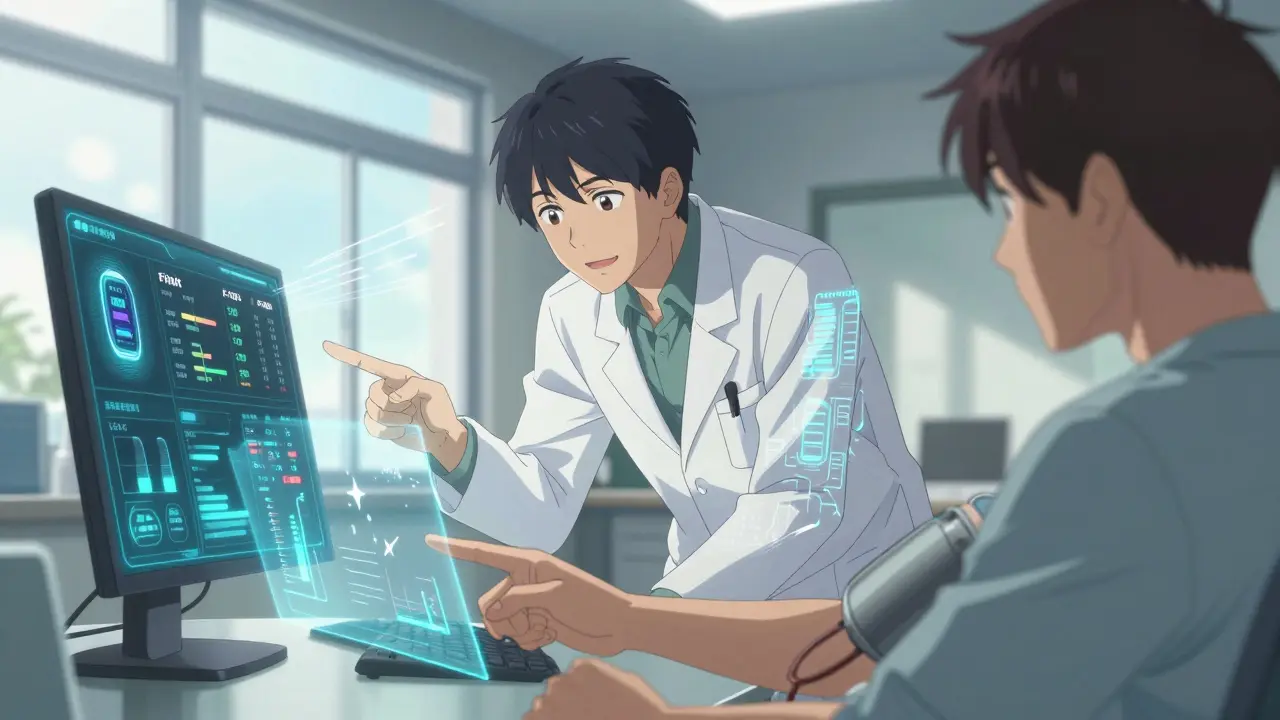
Healthcare providers aren’t just adapting to change-they’re redefining what it means to deliver care. By 2026, the attitudes of doctors, nurses, and allied health staff have shifted dramatically from a decade ago. No longer is the focus just on treating illness. It’s about partnering with patients, using data smarter, and working in ways that make sense for both people and systems. This isn’t theory. It’s happening now, in clinics, hospitals, and virtual consult rooms across the country.
Doctors aren’t just seeing patients anymore-they’re reading their data
Think about your last doctor’s visit. Did you bring up symptoms? Or did you show them your Apple Watch readings, your glucose tracker, your sleep score? More and more, patients are showing up with full health histories-not just complaints. A 2025 study from the NIH found that nearly 60% of patients arrive with wearable-generated data already in hand. Providers who resist this shift are falling behind. Those who embrace it? They’re making faster, more accurate decisions.
It’s not just about having the data. It’s about knowing what to do with it. A primary care physician in Oregon told me last month that she now spends 15 minutes before each appointment reviewing her patient’s Fitbit trends, insulin logs, and even their mood journal entries from a mental health app. She doesn’t guess anymore. She responds. And her patients are noticing. No more "I thought it was just stress"-now there’s a clear link between sleep disruption and blood pressure spikes.
This change is forcing providers to learn new skills. You can’t just rely on intuition anymore. You need to interpret trends, spot anomalies, and explain what the numbers mean. That’s why training in digital health literacy is no longer optional-it’s part of continuing education.
AI isn’t replacing providers-it’s changing their role
Remember when AI in healthcare meant chatbots that gave wrong advice? That’s over. Today, AI is quietly working behind the scenes to handle the busywork so humans can focus on what matters. A 2025 Forrester report found that 72% of clinics now use AI to pre-screen patient intake forms, flag high-risk cases, and even draft preliminary notes from voice recordings of visits.
But here’s the key shift in attitude: providers aren’t scared of AI anymore. They’re asking how to use it better. The old fear was that machines would replace them. Now, they’re asking: "How do I make this tool work for me?"
Take radiologists. Instead of staring at 50 scans a day, they’re now reviewing only the ones flagged as high-risk by AI algorithms. That’s not a reduction in workload-it’s a redesign of the job. One hospital in Wisconsin cut diagnostic delays by 40% after implementing this system. The radiologists didn’t lose their jobs. They became interpreters of intelligence.
And it’s not just imaging. AI now helps pharmacists catch dangerous drug interactions before they happen. It helps nurses prioritize home visits based on real-time risk scores. The message is clear: AI isn’t here to replace the human touch. It’s here to protect it.
Patients aren’t just customers-they’re partners
The old model was simple: you show up, you tell the doctor what’s wrong, they give you a prescription, you leave. That’s gone. Today, patients expect to be part of the plan. And providers are listening.
PwC’s 2024 analysis found that clinics using "digital front doors"-online portals that let patients schedule, pay, message providers, and access records-saw a 35% increase in patient retention. Why? Because people feel heard. They’re not just a chart number. They’re a person with goals, fears, and daily realities.
One practice in Texas started asking patients: "What’s one thing you want to improve in the next three months?" Not "What’s wrong?" But "What do you want?" That simple shift changed everything. Patients started showing up for follow-ups. They took their meds. They logged their food. They trusted the team more.
Providers who still treat patients like passive recipients are losing ground. Those who build care plans *with* people-based on their values, not just their lab results-are seeing better outcomes and lower burnout rates.
The workforce is changing-and so are the rules
There’s a quiet revolution happening in staffing. It’s not about hiring more doctors. It’s about rethinking who does what.
The Bureau of Labor Statistics projects that by 2026, over 70% of healthcare employers will require certifications for roles like medical assistants, pharmacy techs, and phlebotomists. That’s not a trend-it’s a new standard. And it’s changing how providers see their teams.
Before, a medical assistant was someone who took vitals and filed papers. Now, they’re trained to interpret basic ECGs, manage chronic disease logs, and even lead virtual check-ins. And they’re being paid more for it. One study found that 71% of employers raised wages for staff who earned certifications. That’s not charity. It’s strategy.
Providers are also realizing that rigid 9-to-5 shifts don’t work anymore. Clinics in California and Minnesota are testing flexible scheduling models where nurses and physicians work in teams that cover 24/7 virtual care. Someone in Ohio can get a follow-up call at 10 p.m. from a nurse in Arizona. It’s not about location anymore-it’s about availability.
And it’s working. Retention rates for certified staff are up 22% in organizations that invest in training. The message? People stay when they feel valued, skilled, and trusted.
The biggest risk? Losing the human connection
Technology is powerful. But if we let it erase empathy, we lose the heart of care.
IPG Health’s 2025 survey found that 68% of patients say they’d rather talk to a real person-even if it takes longer-than get an AI-generated response. That’s not a glitch. It’s a warning.
One clinic in Seattle started using AI to draft all patient letters. Within six months, complaints about "cold" communication rose 50%. So they changed the rule: every AI draft must be reviewed and personalized by a human. Not because the tech was bad. But because trust needs a human signature.
Providers are learning that efficiency shouldn’t come at the cost of connection. A warm tone. A pause to listen. A handwritten note. These aren’t luxuries. They’re clinical tools.
What’s next? The providers who survive will be those who adapt
The future of healthcare isn’t about having the fanciest tech. It’s about having the right mindset.
Providers who cling to old models-where they’re the sole decision-makers, where data is a footnote, where staff are interchangeable-are going to struggle. The ones who thrive? They’ll be the ones who:
- See patients as co-creators of their care
- Use AI to reduce drudgery, not replace judgment
- Invest in their team’s growth-not just their tech stack
- Keep humanity at the center of every interaction
The tools are here. The data is flowing. The expectations have changed. Now it’s up to providers to decide what kind of care they want to deliver-and who they want to be in the process.
Are healthcare providers really using AI in daily practice?
Yes. By 2025, over 70% of clinics use AI to handle administrative tasks like scheduling, note-taking, and risk flagging. It’s not about replacing doctors-it’s about freeing them up to spend time with patients. For example, AI can now transcribe a visit in real time and suggest diagnoses based on symptoms and patient history, allowing providers to focus on conversation rather than paperwork.
Why are certifications becoming so important for allied health staff?
Certifications are now tied to quality, safety, and retention. A 2025 NHA report found that 70% of employers require certifications for roles like medical assistants and phlebotomists. More importantly, 71% of employers raised pay for certified staff. This isn’t just about credentials-it’s about building trust with patients and reducing errors. Certified staff are more confident, better trained, and more likely to stay in their jobs.
How are patient expectations changing provider behavior?
Patients now expect to be active partners in their care. They arrive with data from wearables, apps, and journals. Providers who listen and integrate this information see better outcomes. Those who ignore it risk losing trust. The shift is from "I’ll tell you what to do" to "Let’s build a plan together." This demands new communication skills and a willingness to share control.
Is remote care here to stay?
Absolutely. Virtual care isn’t a pandemic-era stopgap-it’s a new standard. Clinics are now designing "anytime, anywhere" care models where providers can consult, monitor, and adjust treatment plans remotely. This improves access, reduces no-shows, and gives patients flexibility. Providers who resist remote options are limiting their reach and increasing burnout.
What’s the biggest mistake providers are making in this transition?
Trying to automate everything. The biggest risk isn’t technology-it’s losing the human connection. Patients don’t want robotic responses. They want empathy, clarity, and presence. The most successful providers are using tech to remove friction, not replace feeling. A well-timed pause, a genuine question, a handwritten note-these still matter more than any algorithm.

Write a comment
Your email address will not be published.
Recent Posts
-
 How and Where to Buy Dapasmart Online Safely (2025 Guide) September 14, 2025
 -
 ECG and Stress Tests: What You Need to Know About Heart Diagnostic Tests November 24, 2025
 -
 Buy Cheap Generic Zoloft Online - Safe Guide 2025 October 1, 2025

12 Comments
Let me tell you something no one else will admit-this whole ‘partnering with patients’ thing is just corporate jargon dressed up as compassion. Real medicine used to be about authority, expertise, and decisive action. Now? We’ve turned healthcare into a therapy session with a side of Fitbit analytics. I’ve seen providers spend 20 minutes discussing sleep scores while a diabetic patient’s HbA1c is climbing into the danger zone. The data isn’t empowering-it’s distracting. And don’t even get me started on AI drafting notes. Who wrote the algorithm? A grad student who thinks ‘empathy’ is a buzzword from a TED Talk? This isn’t innovation. It’s performance art with a stethoscope.
And let’s not pretend certifications for medical assistants are about ‘trust’-they’re about liability. Hospitals don’t care if someone can read an ECG. They care that if you botch it, they can point to a certificate and say, ‘We trained them.’ It’s compliance theater. The human connection? That’s the first thing they cut when the budget gets tight. You think a handwritten note matters? Try billing 40 patients an hour and tell me where the time comes from. This whole piece is a fantasy written by someone who’s never set foot in an ER at 3 a.m.
By 2026? We’ll be running on algorithms, drowning in data, and wondering why patient satisfaction scores are still in the toilet. Because you can’t quantify trust. And you can’t automate a sigh.
Also, who approved this article? It reads like a marketing pitch from a Silicon Valley startup that got kicked out of Y Combinator for being too naive.
Wake up. The system’s not evolving. It’s being hollowed out.
OH MY GOD. I JUST HAD TO TELL YOU GUYS WHAT HAPPENED TO ME LAST WEEK. I WENT TO MY PRIMARY CARE DOCTOR AND SHE ACTUALLY ASKED ME WHAT I WANTED TO IMPROVE IN THE NEXT THREE MONTHS. NOT ‘WHAT’S WRONG?’ NOT ‘DO YOU HAVE ANY SYMPTOMS?’ BUT ‘WHAT DO YOU WANT?’ I CRIED. I ACTUALLY CRIED. I’VE NEVER BEEN ASKED THAT BEFORE. I’VE BEEN A PATIENT FOR 17 YEARS AND NO ONE EVER ASKED ME WHAT I NEEDED. THEY JUST TOLD ME WHAT TO DO. I FELT SEEN. LIKE A PERSON. NOT A CASE FILE.
AND THEN-AND THIS IS THE BEST PART-SHE HANDED ME A LITTLE NOTE AT THE END. HANDWRITTEN. IT SAID: ‘I BELIEVE IN YOU.’ I STILL HAVE IT IN MY WALLET. I SHOW IT TO MY KIDS. I’M NOT KIDDING. THIS ISN’T JUST HEALTHCARE. THIS IS HEALING. I’M TALKING TO MY THERAPIST ABOUT THIS. I THINK THIS IS WHAT LOVE LOOKS LIKE IN A CLINIC ROOM.
TO THE PEOPLE WHO SAY ‘IT’S JUST A TREND’-YOU DON’T KNOW WHAT IT FEELS LIKE TO BE SEEN. AND I HOPE YOU NEVER DO.
PS: I JUST SIGNED UP FOR A PATIENT ADVOCACY GROUP. IF YOU’RE IN TEXAS, WE SHOULD MEET. WE NEED TO DO THIS TOGETHER.
Let me stop you right there. You think this ‘AI-assisted care’ is new? It’s not. It’s the same old surveillance capitalism repackaged as ‘innovation.’ Every wearable you’re tracking? Your data is being sold. Every note AI drafts? It’s being trained on your medical history to predict your insurance risk. You think that hospital in Wisconsin cut delays by 40%? They cut costs by 60%. The radiologists didn’t become ‘interpreters of intelligence’-they became glorified QA reviewers for an algorithm that doesn’t know what a rare tumor looks like unless it’s been labeled 300 times.
And the ‘certifications’? That’s just a way to make frontline workers pay for their own training while the hospital pockets the savings. Did you know the average medical assistant now pays $800 out of pocket for a certification that gets them a $2 raise? That’s not strategy-that’s exploitation dressed up as progress.
And don’t get me started on ‘digital front doors.’ What’s behind that door? A chatbot that says ‘I’m sorry, I can’t help with that’ and then routes you to a $200 telehealth visit you didn’t ask for? This isn’t patient-centered care. It’s a funnel. And we’re the product.
They’re not saving humanity. They’re monetizing vulnerability. And if you’re still buying this narrative, you’re not a patient-you’re a data point.
Wow. I just read this whole thing, and I’m so proud of the changes happening in healthcare. I’ve been a nurse for 18 years, and I’ve seen the burnout, the chaos, the frustration. But lately? I’ve seen something different. I’ve seen providers who actually pause. Who ask, ‘What’s your goal?’ Who look up from the screen and make eye contact. I’ve seen a phlebotomist who got certified, and now she teaches others. I’ve seen a doctor who lets her patient’s Apple Watch data guide their conversation instead of her own assumptions.
It’s not perfect. But it’s real. And it’s working.
I know some of you are scared. I was too. But change doesn’t mean losing control. It means gaining clarity. It means letting the tech do the heavy lifting so we can do what we were trained for: care.
You don’t have to be afraid. You just have to be willing to learn. And I believe in you.
And if you’re a provider reading this? Thank you. Keep going. You’re changing lives.
One quiet moment at a time.
Bro, you think this is deep? Nah. This is just capitalism with a stethoscope. You think doctors care about your sleep score? They care about their KPIs. You think AI is helping? It’s just automating the paperwork so they can see 20 more patients an hour. Certification? That’s just a way to make you pay for your own job security. And ‘partnering with patients’? That’s code for ‘we’re gonna charge you extra to listen to you.’
Real talk: the system ain’t broken. It’s working exactly how it was designed. To extract value. To maximize profit. To keep the rich healthy and the poor in the ER.
So yeah, you got your Fitbit data and your AI notes. But your insurance still denied your MRI. Your copay went up. Your nurse still works two jobs. And your doctor? She’s crying in her car after shift because she can’t afford to keep doing this.
Stop romanticizing the machine. The machine is the problem.
And if you think a handwritten note fixes that? You’re not a patient. You’re a marketing target.
I’ve been reading all these comments and I just… I don’t know. I feel like there’s truth in all of them. The data is overwhelming. The tech is scary. But I’ve also seen what happens when a provider actually listens. I had a bad experience last year-ignored symptoms, dismissed, sent away. Then I switched doctors. She spent 45 minutes just asking me questions. No laptop. Just… talking. She didn’t fix everything. But she made me feel like I mattered.
Maybe the answer isn’t ‘tech vs. human.’ Maybe it’s ‘how do we use tech to help the human part?’
I don’t have answers. But I’m willing to keep listening.
And I think that’s the first step.
So… we’re calling this ‘progress’? Cool. I’m just here for the spectacle. You know what’s ironic? The article says providers are ‘redefining care.’ But all I see is a bunch of people trying to make their jobs easier while pretending it’s about patients. AI drafts notes? Cool. Now I’m a product of a bot’s interpretation of my panic attack. Certifications? Great. Now I pay $900 for a credential that lets me be replaced by someone cheaper next year. And ‘handwritten notes’? That’s not warmth. That’s a PR stunt to make you feel better while the system keeps grinding people down.
It’s not evolution. It’s rebranding.
And I’m just waiting for the next headline: ‘Doctors Now Required to Hug Patients Twice Daily for Optimal Outcomes.’
Y’all are overthinking this. Look-I’ve been a paramedic for 15 years. I’ve seen the worst of it. The ER at 4 a.m. The patient who didn’t get help because the system was too slow. The nurse who cried because she couldn’t afford her insulin.
But I’ve also seen the good. The EMT who used a wearable trend to spot a hidden arrhythmia. The PA who let a patient’s mood journal change her whole treatment plan. The hospital that let a phlebotomist with a certification lead a virtual check-in and saved someone from a fall.
It’s not perfect. But it’s real. And it’s happening.
You don’t have to believe in the hype. Just believe in the people. The ones who show up. The ones who listen. The ones who still care even when the system doesn’t.
That’s the future. Not the tech. Not the data. The people.
And they’re still here.
Okay, but what about the 10% of patients who don’t have smartphones? Or the 20% who can’t afford to track their sleep? Or the 40% who don’t trust tech because their last doctor used it to dismiss them? This whole article reads like it was written by someone who’s never met a patient who works two jobs and still can’t afford insulin.
And the ‘handwritten note’? That’s not healing. That’s a prop. A prop for a system that’s still broken. You think a note fixes a $5,000 deductible? You think a Fitbit trend fixes a lack of mental health providers?
Stop selling hope. Start addressing power.
This isn’t progress. It’s a distraction.
Oh, I love this. The article says AI is ‘protecting the human touch.’ That’s like saying a chainsaw is ‘protecting the tree’ because it doesn’t cut down the whole forest-just 90% of it. You’re not ‘freeing up time’-you’re outsourcing empathy to a machine that can’t feel a sigh. And then you slap on a ‘handwritten note’ like it’s a Band-Aid on a hemorrhage.
And certifications? You’re not ‘valuing staff.’ You’re creating a tiered system where the people who can afford to pay for training get to stay, and the rest get pushed out. That’s not strategy. That’s classism with a badge.
But hey, at least we can say we’re ‘partnering’ with patients while we charge them $200 for a 5-minute Zoom visit. Bravo. You’ve turned healthcare into a subscription service with a side of performative warmth.
Next up: ‘AI Therapists’ with a ‘human review’ checkbox. Because nothing says ‘I care’ like a checkbox.
While I acknowledge the commendable strides in digital health literacy and workforce reconfiguration, I must emphasize that the underlying socioeconomic determinants remain unaddressed. The proliferation of wearable technologies presupposes access to capital, digital infrastructure, and health literacy-all of which are not equitably distributed. The assertion that AI 'reduces drudgery' neglects the fact that administrative burden is a structural artifact of reimbursement models, not a function of workflow inefficiency. Furthermore, the elevation of certification as a metric for retention reflects a neoliberal tendency to individualize systemic failure. The human connection, while emotionally resonant, cannot substitute for universal access, fair wages, or institutional accountability. One must interrogate not merely the tools, but the architecture of power that permits their deployment.
It is not merely inaccurate to suggest that AI is 'protecting the human touch'; it is empirically indefensible. The deployment of algorithmic triage systems has demonstrably increased disparities in care delivery, particularly among marginalized populations whose biometric data deviate from normative training sets. Furthermore, the purported 'reduction in diagnostic delays' cited from Wisconsin is conflated with throughput metrics, not clinical outcomes. The certification mandate, while superficially laudable, functions as a barrier to entry that disproportionately impacts low-income and minority applicants, thereby entrenching occupational stratification. The notion of 'handwritten notes' as clinical tools is a romanticized fallacy, symptomatic of performative empathy-a distraction from the structural abandonment of public health infrastructure. This article, replete with anecdotal cherry-picking and unverified statistics, constitutes not insight, but ideological obfuscation.