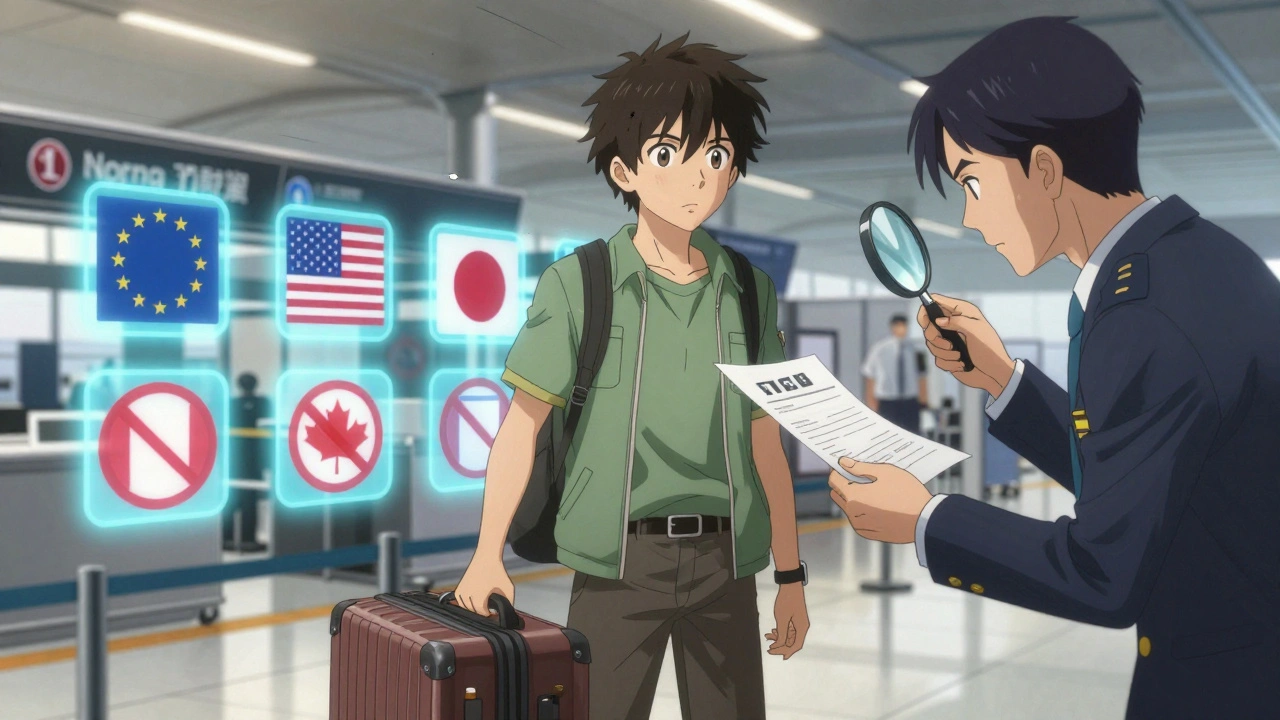
Trying to refill your prescription while traveling abroad isn’t as simple as walking into a local pharmacy. Even if you have the exact same medication, the rules change depending on where you are. A prescription that works in New Zealand might be useless in Japan, and a pill you can buy over the counter in Mexico could be illegal in the U.S. If you’re flying overseas for weeks or months - whether for work, retirement, or just a long vacation - you need to plan ahead. There’s no universal system for transferring prescriptions between countries. What works in Europe won’t help you in Canada or China. Here’s how to actually get your meds when you’re far from home.
Understand the Rules Before You Leave
Every country has its own drug laws, and most don’t recognize foreign prescriptions. The European Union is the exception. If you’re traveling between EU countries like Germany, Spain, or Portugal, your prescription is legally valid in all 27 member states - in theory. In practice, you might run into problems if your medication has a different brand name or isn’t stocked locally. Always carry the generic name of your drug (like metformin, not Glucophage) and the dosage. Pharmacies in EU countries are required to accept prescriptions with this info, but they’re not required to have your exact brand on hand. Outside the EU, things get messy. The U.S. FDA bans importing prescription drugs for personal use under federal law. But here’s the catch: they rarely enforce it if you’re bringing in a 90-day supply for yourself. U.S. Customs and Border Protection says you can carry your meds as long as they’re in their original bottles with your name on them and a doctor’s note. That’s your safety net. But if you try to mail them from abroad or order them online, you’re risking seizure or fines. Canada is another gray zone. U.S. pharmacies won’t transfer your prescription directly to a Canadian pharmacy. Instead, you need what’s called a “cosigning” process: a Canadian doctor reviews your medical records and writes you a new Canadian prescription. This isn’t a transfer - it’s a restart. You’ll need your original prescription, your medical history, and sometimes a signed letter from your U.S. doctor explaining why you need the medication. It takes time. Don’t wait until you’re out of pills.What You Need to Pack
Don’t rely on pharmacies abroad to have your meds. Bring enough for your entire trip - plus a 30-day buffer. If you’re going for six months, bring seven months’ worth. Pharmacies in places like China, the Middle East, or Southeast Asia may not carry your medication at all, even if it’s common elsewhere. Some countries classify common U.S. drugs as controlled substances. For example, Adderall is illegal in Japan. Tramadol is restricted in the UAE. Even melatonin is a prescription drug in Germany. Pack your medications in your carry-on. Checked bags get lost. Keep them in original containers with clear labels. Bring a copy of your prescription and a letter from your doctor. The letter should include:- Your full name and date of birth
- The name of each medication (generic and brand)
- The dosage and frequency
- The medical condition being treated
- Confirmation that the medication is for personal use during travel
- The doctor’s signature, license number, and contact info
How to Get a New Prescription Abroad
If you run out or lose your meds, you can’t just walk into a clinic and get a refill. Most countries require you to see a local doctor first. In the UK, Australia, or Canada, you can visit a walk-in clinic and explain your situation. Bring your original prescription and doctor’s letter. They’ll likely write you a new prescription based on your history. In countries with stricter rules - like Thailand, India, or Brazil - you may need to see a specialist or get a formal diagnosis from a local physician. Some clinics will refuse to write a prescription unless they’ve examined you in person. That means scheduling an appointment, possibly paying out-of-pocket, and waiting days or weeks. Pro tip: Look for international medical clinics in major cities. These are often staffed by English-speaking doctors familiar with foreign prescriptions. They’re more expensive than local clinics, but they save time and stress. In Tokyo, for example, the Tokyo International Clinic handles U.S. and European prescriptions regularly. In Mexico City, Clinica Medica Internacional does the same.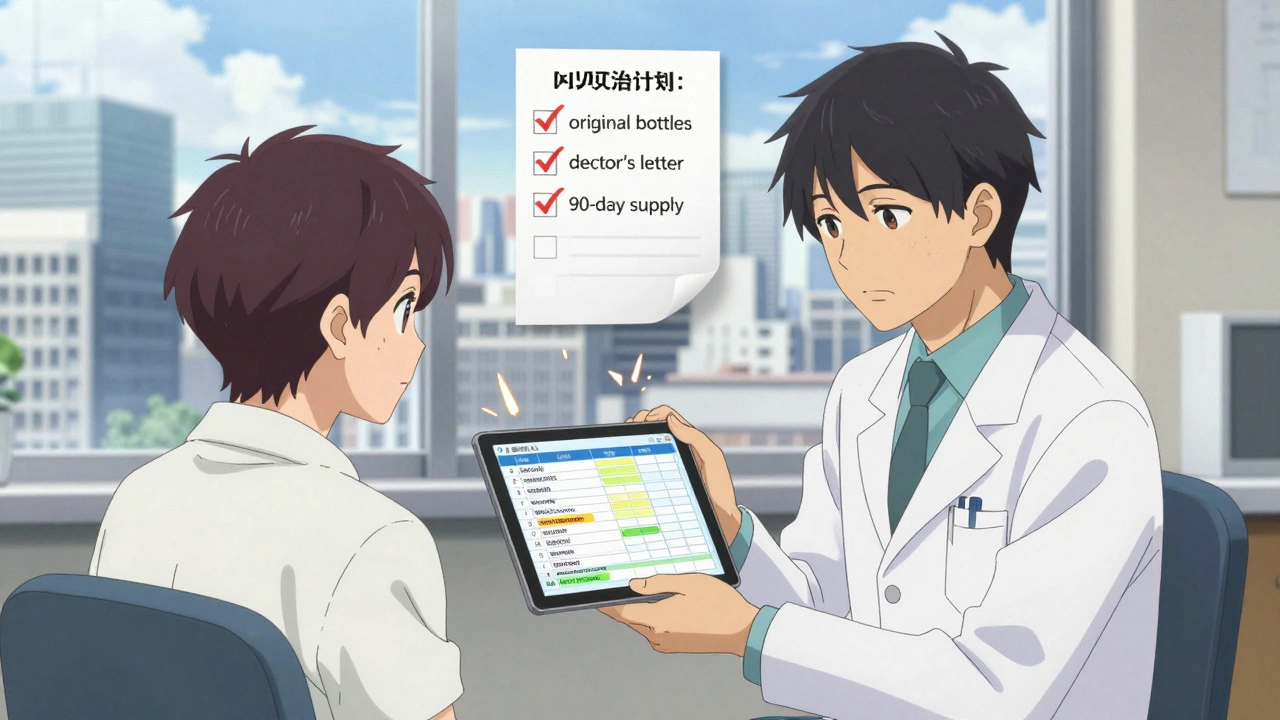
Why U.S. Pharmacies Won’t Transfer Prescriptions Overseas
You might think your U.S. pharmacy can just email your prescription to a pharmacy in France or Australia. They can’t. The DEA’s 2023 rule allowing electronic prescription transfers only applies within the U.S. - between two U.S. pharmacies. It doesn’t extend to other countries. Why? Because U.S. pharmacists aren’t licensed to dispense drugs under foreign regulations. They don’t know if the foreign pharmacy follows safety standards. They also can’t verify if the drug is legal in that country. Most U.S. pharmacy chains - CVS, Walgreens, Rite Aid - have policies that explicitly forbid international transfers. Even if you call 10 times, you’ll get the same answer: “We’re not allowed.” Some independent pharmacies might bend the rules, but they risk losing their license. Don’t pressure them. Instead, focus on solutions that work within the system.What to Do If You’re in a Country With No Access
If you’re stuck in a place like Vietnam, Egypt, or Indonesia and your meds aren’t available, here’s what works:- Call your U.S. doctor. Ask them to fax or email a copy of your prescription to a pharmacy in your destination country. Some international pharmacies accept this.
- Use a service like PharmacyChecker. They partner with verified international pharmacies that can fill U.S. prescriptions with a cosigning doctor. It’s not cheap - expect $50-$150 per order - but it’s faster than flying home.
- Contact your country’s embassy. They often have lists of local doctors and pharmacies that serve expats. In emergencies, they may help you contact a medical evacuation service.
- Check if your insurance covers telehealth. Some plans let you video-call a doctor abroad who can write a local prescription.
Controlled Substances Are a Different Ballgame
If you’re on opioids, benzodiazepines, ADHD meds, or sleep aids, your situation is much harder. These are tightly controlled everywhere. The DEA doesn’t allow international transfers of any controlled substances. Even if you have a valid prescription, many countries classify them as illegal narcotics. For example:- Ambien (zolpidem) is illegal in Japan and Singapore.
- Valium (diazepam) requires special permits in Australia and the UK.
- Adderall (amphetamine) is banned in most Asian countries.
Real Stories: What Actually Works
One traveler from New Zealand flew to Germany for a six-month work assignment. She brought six months’ worth of her antidepressant, plus a doctor’s letter. When she ran out, she visited a local clinic in Berlin. The doctor reviewed her records, wrote a new prescription, and she filled it at a pharmacy down the street. No issues. A retiree from Florida moved to Costa Rica. He couldn’t get his blood pressure med (lisinopril) locally. He used PharmacyChecker to order it from a Canadian pharmacy that shipped to Costa Rica. He paid $18 for a 90-day supply - half the U.S. price. He’s been doing this for three years. A nurse from Texas traveled to Thailand for three months. Her anxiety medication (clonazepam) wasn’t available. She contacted the U.S. Embassy in Bangkok. They gave her a list of English-speaking psychiatrists. She saw one, got a local prescription, and filled it for $12. She carried her original U.S. prescription as backup.What Doesn’t Work
Don’t rely on these myths:- “I can just buy it online.” Unregulated online pharmacies sell fake or contaminated drugs. The FDA shuts down hundreds every year.
- “My friend in Mexico sells the same pill.” Even if it looks identical, the dosage or ingredients may be wrong. You could overdose.
- “The pharmacist will understand.” Pharmacists abroad aren’t trained in U.S. systems. They follow local laws - not your doctor’s orders.
- “I’ll just bring extra.” You can’t bring more than a 90-day supply into most countries without a permit. Customs agents will confiscate it.
Final Checklist Before You Fly
Use this to make sure you’re ready:- Bring at least 30 days more than your trip length
- Keep all meds in original containers
- Carry a printed copy of your prescription
- Get a signed doctor’s letter with diagnosis and travel purpose
- Check your destination’s drug laws on their embassy website
- Know the generic names of your drugs
- Save contact info for your doctor and local embassy
- Have a backup plan: pharmacy locator, telehealth service, or cosigning provider
If you’re traveling to the EU, you’re in the easiest zone. Everywhere else? You’re on your own. But with the right prep, you won’t go without your meds. The key isn’t hoping a pharmacy will transfer your script. It’s bringing enough, knowing the rules, and having a plan B.
Can I transfer my U.S. prescription to a pharmacy in Canada?
No, U.S. pharmacies cannot directly transfer prescriptions to Canadian pharmacies. Canadian law requires all prescriptions to be issued by a licensed Canadian doctor. You’ll need to go through a “cosigning” process: send your U.S. prescription and medical history to a Canadian pharmacy, and they’ll arrange for a Canadian doctor to review your case and issue a new prescription. This can take 5-10 business days, so plan ahead.
Is it legal to bring prescription drugs into the U.S. from another country?
Under U.S. federal law, it’s illegal to import prescription drugs for personal use. However, the FDA rarely enforces this if you’re bringing in a 90-day supply for yourself, the medication is for a serious condition, and it’s not available in the U.S. You must carry it in its original container with a valid prescription. Customs officers can still seize your meds if they suspect abuse or if the drug is banned (like certain opioids or stimulants).
What if my medication isn’t available in the country I’m visiting?
Contact your doctor back home and ask if they can recommend a similar medication with the same active ingredient. If not, visit a local clinic or international medical center. Many countries have English-speaking doctors who can write a new prescription based on your history. Always carry your original prescription and doctor’s letter to support your case. Avoid buying pills from street vendors or unverified online pharmacies - they’re often fake or dangerous.
Do I need a letter from my doctor for every country?
Not every country requires it, but it’s smart to have one for every trip. Countries like China, Japan, Saudi Arabia, and Russia demand a doctor’s letter with a diagnosis and travel purpose. Even in countries like the UK or Australia, having one speeds up the process if you need a refill. Make sure the letter is printed on official letterhead, signed, and includes your doctor’s license number and contact info.
Can I get my prescription refilled at a U.S. embassy or consulate?
No, U.S. embassies and consulates cannot provide prescription medications or refill prescriptions. However, they can help you find local doctors, pharmacies, or medical services that cater to Americans. Some embassies maintain lists of English-speaking healthcare providers. In emergencies, they may assist with medical evacuation, but not with medication access.

Write a comment
Your email address will not be published.
Recent Posts
-
 How to Buy Cheap Generic Celexa Online: 2026 Pricing Guide April 28, 2026
11 Comments
Let’s be real - this guide is 80% common sense, but the 20% that’s not? That’s the part that gets people arrested. I once tried to bring my Xanax into Thailand with a doctor’s note and got detained for 12 hours because the pharmacist didn’t recognize the brand name. Never again. Always use generic names. Always. And never, ever assume your insurance covers telehealth abroad - mine didn’t, and I had to pay $400 for a 10-minute consult with some guy in Manila who spoke English but not medicine.
Also, PharmacyChecker? Overpriced. I found a Canadian pharmacy that shipped to me for half the cost just by Googling ‘legit international pharmacy + [drug name]’ and checking their licensing on Health Canada’s site. No middleman needed.
And yes, melatonin is a prescription in Germany. I learned that the hard way. Don’t be that person.
TL;DR: Bring extra, know the generic names, and never trust a local pharmacist’s word without documentation.
It is deeply concerning that this article casually suggests that violating federal law is somehow acceptable if one is merely ‘bringing in a 90-day supply.’ The FDA does not ‘rarely enforce’ - it enforces selectively, and those who are caught are often subjected to criminal prosecution, asset forfeiture, and permanent immigration consequences. This is not a ‘gray zone’ - it is a legal minefield disguised as a travel tip.
Furthermore, the normalization of using unregulated international pharmacies - even those vetted by PharmacyChecker - constitutes a dangerous precedent. These entities operate outside the U.S. pharmaceutical supply chain, which means no FDA oversight, no batch tracking, no adverse event reporting. You are not ‘saving money’ - you are gambling with your life.
And the suggestion to ‘ask your embassy’ is laughable. U.S. embassies are not medical providers. They are diplomatic missions with zero authority to dispense or prescribe. To imply otherwise is irresponsible.
Proper medical care abroad requires relocation, not improvisation. If you cannot access your medication legally in another country, you should not be living there - not without a licensed prescriber on the ground. This guide is not helpful. It is a public health hazard.
Okay but have you heard about the new thing where some countries are putting microchips in pills now? I read on a forum that Japan started embedding tracking chips in all psych meds so the government can monitor who’s taking what. That’s why they ban Adderall - not because it’s dangerous, but because they don’t want you to be ‘too productive.’
And don’t even get me started on the EU. They’re all in bed with Big Pharma. The ‘generic name’ thing? That’s just a distraction. The actual drug in the bottle is different - they swap out inactive ingredients to make it ‘comply’ with local regulations. You think metformin is metformin? Nah. It’s metformin with a side of bureaucratic filler that makes you bloated for three weeks.
I know a guy who got arrested in Dubai for carrying his antidepressants. He had the prescription. He had the bottle. He had the doctor’s letter. They still threw him in jail for 47 days. Said his meds were ‘psychoactive substances under Sharia law.’
So yeah. Bring extra. But also… pray.
And maybe don’t go to the Middle East. Just saying.
This is one of the most practical and well-researched guides I’ve read on this topic. Thank you for taking the time to compile this - it’s clear you’ve spoken to people who’ve been through the trenches.
I’ve lived in five countries over the past decade, and the only consistent rule is: never assume. What works in Canada won’t work in Australia. What’s allowed in Mexico might be illegal in Colombia. The key is preparation, not panic.
I especially appreciate the emphasis on original packaging and doctor’s letters. I once lost my bag in Lisbon, had to visit a local clinic, and the doctor was able to help me immediately because I had the letter. No drama. No delays.
And for those thinking of ordering from sketchy websites - please don’t. I’ve seen friends end up in hospital with counterfeit pills that looked identical. The difference isn’t visible. It’s lethal.
One small addition: if you’re on a long-term visa, some countries allow you to register as a temporary resident and get local prescriptions. Check with immigration authorities - it’s often easier than you think.
You Americans think you can just carry your pills everywhere like it’s your right? In India, we have strict laws because your junk medicine kills people! You bring Adderall here? You go to jail. No warning. No second chance. We don’t care if you have a ‘doctor’s letter’ - we have our own system. Your pills are poison here. You think you’re special? You’re not. You’re just another foreigner who thinks the world owes you your drugs. Go home and take your pills there. We don’t need your pharmaceutical colonialism.
And PharmacyChecker? That’s a scam. All those ‘Canadian’ pharmacies? They’re run by Indians in Delhi. You think they care about your blood pressure? They care about your credit card.
My cousin got sick from fake insulin from ‘trusted’ site. Now he’s on dialysis. You want to be next?
I lived in Bangalore for two years and needed my thyroid med. Couldn’t find it anywhere. Tried the local pharmacy - they gave me something that looked similar but made me dizzy. I was terrified.
Then I found a small expat group on Reddit. Someone shared the name of a clinic near Indiranagar that worked with U.S. doctors. I emailed my prescription, they called my doctor in Chicago, and within 3 days I had my refill for $8.
It’s not perfect. It’s not fast. But it’s human.
People forget that medicine is about care, not just law. The system fails us - but sometimes, other people don’t.
So if you’re stuck? Ask. Talk to expats. Find the quiet ones who’ve been there. They’ll help you.
And yes, melatonin is a prescription in Germany. I learned that from a German nurse who laughed and said, ‘You Americans think sleep is a right.’
Let me break this down for the uninitiated: the entire premise of this article is built on the assumption that you have access to privilege. You have a doctor. You have insurance. You have a passport. You have a credit card. You have the luxury of choosing where to travel.
Most people in the world don’t. Most people take their meds on a strict schedule because they have chronic illness - not because they’re ‘traveling for fun.’
And yet here we are, treating this like a travel hack. ‘Oh, just use PharmacyChecker!’ - like it’s Amazon Prime. Like the global pharmaceutical system isn’t a patchwork of colonialist, capitalist, and bureaucratic nightmares.
What’s missing? The voices of people who can’t afford to fly home. Who can’t afford a $150 international order. Who live in countries where the only ‘international clinic’ is a clinic that charges $300 just to walk in.
This guide is not about access. It’s about how the wealthy navigate the system. The rest of us? We’re just hoping we don’t die before the next flight.
So basically… bring extra pills, don’t be dumb, and don’t trust anyone who says ‘I know a guy.’
Simple.
Why does this need to be 2,000 words?
I just got back from 4 months in Vietnam. My anxiety med wasn’t available. I went to a clinic, showed my bottle and doctor’s note, and they gave me a local version. Same active ingredient. Different brand. Cost $5.
Also, I brought 120 days’ worth. Didn’t need it. But I’m glad I had it.
Pro tip: Google ‘[drug name] + [country] + legal’ - not ‘can I bring.’ The results are way more useful.
And yes, I cried in a pharmacy in Hanoi because I was out and scared. It happens. You’re not alone.
One thing this guide doesn’t mention: the psychological toll. Running out of medication while abroad isn’t just inconvenient - it’s traumatic. I’ve had panic attacks because I thought I’d lost my pills in transit. I’ve sat in foreign ERs with shaking hands, begging for help, praying someone would understand.
The logistics are important - yes. But the emotional weight? That’s the real burden.
Bring more than you think you need. Not because the law says so - because your body remembers what it needs. And when it doesn’t get it? Your mind doesn’t care about borders.
Also - keep a printed copy of your prescription in your wallet. Not just in your phone. Power dies. Phones get stolen. Paper doesn’t.
While the article exhibits a commendable degree of pragmatic orientation, it fundamentally misconstrues the epistemological foundations of pharmaceutical sovereignty. The notion that a ‘doctor’s letter’ constitutes a legitimate juridical instrument in transnational pharmacological governance is a liberal fallacy rooted in the illusion of regulatory harmonization.
Indeed, the FDA’s de facto tolerance of personal importation is not an endorsement - it is an administrative lapse, a consequence of resource constraints and political expediency. To treat this as a precedent is to conflate permissiveness with legality.
Furthermore, the recommendation to utilize PharmacyChecker ignores the absence of binding international standards for pharmaceutical quality control. The ‘verification’ offered is neither statutory nor reciprocal; it is a private certification mechanism with no enforceable liability.
One must conclude that this guide, while superficially useful, perpetuates a dangerous myth: that global mobility can be reconciled with pharmacological security through procedural compliance. In truth, such reconciliation is impossible under the current paradigm of national pharmaceutical exceptionalism.
One should, therefore, not travel with medication - one should travel without dependency. The body, after all, is not a vending machine.