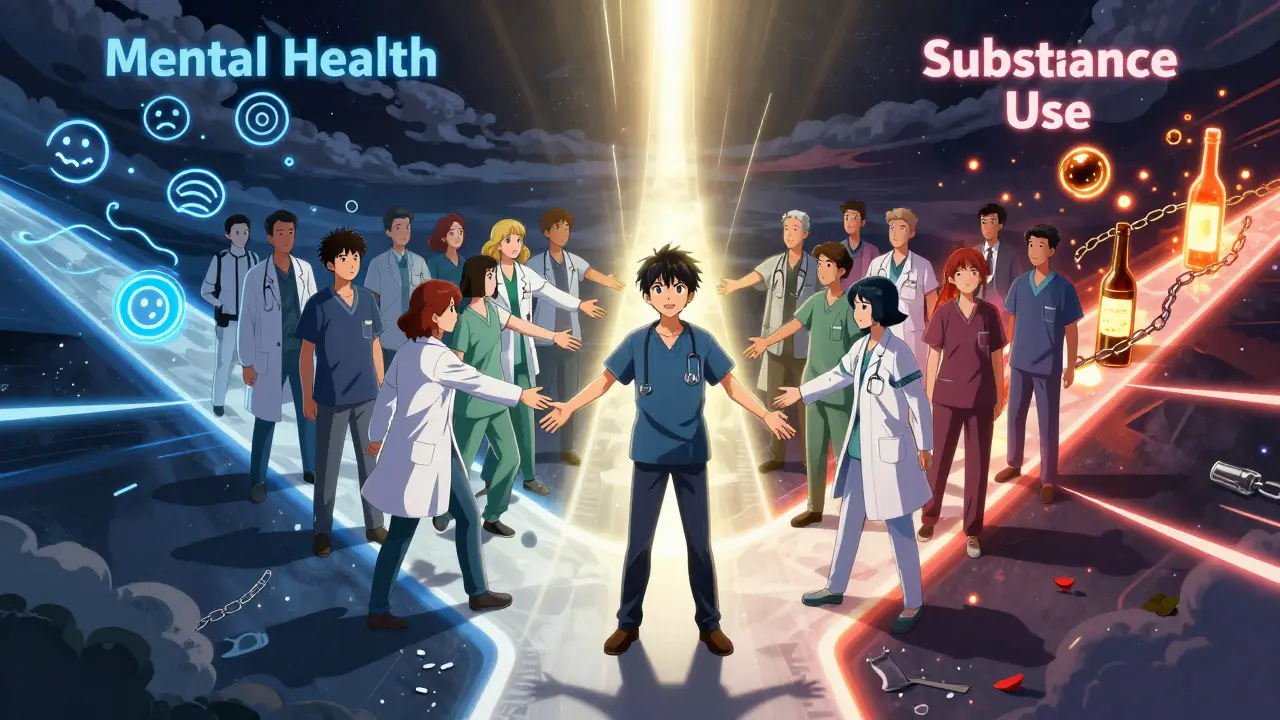
Imagine needing help for depression and alcohol use at the same time. But instead of one team working together, you’re shuttled between two different clinics, two different therapists, two different treatment plans. One says, "Get sober first." The other says, "Stabilize your mood first." Meanwhile, your anxiety spikes, your cravings grow, and you feel like you’re failing at both. This isn’t rare-it’s the norm for most people with co-occurring disorders. And it’s broken.
Why Separate Treatment Doesn’t Work
For decades, mental health and substance use treatment ran on parallel tracks. You’d go to a psychiatrist for your bipolar disorder, then a separate rehab center for your opioid use. But the reality is, these conditions feed each other. Untreated anxiety leads to self-medication with alcohol. Chronic drug use rewires brain circuits, making depression harder to treat. This cycle traps people in a loop of relapse and crisis. Research shows that when you treat one condition without the other, outcomes suffer. The Substance Abuse and Mental Health Services Administration (SAMHSA) calls parallel treatment "costly, inefficient, and ineffective." Why? Because symptoms of one disorder often trigger or worsen the other. A person in recovery might relapse after a panic attack. Someone stabilized on antidepressants might start drinking again to cope with emotional numbness. Without addressing both at once, progress is fragile.What Is Integrated Dual Diagnosis Care?
Integrated Dual Diagnosis Treatment (IDDT) is the evidence-based solution. It’s not just a better approach-it’s a complete system redesign. Instead of two separate services, IDDT brings everything under one roof. The same team, trained in both mental health and addiction, handles screening, assessment, treatment planning, and ongoing care. Developed in the 1990s by researchers at Dartmouth and New Hampshire, IDDT is now recognized as the gold standard by SAMHSA and leading behavioral health organizations. It’s built on the simple idea: if you have two diagnoses, you deserve one plan. The model isn’t theoretical. A 2018 randomized trial involving 154 patients with severe mental illness and substance use disorders found a statistically significant drop in days of alcohol and drug use after IDDT implementation. Patients didn’t just stop using more often-they reported feeling less confused, less abandoned, and more understood. One patient said, "I didn’t have to keep explaining my story twice. They just got it."The Nine Core Components of IDDT
IDDT isn’t a single therapy. It’s a full toolkit with nine evidence-based practices woven together:- Motivational interviewing: Helps patients explore their own reasons for change without pressure or judgment.
- Substance abuse counseling: Focuses on managing triggers, cravings, and high-risk situations-not just pushing for abstinence.
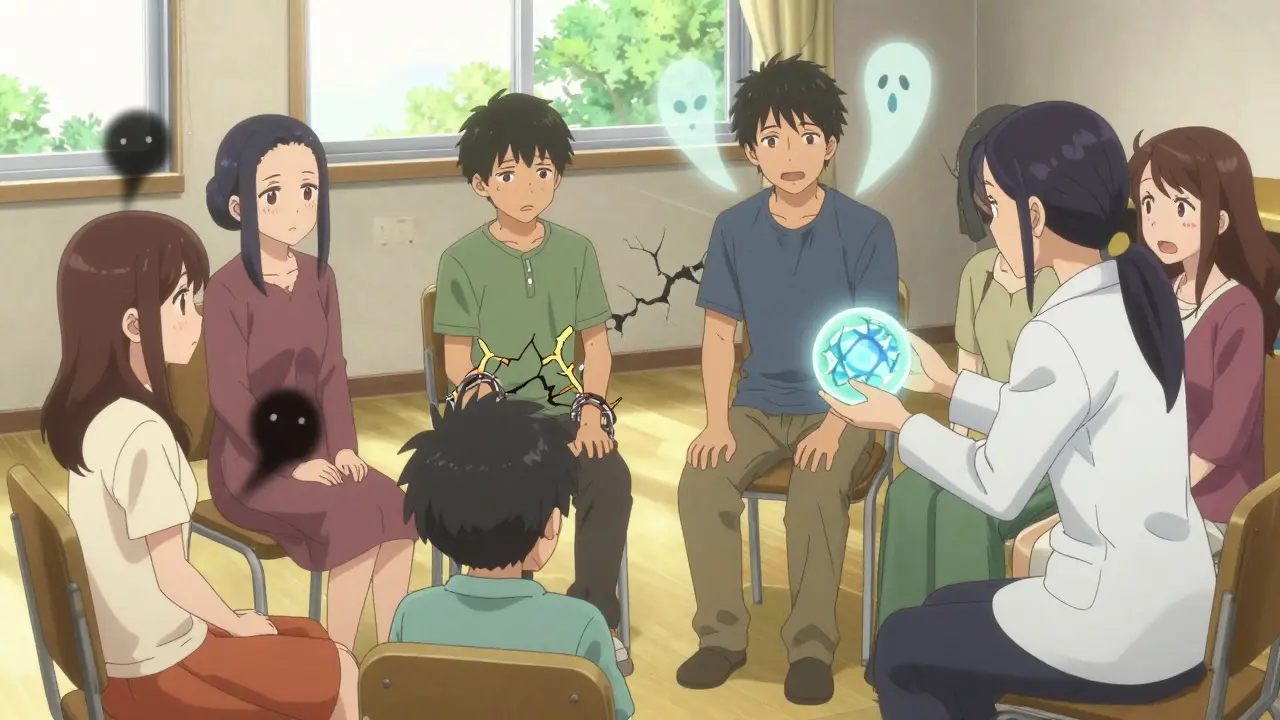
- Group treatment: Builds peer support in a setting where others face the same dual challenges.
- Family psychoeducation: Teaches loved ones how to support recovery without enabling or blaming.
- Participation in self-help groups: Encourages connection to AA, NA, or other peer-led communities.
- Pharmacological treatment: Uses medications like buprenorphine for opioid use or mood stabilizers for bipolar disorder, carefully coordinated to avoid interactions.
- Health promotion: Addresses physical health issues often ignored in mental health care-nutrition, sleep, exercise, chronic disease management.
- Secondary interventions: For those who don’t respond to initial treatment, offering more intensive or alternative approaches.
- Relapse prevention: Plans aren’t just about avoiding use-they’re about managing setbacks without shame or giving up.
What makes IDDT different is its realism. It doesn’t demand immediate sobriety. It meets people where they are. If someone still uses drugs, the team works with them to reduce harm-fewer overdoses, safer use, better hygiene, access to clean needles. This harm-reduction mindset builds trust. And trust is what keeps people in treatment.
Who Benefits Most?
IDDT works best for people with severe mental illnesses-like schizophrenia, bipolar disorder, or major depression-combined with substance use disorders. But it’s not just for the most severe cases. Anyone juggling anxiety and alcohol, PTSD and opioids, or ADHD and stimulant misuse can benefit. The numbers are staggering. In 2023, about 20.4 million U.S. adults had a dual diagnosis. That’s 1 in 12 adults. Yet only about 6% of them received integrated care. That means over 19 million people are stuck in fragmented systems that don’t address their full needs. The Washington State Institute for Public Policy found IDDT reduces alcohol use disorder symptoms by 16.5% and illicit drug use symptoms by 20.7%. Those aren’t just statistics-they’re days not spent in emergency rooms, jail cells, or hospital beds. They’re jobs kept, relationships repaired, lives rebuilt.The Hidden Barriers to Implementation
Despite clear benefits, IDDT is still rare. Why? Because changing systems is hard. Most clinics are funded and structured for single-diagnosis care. Mental health clinics don’t have addiction counselors. Addiction centers don’t have psychiatrists. Billing systems don’t support combined services. Staff often get trained in one area, then expected to handle both-without proper support. A 2018 study showed that even after a three-day IDDT training, clinicians didn’t improve in their knowledge or motivational interviewing skills. Training alone isn’t enough. You need ongoing supervision, team collaboration, and organizational buy-in. Funding is another wall. The Washington State analysis found that while IDDT reduces substance use, its benefit-cost ratio is under 1-meaning costs still outweigh measurable savings. That doesn’t mean it doesn’t work. It means we’re not counting the full value: fewer arrests, lower homelessness rates, reduced ER visits, improved productivity. These outcomes are real-but they don’t always show up in traditional cost-benefit models.
What Success Looks Like
Success in IDDT isn’t always total abstinence. It’s fewer overdoses. It’s someone taking their medication regularly. It’s showing up for therapy. It’s reconnecting with family. It’s holding a job for six months instead of three. One woman with schizophrenia and cocaine dependence went from using daily to using once a month after joining an IDDT program. She started attending group therapy, got help with housing, and began taking her antipsychotic consistently. She didn’t quit cocaine overnight. But she stopped using in the mornings, which let her sleep better and manage her voices more effectively. That’s progress. Another man with bipolar disorder and alcohol use disorder stopped drinking after learning how alcohol worsened his mood swings. His therapist helped him track triggers-loneliness, payday, arguments-and replace drinking with phone calls to his support group. He didn’t need to hit rock bottom. He just needed someone who understood both sides of his struggle.The Future of Integrated Care
The tide is turning. Medicaid and Medicare are slowly shifting toward value-based payments that reward outcomes, not just visits. That’s good news for IDDT. When providers are paid for keeping people stable-not just for running them through a program-they have more incentive to invest in integrated care. SAMHSA continues to support IDDT through technical assistance, state grants, and the Co-Occurring Center of Excellence. More states are piloting integrated models. But progress is slow. The real change will come when we stop treating mental illness and addiction as separate problems-and start treating people as whole human beings.What is the difference between parallel and integrated treatment for dual diagnosis?
Parallel treatment means separate services for mental health and substance use-different providers, different schedules, different goals. Integrated treatment combines both under one team. The same clinician assesses both conditions, creates one treatment plan, and monitors progress for both. This eliminates confusion, reduces gaps in care, and addresses how each disorder affects the other.
Does integrated treatment require complete abstinence from drugs or alcohol?
No. IDDT uses a harm reduction approach. While abstinence is a goal for many, the priority is reducing harm. If someone still uses substances, the team works with them to minimize risks-like avoiding mixing alcohol with medication, using clean needles, or not using alone. Progress is measured in reduced use, improved stability, and better quality of life-not just zero use.
Can IDDT help someone with mild depression and occasional marijuana use?
Yes. IDDT isn’t just for severe cases. People with mild to moderate mental health conditions and substance use patterns benefit from coordinated care. Even occasional marijuana use can worsen anxiety or depression over time. An integrated team can help understand the connection, explore healthier coping strategies, and prevent escalation before it becomes a crisis.
Why don’t more clinics offer integrated treatment?
Most clinics are funded and organized for single-diagnosis care. Mental health and addiction services have separate funding streams, billing codes, and staff training requirements. Training clinicians to handle both takes time and money. Many organizations lack the resources or leadership commitment to make the shift. It’s not a lack of evidence-it’s a lack of systemic support.
How long does it take to see results with IDDT?
Improvements in substance use often show up within 6 to 12 months. Reductions in hospitalizations, homelessness, or incarceration can take longer-sometimes 18 to 24 months. But many patients report feeling more supported and less alone within weeks. Recovery isn’t linear, but consistent, integrated care builds momentum over time.
Are medications part of integrated dual diagnosis treatment?
Yes. Medications are carefully coordinated. For example, someone with bipolar disorder might take lithium, while also receiving buprenorphine for opioid use. The treatment team monitors for interactions and side effects. Medication isn’t a substitute for therapy-it’s one tool in a broader plan that includes counseling, peer support, and lifestyle changes.

Write a comment
Your email address will not be published.
Recent Posts
-
 How to Evaluate Stability of Repackaged or Pillbox Medications September 5, 2026
 -
 Panic Attack Action Plan: Breathing, Grounding, and Medication December 22, 2025



12 Comments
They say integrated care is the gold standard, but let’s be real-this whole system is rigged. You think they care about people? Nah. They care about funding streams and grant money. They slap a fancy label on it, call it ‘evidence-based,’ and then charge triple for the same old pills and pep talks. I’ve seen it. My cousin went through three programs. All they wanted was to tick boxes, not heal.
i just want to say thank you for writing this. i’ve been stuck in the parallel system for years and it felt like i was being pulled apart. finally found a clinic that does iddt and honestly? it’s the first time i’ve felt seen. not perfect, but real. thank you.
THIS. This is the revolution we’ve been waiting for. Stop treating people like broken machines with separate parts. We’re not bipolar OR addicted-we’re human beings trying to survive a world that doesn’t give a damn until we’re on the street or in the ER. IDDT isn’t just treatment-it’s dignity. And dignity shouldn’t be a luxury.
Love the breakdown of the nine components. Really thoughtful. I’ve worked in mental health for over a decade and I’ve seen how fragmented care destroys trust. IDDT isn’t just clinically smarter-it’s emotionally smarter. People need to feel like they’re not a case file with two tabs.
Let me guess-this is all part of the Big Pharma-UN-NWO agenda to control the masses through ‘integrated’ mind control. They don’t want you cured. They want you dependent. Buprenorphine? Lithium? These aren’t treatments-they’re chemical leashes. They’ve been doing this since the 1950s. The ‘harm reduction’ nonsense? That’s just letting people die slower so the system stays funded. Wake up.
Oh please you think this is new? This is just the same old colonial psychiatry with a new logo. They take our pain, package it into nine bullet points, sell it to the state, and call it innovation. Meanwhile, the real solution? Community. Family. Food. Shelter. Not more pills and group sessions run by overworked therapists who get paid $20 an hour to fix a system they didn’t create
My sister’s in an IDDT program now. She used to hide her pills and her mood swings. Now she talks about both in the same room with the same person. It’s not magic-but it’s the first time she’s not afraid to be herself. That matters more than any statistic.
They say IDDT works but who pays? The poor? The undocumented? The homeless? The system doesn’t care about healing. It cares about paperwork. I’ve seen clinics shut down IDDT programs because the insurance wouldn’t cover both diagnoses at once. This is a fantasy for rich people with good insurance
Look. I’ve been in and out of rehabs since I was 19. I’ve had therapists who told me to quit drinking before I dealt with my PTSD. I’ve had addiction counselors who acted like my depression was a personal failure. IDDT? Finally someone looked me in the eye and said, ‘You’re not broken. You’re surviving.’ That’s not therapy. That’s liberation.
While the conceptual framework of IDDT is laudable, its operational efficacy remains questionable due to the absence of longitudinal, peer-reviewed meta-analyses with control groups exceeding 1,000 participants. Furthermore, the conflation of ‘harm reduction’ with clinical success risks pathologizing normal human coping mechanisms. The data cited lacks sufficient methodological rigor to support its sweeping policy implications.
They want to integrate care? Fine. But first, fix the borders. Fix the schools. Fix the jobs. Stop letting illegals and welfare queens drain the system while real Americans suffer. This ‘integrated care’ is just another socialist handout disguised as compassion. We don’t need more programs-we need more responsibility.
How quaint. A Western institution, funded by state subsidies, pretending to ‘understand’ trauma while ignoring the evolutionary biology of addiction. The human brain doesn’t respond to ‘team-based care’-it responds to hierarchy, discipline, and consequence. This ‘harm reduction’ nonsense is merely a surrender to weakness. True healing requires structure, not sympathy.