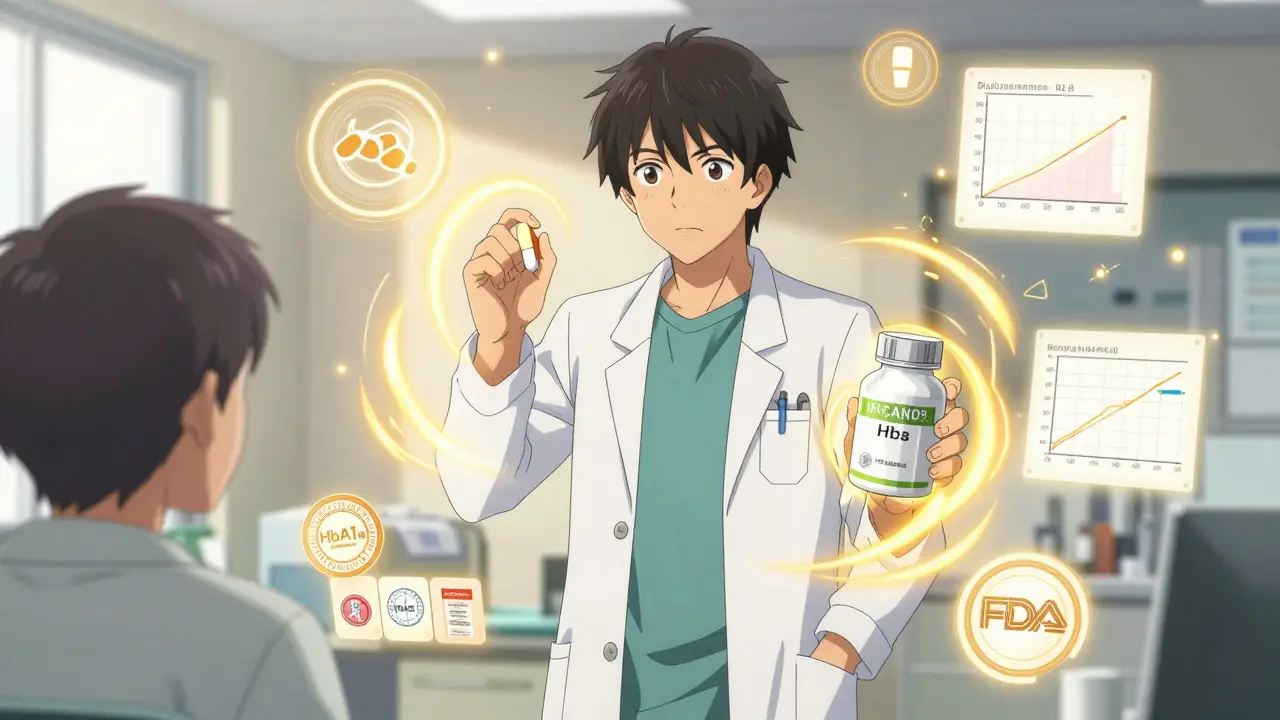
When a patient walks into your office asking why they’re now taking a generic version of their blood pressure pill, the real question behind their concern isn’t about cost-it’s about safety. Generic drugs are prescribed in 9 out of 10 U.S. prescriptions, yet many providers still hear doubts from patients-and sometimes from colleagues. The truth? The data doesn’t lie. Decades of rigorous studies show that generics work just as well as brand-name drugs for nearly every condition.
How We Know Generics Work the Same
The FDA doesn’t approve generics based on trust. It requires proof. Every generic drug must meet the same strict standards as its brand-name counterpart. That means identical active ingredients, the same dosage form, strength, and route of administration. But the real test is bioequivalence. To get approved, a generic must deliver the same amount of active ingredient into the bloodstream within the same time frame as the brand. The acceptable range? 80% to 125% of the brand’s pharmacokinetic profile. For most drugs, that’s a tight enough margin to guarantee the same clinical effect. For drugs with a narrow therapeutic index-like warfarin, levothyroxine, or tacrolimus-the standards are even stricter. Studies using scaled average bioequivalence (SCABE) look at how patients respond across multiple switches between brand and generic. A 2020 study in Nature Scientific Reports tracked transplant patients switching between brand and generic tacrolimus over 42 days. No clinically meaningful differences in blood levels or rejection rates were found. That’s not luck. That’s science.What the Real-World Data Shows
Lab results are one thing. Real patients are another. The 2019 PLOS Medicine study analyzed over 1.3 million patient records across 14 drug classes. It compared outcomes like hospitalizations, emergency visits, and medication adherence between those taking generics versus brand-name versions. The results? For most drugs, the hazard ratios hovered right around 1.00-meaning no difference in risk. For example:- Patients on generic amlodipine had a 9% lower risk of heart attack or stroke than those on the brand.
- Generic glipizide and brand-name glipizide led to identical rates of insulin initiation due to poor blood sugar control.
- Generic quinapril showed no difference in hospitalizations for heart-related events.
Why Some Providers Still Hesitate
It’s not that providers don’t trust the data. It’s that they’ve seen patients react differently. A patient might say, “This generic doesn’t work like the other one,” and it’s easy to assume the drug is the problem. But the issue is often the packaging, the pill color, or the size. The FDA’s own 2019 study confirmed that changes in inactive ingredients-like dyes or fillers-don’t affect how the drug works. Yet those changes can trigger nocebo effects: when patients expect side effects, they experience them. Another concern? Switching back and forth. Some patients get switched from brand to generic, then back to brand, then to a different generic. The FDA found that traditional generics had a 2.7% switch-back rate, while authorized generics had just 1.8%. But here’s the key: even those who switched back didn’t have worse health outcomes. Their ER visits, hospitalizations, and lab results stayed the same. The switch-backs were about comfort, not clinical need.
What the Numbers Don’t Show-But Providers Should Know
The biggest win with generics isn’t just clinical equivalence-it’s access. In 2021 alone, generic drugs saved the U.S. healthcare system $377 billion. Since 2009, that total exceeds $2.2 trillion. That’s not just money. That’s insulin for a child who couldn’t afford it. That’s a heart medication for an elderly patient on a fixed income. That’s a diabetes drug that keeps someone out of the hospital. And the savings aren’t just theoretical. A 2023 JAMA Network Open study followed 2.1 million people with type 2 diabetes. Those on generic metformin had the same HbA1c control as those on the brand-down to 0.02% difference. No one got sicker. No one needed more treatment. The only difference? Cost.When to Be Cautious
Not every drug is the same. About 3% of generics are classified as “B-rated” in the FDA’s Orange Book. These are complex formulations-like inhalers, topical creams, or injectables-where small differences in delivery can matter. For these, you should check the Orange Book and consider sticking with the brand unless you have strong evidence the generic works for your patient. Also, don’t assume all generics are created equal. Some manufacturers produce higher-quality products than others. If you notice a pattern-say, multiple patients on the same generic version of levothyroxine start having abnormal TSH levels-it’s worth checking which company made it. The FDA tracks this. You can report it. And you can switch to a different generic or back to the brand if needed.
How to Talk to Patients
Patients don’t need a lecture. They need reassurance. Start by saying: “This generic is the same medicine, made to the same strict standards as the brand. The FDA requires it to work the same way.” Then add: “It’s been tested on thousands of people. The data shows it’s just as safe and effective.” If they’re still worried, offer to check the FDA’s Orange Book with them. Show them the “A-rated” designation. Tell them 97% of generics are rated this way. Remind them that the same pills they’re taking now were once brand-name drugs-and that the generic version was tested before it ever hit the shelf.What the Experts Say
Dr. Aaron Kesselheim from Harvard, who led one of the largest reviews on this topic, put it simply: “The totality of evidence demonstrates that generic drugs are clinically equivalent to their brand-name counterparts for nearly all therapeutic classes.” The American College of Physicians agrees. Their 2016 position paper says: “Physicians should generally prescribe generic drugs rather than brand-name drugs when equivalent generics are available.” The FDA’s Office of Generic Drugs says it plainly: “An approved generic medicine has been shown to be bioequivalent to the brand-name medicine and is considered therapeutically equivalent.” That’s not marketing. That’s regulatory policy backed by over 40 years of data.Bottom Line for Providers
You’re not choosing between effectiveness and affordability. You’re choosing between the same effectiveness at a fraction of the cost. The data doesn’t support the idea that generics are inferior. It shows they’re equivalent-sometimes even better, because patients are more likely to stay on them when they’re affordable. The real question isn’t whether generics work. It’s whether you’re willing to let cost barriers keep patients from getting the care they need. The evidence is clear. The choice is yours.Are generic drugs as safe as brand-name drugs?
Yes. Generic drugs must meet the same FDA safety and quality standards as brand-name drugs. They contain the same active ingredients and are tested for bioequivalence. Adverse event reports show only 0.02% of all drug-related safety reports involve generic-specific issues, compared to 3.2% for brand-name drugs.
Why do some patients say generics don’t work for them?
This is often due to the nocebo effect-when patients expect side effects or reduced effectiveness, they experience them. Changes in pill color, size, or inactive ingredients can trigger this, even though the active drug is identical. Studies show no difference in clinical outcomes when comparing patients who switched to generics versus those who stayed on brand-name drugs.
Are there any drugs where generics aren’t recommended?
For 97% of drugs, generics are fully equivalent. But about 3% are classified as “B-rated” in the FDA’s Orange Book-these include complex formulations like inhalers, topical creams, or certain injectables. For these, clinical judgment matters. If a patient is stable on a brand-name version and switching causes instability, it’s reasonable to continue the brand-especially if cost isn’t a barrier.
Do generic drugs take longer to work?
No. Bioequivalence testing requires generics to reach the same peak blood concentration (Cmax) and total exposure (AUC) as the brand-name drug within the same time frame. If a generic worked slower, it wouldn’t pass FDA approval. Any perceived delay is psychological, not pharmacological.
Can I trust generics for chronic conditions like hypertension or diabetes?
Absolutely. Large-scale studies show no difference in outcomes for chronic conditions. For example, a 2023 study of 2.1 million diabetic patients found identical HbA1c control with generic metformin versus the brand. Similar results exist for blood pressure, cholesterol, and thyroid medications. Generics are the standard of care in most developed countries for these conditions.

Write a comment
Your email address will not be published.
Recent Posts
-
 How and Where to Buy Dapasmart Online Safely (2025 Guide) September 14, 2025

14 Comments
i cant believe we still have to prove this shit. generics are just as good. my grandma takes 5 different ones and still kicks ass at 82. stop overthinking it.
I must respectfully commend the thoroughness of this post. The data is unequivocal, and the emphasis on bioequivalence standards is both scientifically rigorous and ethically imperative. Thank you for articulating this with such clarity and grace. 🙏
Let’s be real-this is just corporate propaganda dressed up as science. The FDA is a revolving door for pharma execs. You think they’d approve a generic that actually works the same? Nah. They approve what keeps the stock prices up. The real evidence? The ones who don’t speak up-because they’re too busy dying in rural clinics.
I’ve seen this play out so many times. A patient says, 'This generic made me feel weird,' and you check their labs-perfect. It’s not the drug. It’s the fear. The pill looks different. That’s all. 🌱
I don’t care what the studies say. If I were on a generic for my heart meds, I’d want the brand. I’ve seen too many people get sick after switching. No amount of data changes that. You don’t gamble with your life.
Bro, the FDA approves generics based on what? A lab in Ohio that’s paid by the company? Come on. This is the same agency that let Purdue push OxyContin. Trust the system? Nah.
They want you to take the cheap pills so you don’t complain about the price of insulin. This is a global control scheme. Generics are fine for the poor, but the elite? They get the real stuff. You think they’d let their kids on generics? Think again.
This is such an important conversation. So many patients feel ashamed for questioning generics, but their concerns are valid-even if the science says otherwise. We need to meet them where they are, with patience and facts. You’ve done a beautiful job here.
I mean... really? You're citing 'PLOS Medicine' like it's the Holy Grail? The journal's editorial board is full of left-leaning academics who hate Big Pharma-so of course they'll publish anything that makes generics look good. And the FDA? Please. They're owned by lobbyists. This is not science. It's ideology.
I love how you broke this down. ❤️ My mom was terrified of switching her thyroid med to generic-until I showed her the FDA’s bioequivalence charts. Now she saves $80/month and feels better than ever. It’s not magic. It’s math. And compassion.
The fact that you feel the need to defend generics at all is telling. If they were truly equivalent, why do we even have brand-name drugs? Why does the industry spend billions on marketing? There’s a reason. The market knows something the data won’t admit.
You call this 'data'? This is cherry-picked fluff. What about the 2018 study from India where 40% of generics failed potency tests? Or the 2021 FDA inspection that found 70% of Indian manufacturing plants had sanitation violations? You ignore the supply chain. That’s not science. That’s wishful thinking.
I used to think generics were sketchy too. Then I saw my cousin’s insulin bill drop from $500 to $15. He’s alive. That’s all I need to know.
In India we use generics for everything. No one dies. No one gets worse. People just pay less. Why is this even a debate in the US? You guys have money. You should be leading, not freaking out.