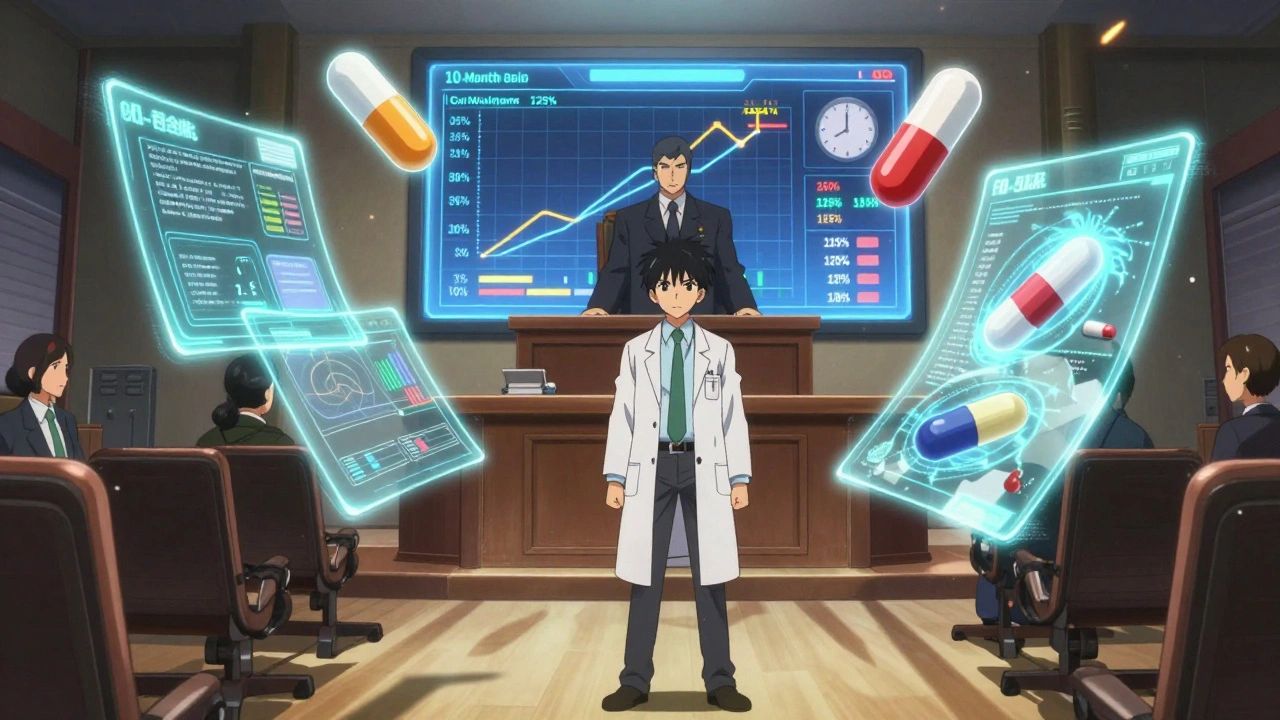
When you pick up a prescription at the pharmacy and see a generic version of your brand-name drug, you’re seeing the result of a highly structured, science-backed process called the Abbreviated New Drug Application (ANDA). It’s not a shortcut-it’s a precise, regulated pathway that lets safe, effective generic drugs reach patients at a fraction of the cost. In 2023, nearly 90% of all prescriptions filled in the U.S. were for generics, saving the healthcare system $373 billion that year. But how does the FDA make sure these cheaper drugs work just like the expensive ones? The answer lies in the ANDA process.
What Is the ANDA Process?
The ANDA is a regulatory submission to the U.S. Food and Drug Administration (FDA) that allows companies to market a generic version of a brand-name drug without repeating all the expensive clinical trials. Instead of proving the drug is safe and effective from scratch, generic manufacturers must prove their product is therapeutically equivalent to an already approved drug, called the Reference Listed Drug (RLD). This system was created by the Hatch-Waxman Act of 1984, a landmark law designed to balance innovation with access. It gave brand-name companies some patent protection while opening the door for competition once those patents expired.The ANDA pathway is governed by Section 505(j) of the Federal Food, Drug, and Cosmetic Act. It’s not just about copying a pill. The generic version must match the RLD in every key way: same active ingredient, same strength, same dosage form (tablet, injection, capsule), same route of administration (oral, topical, etc.), and same conditions of use. Even the labeling must be nearly identical, with only minor exceptions for differences in manufacturer details or patent statements.
How the ANDA Process Works Step by Step
The ANDA process doesn’t happen overnight. It’s a multi-phase review that can take years, even for experienced companies. Here’s how it breaks down:- Submission: The applicant files an electronic ANDA through the FDA’s Electronic Submission Gateway. Required forms include FDA-356h (the application itself) and FDA-3674 (disclosing financial interests). The filing division checks for completeness within 60 days. If anything’s missing, the application is refused.
- Discipline Reviews: Once accepted, the application is split among specialized FDA teams: chemistry, manufacturing, microbiology, labeling, and bioequivalence. Each team digs into their area. Chemistry checks the drug’s composition. Manufacturing reviews the facility and production methods under current Good Manufacturing Practices (cGMP). Bioequivalence is the heart of the process-did the generic drug get into the bloodstream at the same rate and amount as the brand? If not, it’s not approved.
- Information Requests and Responses: Most applications get flagged with Information Requests (IRs). These are requests for more data, clarification, or corrections. On average, applicants receive 10-15 IRs per submission. Responding thoroughly is critical. A single unresolved issue can delay approval by months.
- Final Decision: If all teams agree and the manufacturing site passes inspection, the FDA issues Final Approval. But sometimes, even if the science is solid, approval is delayed. That’s called Tentative Approval. It means the FDA is ready to approve-but a patent or exclusivity period on the brand drug is still active. The generic can’t launch until that protection expires.
The FDA’s goal under GDUFA III (Generic Drug User Fee Amendments, effective 2022) is to approve 90% of original ANDAs within 10 months. In 2022, they hit a 91% first-cycle approval rate. But that’s only for applications that get it right the first time. The average time from submission to approval is about 30 months due to back-and-forth reviews and inspection delays.
Why Bioequivalence Is the Make-or-Break Factor
The most common reason ANDAs get rejected? Inadequate bioequivalence data. In 2022, 35% of Complete Response Letters cited bioequivalence issues. That means the generic didn’t prove it behaves the same way in the body as the brand-name drug.Bioequivalence is usually tested in healthy volunteers using blood samples. The generic must deliver the same amount of active ingredient into the bloodstream at the same rate as the RLD. The acceptable range is strict: the generic’s absorption must fall within 80% to 125% of the brand’s. For simple oral tablets, this is straightforward. But for complex products-like inhalers, topical creams, or injectables-it’s much harder. These require specialized studies, sometimes with patients instead of healthy volunteers. One company spent $1.2 million and three tries just to prove bioequivalence for a topical cream.
The FDA has published over 2,000 product-specific guidances to help applicants navigate these challenges. For example, there are separate guidelines for nasal sprays, transdermal patches, and complex injectables. Companies that use these guidances from the start have a much higher success rate.
ANDA vs. NDA: Why Generics Cost So Much Less
The difference between an ANDA and a New Drug Application (NDA) is massive. An NDA for a brand-new drug requires full clinical trials-Phase I, II, and III-covering safety, dosing, and effectiveness in thousands of patients. The cost? Around $2.3 billion, according to Tufts Center for the Study of Drug Development.An ANDA? Typically $1 million to $5 million. That’s because it leans on the FDA’s prior approval of the brand drug. No need to retest safety. No need to reprove efficacy. Just prove you can make the same medicine, the same way, and it behaves the same in the body.
That’s why generic drugs cost, on average, only 15% of the brand-name price within a year of launch. The savings aren’t just theoretical-they’re in your wallet. A 30-day supply of brand-name Lipitor might cost $300. The generic version? $10. That’s the power of the ANDA process.
Who’s Behind the ANDA Submissions?
The generic drug market is dominated by a few big players. Teva Pharmaceuticals holds about 22% of the U.S. market. Viatris (formerly Mylan) and Sandoz follow with 15% and 12% respectively. But over 75% of ANDA submissions come from companies that have already approved at least five generic products. Experience matters.Smaller companies often struggle with the complexity. One survey found that 78% of applicants face unexpected Information Requests. Another 63% report delays due to facility inspections. The FDA inspects every manufacturing site listed in the ANDA, whether it’s in the U.S., India, or China. If the site fails inspection, approval is blocked-even if the science is perfect.
Leading companies now use Quality by Design (QbD) principles to build robust manufacturing processes from the start. This reduces variability and cuts down on IRs. They also hold pre-ANDA meetings with the FDA. About 78% of successful applicants do this. It’s not required, but it’s a game-changer.
Challenges and the Future of Generic Approval
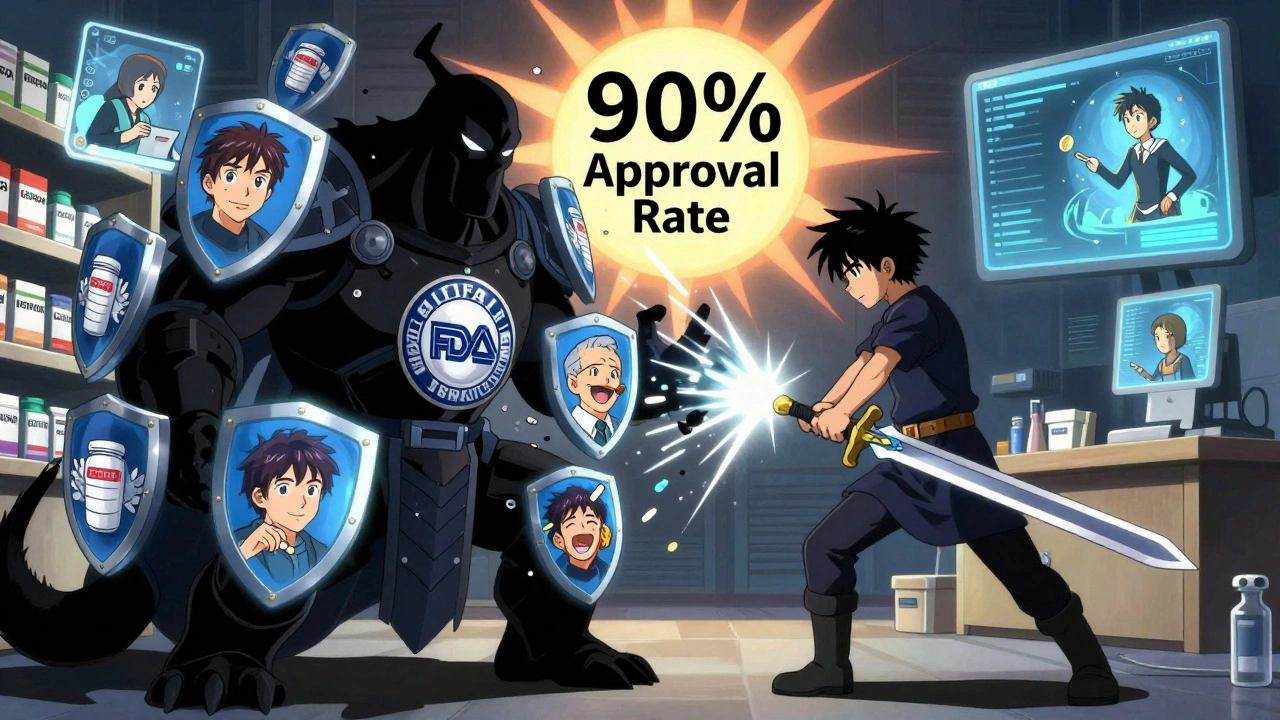
Despite its success, the ANDA process isn’t flawless. Patent thickets-where brand companies file multiple overlapping patents to delay generics-remain a major barrier. Some drugs have over 100 patents, making it hard for generics to enter even after the original patent expires.Another growing issue: complex generics. These include drugs that are hard to replicate, like inhaled corticosteroids or long-acting injectables. In 2022, 35% of pending ANDAs were for complex products. The FDA launched its Complex Generic Drug Products Initiative in 2018 to tackle this. Today, they’re using AI tools to speed up chemistry reviews-78% of reviewers now use AI-assisted tools to analyze data faster and more accurately.
The future of ANDAs will likely involve more real-world evidence, harmonized global standards through the International Council for Harmonisation (ICH), and better tools to assess complex products. But the core principle remains unchanged: if a generic drug is proven equivalent, it deserves a place on the shelf.
What This Means for Patients
You don’t need to be a scientist to benefit from the ANDA process. When your doctor prescribes a generic, you’re getting a drug that’s been reviewed by the same agency that approved the brand-name version. The FDA holds generics to the same standards. They’re not second-rate. They’re rigorously tested alternatives.For people managing chronic conditions-diabetes, high blood pressure, depression-switching to a generic can mean the difference between sticking with treatment and skipping doses because of cost. The ANDA process doesn’t just lower prices. It saves lives.
And while the system isn’t perfect-delays happen, inspections take time, and complex drugs are still tough to copy-it’s working. The U.S. generic drug market is projected to grow from $127.6 billion in 2022 to $189.2 billion by 2027. More competition. Lower prices. More access. That’s the real goal of the ANDA process.
Is a generic drug the same as the brand-name drug?
Yes, but with a key distinction. A generic drug contains the same active ingredient, strength, dosage form, and route of administration as the brand-name drug. It must also meet the FDA’s strict bioequivalence standards, meaning it delivers the same amount of medicine into your bloodstream at the same rate. The only differences are in inactive ingredients (like fillers or dyes) and packaging. These don’t affect how the drug works.
Why do some generic drugs look different from the brand?
U.S. law requires generic drugs to look different from the brand-name version to avoid trademark infringement. That means the color, shape, or size might be different. But the active ingredient-and how your body absorbs it-is identical. If you’re concerned, check the label or ask your pharmacist. The active ingredient name will be the same.
Can a generic drug be less effective than the brand?
No. The FDA requires all generics to meet the same high standards for quality, strength, purity, and stability as brand-name drugs. If a generic doesn’t prove it works the same way in the body, it won’t be approved. Studies show generics perform just as well as brands in real-world use. Millions of patients rely on them daily without issue.
What is Tentative Approval, and why does it happen?
Tentative Approval means the FDA has found your generic drug scientifically acceptable, but it can’t be fully approved yet because a patent or exclusivity period for the brand-name drug is still active. You can’t sell the drug until that protection expires. It’s not a rejection-it’s a hold. Once the patent ends, the FDA will issue Final Approval automatically.
How long does it take to get an ANDA approved?
The FDA aims to approve 90% of original ANDAs within 10 months under GDUFA III. But in practice, the average time from submission to approval is about 30 months. Delays often come from incomplete applications, multiple Information Requests, or facility inspection backlogs. Companies with experience and strong preparation can hit the 10-month goal.
Are generic drugs made in the same facilities as brand-name drugs?
Sometimes. Many brand-name companies also make generic versions of their own drugs. Other times, generics are made in facilities in the U.S., India, China, or elsewhere. The FDA inspects every facility listed in the ANDA-no matter where it is. If the facility fails inspection, the application is blocked. Quality control is the same, regardless of location.
Do all generic drugs have the same quality?
All FDA-approved generics must meet the same strict standards. There’s no official ranking of “better” or “worse” generics. But differences in inactive ingredients can affect how a pill feels or tastes. Rarely, a patient might react differently to one generic versus another due to fillers. If that happens, talk to your doctor or pharmacist. Switching to a different generic brand might help.
What’s the difference between ANDA and 505(b)(2)?
ANDA (505(j)) is for exact copies of brand-name drugs and relies entirely on the FDA’s prior findings. The 505(b)(2) pathway is for modified versions-like a new dosage form, new combination, or new indication. It allows companies to reference existing data but requires new clinical studies for the changes. It’s a middle ground between full NDA and simple ANDA.
Final Thoughts
The ANDA process is one of the most successful public health policies in modern medicine. It’s not flashy. It doesn’t make headlines. But it’s the quiet engine behind the billions in savings, the millions of prescriptions filled, and the lives improved because people can afford their meds. It’s science, regulation, and competition working together-and it’s working well.
Write a comment
Your email address will not be published.
Recent Posts
-
 Buy Cheap Generic Doxycycline Online - Safest Guide 2025 October 12, 2025
 -
 Amlodipine and Mental Health: How It Impacts Anxiety and Depression September 11, 2025
 -
 Betamethasone for Urticaria: How It Works, Benefits & Risks September 14, 2025

15 Comments
Generic drugs saved my life. I’m on a $400/month med for diabetes-generic brought it down to $12. No joke, I cried when I saw the receipt. The FDA’s process? Solid. Don’t let anyone tell you otherwise.
Why do we even let foreign factories make our meds? India and China? I’d rather pay more and know my pills were made in Ohio. Safety first, not cost-cutting.
It’s not about equivalence-it’s about control. The FDA, Big Pharma, and the GDUFA… it’s a beautifully orchestrated ballet of regulatory capture. Bioequivalence? A myth constructed to pacify the masses. The active ingredient is the same-but the excipients? The binders? The fillers? They’re not inert. They’re *psychosomatic variables*. And we’re all lab rats in a $373 billion placebo experiment.
Who even *defines* ‘therapeutic equivalence’? A committee that gets paid by the same companies that submit the applications. The FDA doesn’t inspect every facility-it inspects the ones they *want* to inspect. And the 30-month approval timeline? That’s not inefficiency. That’s deliberate obstruction. Patent thickets aren’t loopholes-they’re *features*.
And don’t get me started on the ‘complex generics’ initiative. AI-assisted reviews? That’s just automation masking institutional decay. They’re not speeding things up-they’re outsourcing judgment to algorithms trained on biased data. The real question isn’t whether generics work-it’s whether we’ve surrendered our right to question the system that says they do.
And yet… we still take them. Because we have no choice. And that’s the most terrifying part.
Just had my first generic switch last month-went from brand-name blood pressure med to generic. Zero difference. My BP’s stable, no side effects. FDA’s got it right. 🙌
As someone from India working in pharma, I can tell you: the quality standards are insane. Our labs are ISO-certified, FDA-inspected, and we’re proud of it. The ‘Made in India’ stigma? It’s outdated. We’re the backbone of the global generic supply chain.
And yes, we’re building AI tools too. We’re not just manufacturers-we’re innovators.
Generic drugs are essential. They allow millions to afford treatment. The process is rigorous. The FDA is not perfect, but it is the best system we have. Thank you for explaining it clearly.
so like… bioequivalence is 80-125%? that seems kinda wide? like… what if its 81%? is that ‘good enough’? or is it just… whatever, close enough? 🤔
Wait-so if a company gets Tentative Approval, they’re basically in line, waiting for the patent to expire? That’s… actually brilliant. It incentivizes early investment without letting them rush the market. And pre-ANDA meetings? That’s the kind of proactive collaboration the FDA should promote more of. Kudos to the agencies that make this work.
Also, the fact that 78% of successful applicants do pre-submission meetings? That’s a stat worth highlighting. It’s not about cutting corners-it’s about doing it right the first time.
And the 10-month goal? Still not fast enough. But it’s progress.
EVERY generic drug is a Trojan horse. The FDA says they’re ‘equivalent’-but what if the inactive ingredients trigger autoimmune flares? What if the fillers are laced with microplastics from Chinese manufacturing? What if the ‘bioequivalence’ is measured in healthy young men-but I’m a 68-year-old woman with liver damage? They don’t test that. They don’t care. They just want you to shut up and take the $10 pill.
My cousin died after switching to a generic. They called it ‘unrelated causes.’ But the packaging changed. The pill looked different. And then… she was gone.
Don’t believe the hype. This isn’t science. It’s corporate convenience dressed up as public health.
my pharmacist switched me to a generic and i was scared but it worked even better?? like my migraines got less frequent?? idk maybe placebo but i’m not complaining 😅
The ANDA process is a masterpiece of regulatory pragmatism. It doesn’t pretend to be perfect-it accepts the reality that innovation must coexist with accessibility. The Hatch-Waxman Act wasn’t just legislation; it was a philosophical compromise: that progress isn’t measured in monopolies, but in availability.
Yes, there are delays. Yes, inspections are slow. Yes, complex generics are hard. But the core principle endures: if a drug works, it shouldn’t be locked behind a patent wall. The body doesn’t care who manufactured it-it only cares whether the molecule reaches the receptor.
That’s why this system works. Not because it’s fast. Not because it’s cheap. But because it’s honest.
I’ve been in this field for 20 years-started as a lab tech, now I help companies prep ANDAs. The process is brutal, but it’s fair. The hardest part? Not the science. It’s the paperwork. One misplaced decimal in a bioequivalence report can delay approval for a year. And the inspections? If your facility has a single rodent sighting, it’s game over. The FDA doesn’t play.
But here’s what no one talks about: the people behind the scenes. The chemists in Hyderabad working 16-hour days to tweak a tablet coating. The inspectors flying to rural China to check humidity controls. The FDA reviewers who’ve read 500+ ANDAs and still read each one like it’s their first. This isn’t bureaucracy. It’s devotion.
And the savings? $373 billion? That’s not a number. That’s 373 million people who didn’t have to choose between insulin and groceries.
generic = life saver 💖
It is imperative to note that the Abbreviated New Drug Application process, while ostensibly designed to facilitate cost-efficiency, inadvertently perpetuates a structural imbalance wherein the intellectual capital of pharmaceutical innovation is systematically exploited by entities lacking in R&D investment. The FDA’s reliance upon bioequivalence metrics, which are inherently reductionist, fails to account for pharmacodynamic variance across heterogeneous populations. One must question whether the commodification of therapeutic equivalence truly serves the public good-or merely satisfies the fiscal imperatives of a corporatized healthcare apparatus.
Generics are fine I guess if you dont mind your meds looking like candy