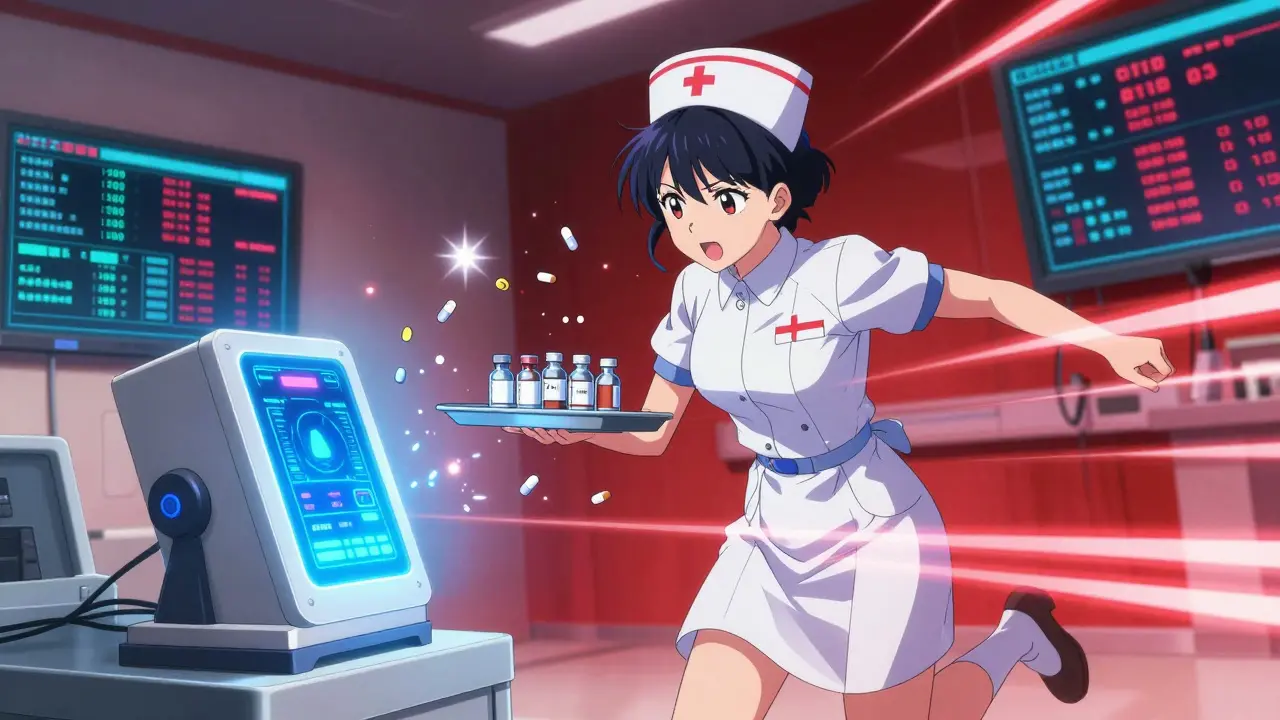
Every year, hospitals and pharmacies discard millions of dollars worth of medication simply because no one noticed it had expired. In long-term care homes, families sometimes find old pills in medicine cabinets with faded labels. Emergency responders carry defibrillators and epinephrine auto-injectors that can’t afford to be outdated. The problem isn’t laziness-it’s that medication expiration tracking has historically relied on manual checks, human memory, and paper logs. But technology is changing that. Today, systems exist that automatically detect when a pill, vial, or injector is about to expire-and even prevent it from being used.
How RFID Tags Are Revolutionizing Medication Tracking
Radio Frequency Identification, or RFID, is no longer just for tracking packages in warehouses. In hospitals, RFID tags the size of a sticker are attached to every medication container. These tags store data like lot number, expiration date, and dosage. When a nurse pulls a medication from a cabinet or crash cart, a handheld scanner or built-in reader instantly checks the tag. If the expiration date is within two days, the system blocks access and flashes an alert. This isn’t hypothetical-it’s happening right now in over 900 hospitals across the U.S., mostly using the KitCheck system.
Before RFID, inventory checks took hours. Pharmacists would manually scan barcodes one by one, entering lot numbers and dates into a computer. With RFID, you can sweep a tray of 50 medications in under 10 seconds. Texas Children’s Hospital reported saving dozens of hours each week after switching. They now track 784 high-value drugs, each costing over $100 per unit. Without RFID, those drugs would’ve been lost to expiration far more often.
RFID doesn’t just save time-it saves money. Hospitals using these systems report a 15-20% drop in expired medication waste. That’s not just about throwing out pills. It’s about avoiding costly recalls, preventing patient harm, and staying compliant with FDA and DEA regulations. One Midwest hospital cut its annual medication waste from $210,000 to under $170,000 in just one year after implementing RFID.
Electronic Medication Administration Records (eMAR) for Care Settings
While RFID works best in large hospitals, eMAR systems are the go-to solution for nursing homes, IDD agencies, and home care providers. An eMAR isn’t just a digital version of a paper chart. It’s a live, connected system that syncs with pharmacy orders, logs who gave which medication, and flags expirations before they happen.
eVero’s platform, for example, automatically imports new prescriptions from pharmacies. When a new bottle of insulin arrives, the system scans the barcode, records the expiration date, and adds it to the patient’s digital profile. Nurses log each dose using biometric login-fingerprint or facial recognition-so there’s no room for mistaken identity. If a medication is set to expire in three days, the system sends an alert to the pharmacist and the care team. No more guessing. No more last-minute runs to the pharmacy.
These systems are especially vital in settings where patients take 10 or more medications daily. In one Iowa facility, staff reduced medication errors by 68% after switching to eMAR. They also cut the time spent on monthly inventory audits from 40 hours to under 5. The real win? Families feel safer knowing their loved ones aren’t getting outdated meds.
Automated Dispensing Cabinets and Smart Storage
Think of Automated Dispensing Cabinets (ADCs) as smart medicine lockers. These are the metal cabinets you see in hospital wings, often with touchscreens and barcode scanners. They don’t just store drugs-they track them. Every time a nurse opens a drawer to grab a dose, the system logs which drug was taken, when, and by whom. It also checks the expiration date in real time.
Some ADCs go further. If a medication is expired or recalled, the drawer won’t unlock. Others can even reorder stock automatically when levels get low. TouchPoint Medical reports that pharmacists using these cabinets reduce inventory errors by 90%. For closed-door pharmacies that serve psychiatric units or rehab centers, this is a game-changer. No more stacking expired bottles behind the counter. No more panic when a recall notice drops.
These systems integrate with electronic health records, so if a doctor prescribes a new medication, the ADC knows to expect it. If the patient’s insurance changes, the system flags it before the drug is even dispensed. It’s not magic-it’s data, linked together.

Mobile Solutions for Emergency Services
Paramedics don’t have time for complex systems. That’s why LogRx was built for ambulances and fire departments. It runs on standard iPhones and Android phones-no special hardware needed. EMTs scan the barcode on a medication bottle, and the app instantly tells them if it’s expired, recalled, or nearing its end date.
Portland Fire & Rescue started using LogRx in 2023. Before, they’d manually check expiration dates once a month. Now, the app alerts them the moment a medication is 14 days from expiring. They’ve cut their expired epinephrine stock by 80%. And because the system logs every scan, they can prove compliance during DEA inspections.
It’s not just about saving lives-it’s about saving paperwork. One UK EMS team reported a 70% drop in administrative hours per week. They used to spend two full days a month filling out compliance logs. Now, it’s all done automatically.
What’s Working and What’s Not
Not every system works everywhere. RFID is powerful but expensive. Installing it in a 300-bed hospital can cost $150,000 or more. Smaller clinics can’t afford that. For them, eMAR or mobile apps make more sense. A rural pharmacy might use a simple app that scans barcodes and sends email alerts. No need for tags or cabinets.
Biggest failure? Trying to force new tech into old systems. One hospital in Ohio installed RFID but didn’t update its legacy pharmacy software. The result? 30% of medication records didn’t sync. Nurses got false alerts. Some expired drugs slipped through. The fix? They paused rollout, fixed the integration, and trained staff over six weeks. It worked.
Staff resistance is common. Nurses used to checking expiration dates by hand don’t always trust a machine. But after three months, most say the same thing: "I don’t know how we lived without it."

How to Get Started
If you’re managing medication in a clinic, nursing home, or EMS unit, here’s how to begin:
- Assess your needs. Are you tracking 10 medications or 1,000? Do you need real-time alerts, or is monthly inventory enough?
- Choose the right tool. Hospitals: RFID (KitCheck, Intelliguard). Long-term care: eMAR (eVero, Cerner). EMS: mobile apps (LogRx). Pharmacies: ADCs with built-in tracking.
- Start small. Pilot the system in one unit-say, the emergency room or one wing of a nursing home.
- Train staff. Don’t assume they’ll figure it out. Show them the alert, the block, the log. Let them test it.
- Measure results. Track how many expired meds you used to throw out. Compare it after three months.
Most systems offer free demos. Take one. Try it. You’ll see how much easier it is to know what’s expired before it ever leaves the shelf.
What’s Coming Next
The next wave of tech is even smarter. AI is now predicting expiration risks before they happen. Intelliguard Health’s pilot system analyzes usage patterns. If a certain antibiotic is rarely used, it flags it for early rotation. Blockchain is being tested to track meds from manufacturer to patient-so you know exactly where each bottle came from.
By 2027, Gartner predicts 45% of U.S. hospitals will use RFID for medication tracking. Right now, it’s 25%. That means the next two years will be the tipping point. More manufacturers are starting to pre-tag medications. That means less work for hospitals. Less cost. More accuracy.
The goal isn’t just to avoid expired drugs. It’s to build a system where you never have to ask, "Is this still good?" The answer is always automatic. And that’s the future of safe medication use.
Can I use technology to track expiration dates at home?
Yes, but options are limited. There are no consumer-grade RFID systems for home use yet. However, some pharmacy apps like Medisafe or MyTherapy let you manually enter expiration dates and send push notifications when pills are about to expire. You can also use QR code scanners on your phone to scan prescription labels-some pharmacies now include expiration data in the code. For now, manual logging with alerts is the most practical home solution.
Do all medications have expiration dates that matter?
Most do, but some last longer than labeled. The FDA requires expiration dates based on stability testing, and most drugs remain effective past that date. However, certain medications-like insulin, nitroglycerin, epinephrine, and liquid antibiotics-lose potency quickly. For these, expiration dates are critical. Even if a pill looks fine, if it’s expired, don’t risk it. Technology helps ensure you’re never unsure.
Are these systems expensive to implement?
It depends. For a small clinic, a mobile app like LogRx costs under $1,000 per year. For a hospital, RFID systems range from $50,000 to $200,000 upfront. But most facilities see a return on investment within 12-18 months through reduced waste, fewer recalls, and labor savings. One study found hospitals saved $120,000-$300,000 annually just from cutting expired drug disposal.
Can these systems prevent drug recalls?
Yes, and that’s one of their biggest strengths. When the FDA issues a recall, systems like eVero and KitCheck receive automatic updates. They scan every medication in inventory and instantly flag affected lots. Instead of manually checking hundreds of bottles, staff get a list of exact items to remove. In one case, a hospital identified and quarantined 17 recalled vials in under 10 minutes. Without the system, it would’ve taken days.
What happens if the system goes down?
All major systems have offline modes. If the network fails, ADCs and eMAR platforms still function using cached data. Staff can manually check expiration dates using printed labels or backup logs. The system doesn’t replace safety-it enhances it. Even during outages, protocols remain in place. Most systems also have redundant servers and 24/7 support to minimize downtime.

Write a comment
Your email address will not be published.
Recent Posts
-
 The Science Behind Cholestyramine: How It Works and Why It's Effective November 18, 2025
 -
 How to Speak Up About Medication Side Effects During Treatment December 17, 2025


11 Comments
So basically we're paying hospitals hundreds of thousands to stop nurses from being human? All this tech sounds cool until you realize it's just replacing common sense with a screen. I've seen med carts with expired stuff before - the problem ain't the system, it's the staff not looking. Tech can't fix laziness.
OMG this is lit 😍 like imagine your meds just whisperin' to you like 'hey dude im about to expire in 2 days' - no more guesswork! I used to keep my insulin in a drawer with a sticky note that said 'dont use after 11/23'... now i just scan it and boom. life changed. also i just bought a smart pillbox and it texts me if i miss a dose. we livin in the future yall.
The integration of RFID with eMAR and ADC ecosystems represents a paradigm shift in pharmacovigilance infrastructure. The granular, real-time traceability afforded by these systems mitigates the risk of iatrogenic harm associated with temporal degradation of pharmacologically active compounds. Moreover, the reduction in administrative overhead - quantified in FTE hours - enables clinical personnel to reallocate cognitive resources toward patient-centered care delivery. The systemic synergy between barcode scanning, biometric authentication, and automated inventory reconciliation constitutes a non-trivial advancement in medication safety architecture.
This is honestly one of the most beautiful things I’ve read all year 🥹 I love how tech can actually help people instead of just making apps that track your steps. My grandma’s nursing home just started using eVero and now she’s got a little notification on her tablet every time her meds are about to expire - she says it makes her feel safe. Thank you for writing this. Also, can we make this a Netflix doc? I’d binge it.
RFID tags in meds? Sounds like the government or Big Pharma is embedding tracking chips so they can monitor who’s taking what and when. Next thing you know they’ll be auto-deleting your prescriptions if you’re deemed 'non-compliant'. And don’t get me started on blockchain - that’s just crypto buzzword bingo with syringes. This isn’t safety. It’s control. And I’m not buying it
Wow. So now we need a whole system just to not give people expired pills? I thought the rule was 'if it looks weird, don’t take it'. Why are we outsourcing common sense to robots? Also, I’ve had pills that expired 3 years ago and they were fine. Just saying.
This is not merely a technological upgrade - it is a moral imperative. Every life saved by preventing an expired medication from being administered is a testament to human ingenuity applied with compassion. The systems described here do not replace human care; they elevate it. When we choose precision over guesswork, we choose dignity over neglect. This is how we honor those who rely on us - not with good intentions, but with reliable systems.
So let me get this straight - nurses used to manually check expiration dates… and now they get a little alert? Congrats, you turned a chore into a notification. Honestly? I’m impressed. But also… did we really need a 3,000-word essay to tell us that scanners are better than sticky notes? Still - props. This is the kind of boring-as-hell innovation that actually saves lives. The unsung heroes of healthcare tech. 🙌
Interesting how the article skips over the elephant in the room: most of these systems require infrastructure that doesn’t exist in rural or underfunded clinics. RFID? Cool. But if your hospital’s internet goes down every Tuesday, does it matter? Also - who pays for the maintenance? Who trains the new hires? The ROI numbers look great on paper… but real-world implementation is a minefield. We need pilot programs, not just hype.
Thank you for this comprehensive overview. The integration of technology with clinical workflows is not merely a convenience - it is a critical component of ethical patient care. The reduction in medication errors and waste reflects a deeper commitment to accountability and precision. I particularly appreciate the emphasis on staff training and phased implementation. Sustainable change requires patience, not just innovation.
It’s fascinating how we’ve moved from handwritten logs to AI-driven predictive analytics - yet the core issue remains unchanged: trust. Do we trust the machine? Do we trust the data? Do we trust the manufacturer? The real breakthrough isn’t the tag or the app - it’s the cultural shift toward accepting that human fallibility must be architecturally mitigated, not just scolded. We’re not just tracking pills. We’re redesigning care.