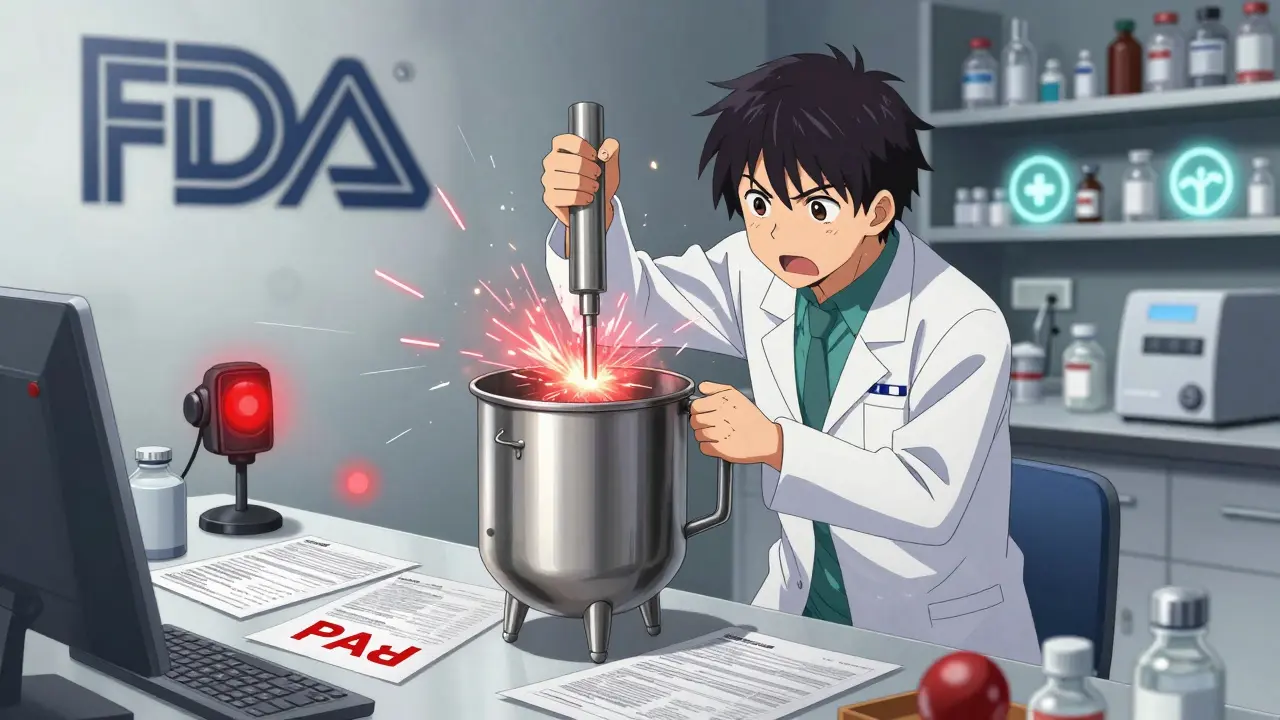
When a pharmaceutical company makes even a small change to how a drug is made - like swapping out a machine, moving a step to a different room, or adjusting a temperature setting - it’s not just an internal decision. It’s a regulatory event. And if you don’t follow the rules, you could face a warning letter, a product recall, or even a shutdown. This isn’t theory. In 2023, the FDA issued four warning letters specifically because companies misclassified equipment changes. One company replaced a lyophilizer without prior approval and got flagged. Another changed a mixing tank and assumed it was "equivalent." It wasn’t. And now they’re under scrutiny.
Why Manufacturing Changes Matter
Every drug you take has a regulatory fingerprint. That fingerprint includes every detail of how it was made: the ingredients, the equipment, the facility, the process steps, even the way workers are trained. When you change any of that, you risk altering the drug’s identity, strength, purity, or effectiveness. That’s why regulators don’t let you just update your internal SOPs and move on. You have to prove the change doesn’t hurt the product.
Think of it this way: if you tweak the recipe for your favorite cookie, you test it. You taste it. You check if it’s still soft in the middle, crisp on the edges. Regulators require the same for drugs - but with lab tests, stability studies, and statistical analysis. And you have to tell them before you start making the new version.
The Three-Tier System (FDA)
The U.S. Food and Drug Administration uses a clear, three-level system for managing manufacturing changes. It’s based on risk. The higher the risk, the more proof you need - and the longer you have to wait before you can ship the product.
- Major changes - These need Prior Approval Supplement (PAS). You can’t make the change until the FDA says yes. Examples: switching the chemical synthesis route for the active ingredient, moving production to a new factory, or changing equipment that affects critical process parameters (CPPs). If your product is a biologic or an advanced therapy, even small equipment swaps often fall here because the product is so sensitive.
- Moderate changes - These use a Changes Being Effected in 30 Days (CBE-30). You submit the paperwork, then wait 30 days before you start making the new version. During that time, the FDA can stop you if they have concerns. Examples: replacing a mixer with the same model from the same manufacturer, updating software that controls a filling machine, or changing a filter supplier if it’s been validated as equivalent.
- Minor changes - These only need an annual report. You document the change and include it in your yearly submission. No waiting. No approval needed. Examples: changing the location of a non-critical labeling step within the same building, updating a printer ribbon, or revising a non-critical training manual.
The key? It’s not about how big the change looks - it’s about how much risk it poses to the drug’s quality. A tiny change in a critical step can be major. A huge change in a non-critical area might be minor.
How Other Regulators Compare
The FDA isn’t the only player. The European Medicines Agency (EMA), Health Canada, and WHO all have their own rules - and they don’t always line up.
EMA uses Type IA, IB, and II:
- Type IA: Very minor. Notify within 12 months. No approval needed.
- Type IB: Moderate. Submit before implementation. Approval required before you start.
- Type II: Major. Full review. Approval required before any change.
Health Canada mirrors the FDA with Level I (PAS), Level II (CBE-30), and Level III (annual report). But here’s the catch: EMA allows some Type IA changes to be made before notifying them. The FDA doesn’t have this "do-and-tell" option. That’s a big difference in practice.
WHO Prequalification requires something called a Comparability Protocol - a full document showing risk analysis, testing results, and stability data. It’s more work, but it’s required if you’re selling to low- and middle-income countries.

What Triggers a Major Change?
Not all equipment swaps are equal. FDA’s 2022 guidance says "equivalent" means:
- Same principle of operation
- Same critical dimensions
- Same material of construction
If you replace a stainless steel mixer with a titanium one? That’s not equivalent. Even if it looks identical. Titanium might interact differently with your drug substance. That’s a PAS.
What about moving a process step from Building A to Building B? If it’s the same equipment, same parameters, same validation? Still a PAS - because facility changes are high risk. You’re moving the product environment. Contamination risk changes. Cleaning validation changes. Airflow changes. Regulators treat this like a new factory.
And don’t assume "same supplier" means "same." A new batch of raw material from the same vendor? If it’s a critical excipient, you might need stability data. If it’s a non-critical one, maybe just an annual report.
Real-World Challenges
Companies struggle with this daily. One senior regulatory affairs specialist on Reddit said classifying a tablet press replacement took 37 hours of meetings. Why? Because the API’s particle size was borderline. Was the new press going to affect it? They ran 12 batches. Tested 15 quality attributes. Consulted the validation team. The quality unit. The manufacturing lead. In the end, it was a CBE-30 - but it cost them days of work.
Small companies get hit hardest. A 2022 PDA survey found only 63% of mid-sized firms had full compliance systems. Large companies like Pfizer use internal risk scoring tools - 15-point checklists that evaluate impact on critical quality attributes, process history, and validation status. They automate parts of it. Smaller firms? They’re using Excel sheets and email chains.
And the learning curve? Regulatory affairs specialists need an average of 18 months of hands-on training to get this right. That’s not a certification course. That’s real-world experience - watching a change get rejected, seeing a warning letter go out, learning what the FDA will and won’t accept.

What You Need to Document
Regardless of the category, you need paper trails. The FDA expects:
- Facility diagrams showing where the change happened
- Process validation reports for the new setup
- Comparative data from at least three consecutive batches made before and after the change
- Risk assessment documentation (FMEA is the industry standard)
- Stability data showing the product still meets specs over time
Missing one? That’s a red flag. In FY2022, 22% of FDA warning letters were tied to poor change documentation. Equipment changes alone made up 37% of those.
What’s Changing in 2025?
Regulators are adapting. The FDA’s 2023 draft guidance pushes for Quality Risk Management - using ICH Q9 principles to make decisions based on data, not just rules. That means if you have strong historical data showing a machine never affected product quality, you might be able to classify a change as minor - even if it’s technically "major" under the old rules.
Continuous manufacturing is also changing the game. If your production line runs 24/7 with sensors monitoring every step, a single equipment swap can affect the whole system. That’s why most continuous manufacturing changes now require PAS - even if they seem small.
And AI? Pilot programs from six big pharma companies in 2022-2023 used real-time data to reduce the need for manual testing. If sensors show no deviation, regulators may accept that as proof - instead of waiting for lab results.
Bottom Line
Manufacturing changes aren’t about innovation. They’re about control. Every change has to be assessed, documented, and approved - or reported - based on its risk to patient safety. There’s no shortcut. No loophole. No "we’ve always done it this way." If you’re in pharma, your job isn’t to make changes. It’s to prove they’re safe. And that means following the rules - not bending them.
What happens if I make a manufacturing change without approval?
You risk regulatory action. The FDA can issue a warning letter, seize your product, or order you to stop distribution. In 2023, four companies received warning letters specifically for unapproved equipment changes. One had to recall over 500,000 units. Fines and delays cost far more than the time it takes to submit the right paperwork.
Can I make a minor change and report it later?
Yes - but only if it truly qualifies as minor. Minor changes (like moving a labeling station within the same building) can be documented in your annual report. But if there’s any doubt, assume it’s moderate or major. Misclassifying a change as minor when it’s actually moderate is one of the most common reasons for FDA citations.
How do I know if equipment is "equivalent"?
FDA says equivalent means: same principle of operation, same critical dimensions, and same material of construction. If you’re replacing a stainless steel mixer with a plastic one, even if it’s the same size, it’s not equivalent. Plastic could leach into your product. Always validate with testing - don’t assume.
Do I need a comparability study for every change?
Not every change - but you need evidence. For moderate and major changes, you must show the product’s quality hasn’t changed. That means comparing at least three batches made before and after the change. Test critical quality attributes like potency, impurity levels, dissolution rate, and particle size. Use statistical analysis. If you can’t prove comparability, the FDA will reject your submission.
Are there tools to help classify changes?
Yes. Many companies use risk assessment tools like FMEA (Failure Modes and Effects Analysis). The Parenteral Drug Association’s Technical Report No. 60 is a widely accepted standard. Some firms have built digital systems that ask 10-15 questions about the change - impact on CQAs, process history, validation status - then auto-classify it. But no tool replaces human judgment. Always consult your quality and regulatory teams.

Write a comment
Your email address will not be published.
Recent Posts
-
 How to Buy Cheap Generic Clomid Online Safely October 12, 2025



11 Comments
Honestly? This is why I hate pharma regs. One tiny swap and suddenly you're in a 3-month audit hell. My team just changed a pump and we had to submit 47 pages of docs. 😩
I appreciate how thorough this is. The FDA’s three-tier system actually makes sense when you break it down by risk. It’s not about bureaucracy - it’s about protecting patients. Small changes can have huge ripple effects.
This is why America’s pharma industry is dying. Europe lets you move faster. Canada’s chill. But here? You need a lawyer just to change a gasket. We’re outcompeting ourselves with red tape.
I love how this post highlights that it’s not about the size of the change - it’s about the risk. That’s such a smart way to think about regulation. It’s not control for control’s sake. It’s about knowing what matters. 💯
People don’t get it. This isn’t "red tape." This is what stops people from dying. I’ve seen what happens when companies cut corners. It’s not pretty. Stop complaining and do the work.
why do we even have to do this? i mean like... if the drug works, who cares? they just wanna make us fill out forms. its not like the medicine changes. lol
I just wanna say 🙌 this post is FIRE. So many people think it’s just "paperwork" but nope - it’s literally life or death. Thank you for explaining it so clearly! 🧪❤️
So let me get this straight… we’re spending $200k on a study to prove a blender doesn’t change a pill’s taste? I’m crying.
I work in a lab in Kenya. Our WHO comparability protocol took 11 months. But knowing our vaccines are safe? Worth every second. This isn’t just American regulation - it’s global safety.
The real issue is no one trains people right. You get a new hire, hand them a 500-page SOP, and say "figure it out." Then they misclassify a change and boom - warning letter. System’s broken.
I’ve been in this field for 12 years and this still hits different. The day I saw a batch get rejected because of a misclassified filter change? That’s when I realized - this isn’t about rules. It’s about trust. We owe it to patients to get it right. 💪