
Pravastatin Side Effect Risk Estimator for Older Adults
How Your Factors Affect Side Effect Risk
Based on the latest clinical research, this tool estimates your personal risk of experiencing common side effects from pravastatin. Your risk score reflects the combined impact of your age, medications, and health conditions.
When you’re over 65 and managing high cholesterol, the goal isn’t just to lower numbers-it’s to stay healthy without new aches, fatigue, or hospital visits. That’s where pravastatin comes in. Unlike other statins, it’s one of the few designed to be gentle on older bodies. It doesn’t pile on drug interactions, doesn’t wreck muscles, and doesn’t confuse the liver. But it’s not perfect. Understanding its side effect profile isn’t optional-it’s the difference between feeling fine and feeling worse.
Why Pravastatin Is Different for Older Adults
Pravastatin is a hydrophilic statin, which means it doesn’t slip easily into muscle cells or the brain. That’s a big deal. Most other statins like simvastatin or atorvastatin are lipophilic-they cross cell membranes like butter on toast. That’s great for lowering cholesterol, but it also means they’re more likely to cause muscle pain, weakness, or even rare but serious muscle damage. In older adults, whose muscles naturally weaken with age, that’s a dangerous combo. The data backs this up. A 2022 meta-analysis in The Lancet tracking over 118,000 patients found that pravastatin caused 28% fewer muscle-related side effects than other statins in people over 75. That’s not a small edge-it’s the reason doctors keep prescribing it to seniors. Even better, it’s cleared mostly by the kidneys (70%), not the liver. That’s huge for older adults who often take five or more medications. A 2022 JAMA Internal Medicine study showed the average elderly patient is on 4.8 prescriptions. Pravastatin plays nice with most of them. Atorvastatin? It interacts with 55 different drugs. Pravastatin? Just 15.What Side Effects Actually Happen
Let’s cut through the noise. The most common side effect of pravastatin in older adults? Nothing. Most people feel no difference at all. But for the ones who do, here’s what shows up:- Muscle aches - Happens in about 5.2% of users, according to a 2020 study of nearly 46,000 elderly patients. That’s less than half the rate of simvastatin (11.7%).
- Upset stomach - Nausea, bloating, or mild diarrhea. Seen in about 8-10% of users, but often fades after a few weeks.
- Headache - Mild and temporary. Reported in under 5% of cases.
- Increased blood sugar - All statins carry a small risk of triggering or worsening type 2 diabetes. Pravastatin has the lowest risk among them-about 12% higher than placebo in elderly patients, compared to 18-22% for others.
- Cognitive changes - Reports of memory fog or confusion are rare with pravastatin. The FDA’s adverse event database shows it’s the least likely statin to cause these issues.
What Doesn’t Happen (And Why That Matters)
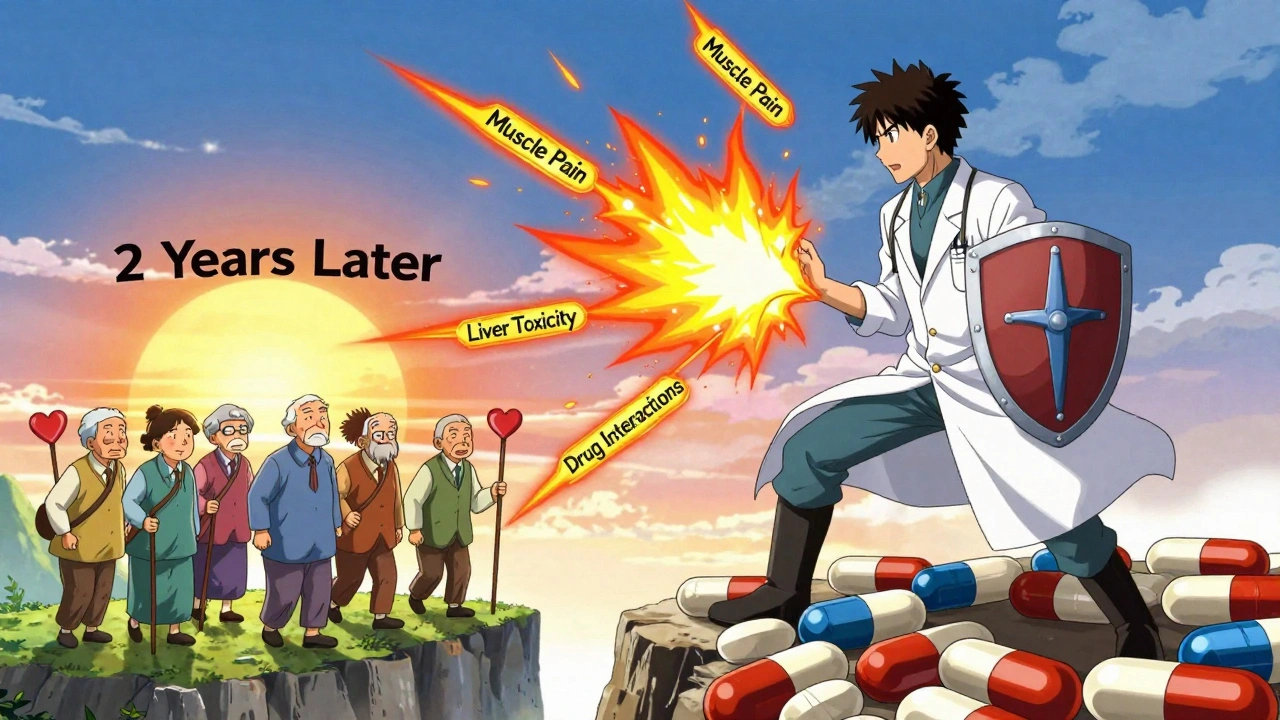
Here’s what you won’t see with pravastatin-and why it’s a game-changer for seniors:- No severe muscle damage (rhabdomyolysis) - Extremely rare. The risk is 1 in 10,000 or lower. For comparison, simvastatin 80mg carries a 1 in 1,000 risk in older adults.
- No major liver damage - Liver enzymes may rise slightly in a few people, but serious injury is almost unheard of with pravastatin.
- No dangerous drug clashes - It doesn’t rely on the CYP3A4 liver enzyme system. That’s the same system that breaks down blood thinners, antidepressants, and even some antibiotics. So if you’re on warfarin, sertraline, or clarithromycin, pravastatin won’t fight with them.
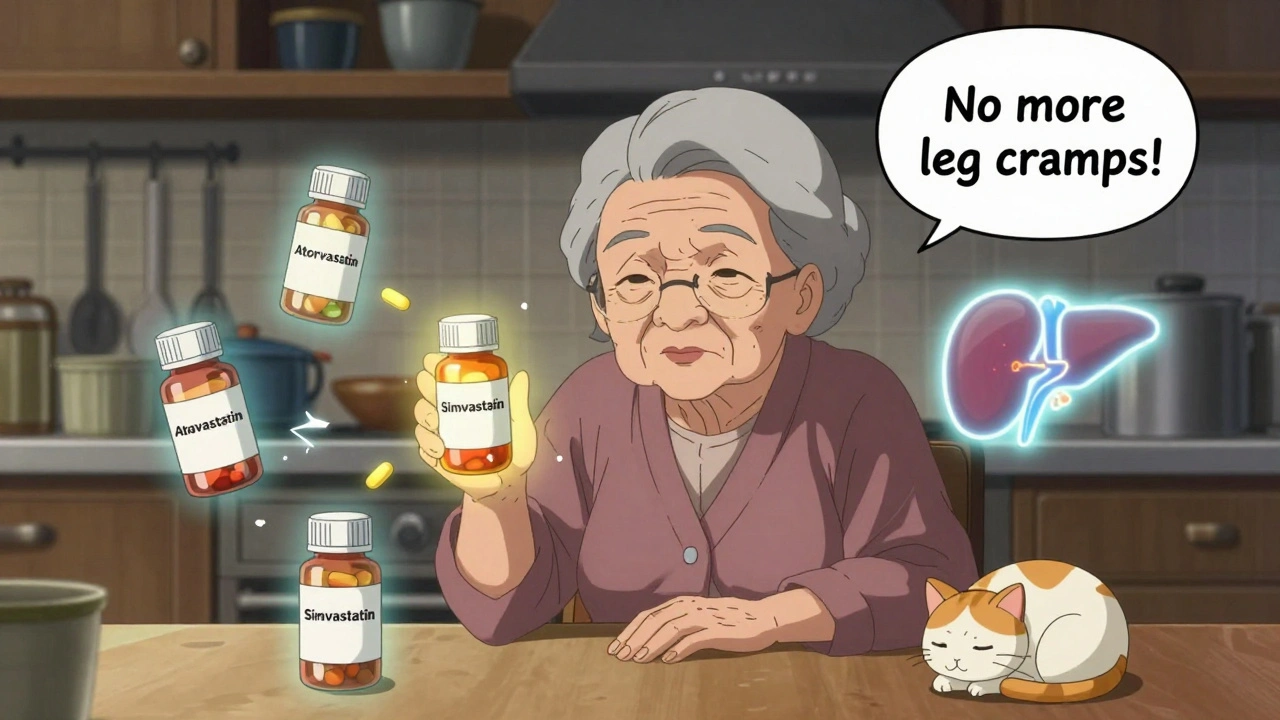
These aren’t theoretical benefits. Real people notice. On Drugs.com, a 72-year-old woman wrote: “Switched from Lipitor to pravastatin. My leg cramps vanished in two weeks. I can walk to the mailbox again.” That’s not an outlier. Sixty-two percent of Reddit users over 65 who’ve tried multiple statins say pravastatin was the first one that didn’t hurt.
The Trade-Off: Lower Potency
Here’s the catch. Pravastatin isn’t strong. A 40mg dose lowers LDL (bad cholesterol) by about 26%. Atorvastatin 20mg? 45%. Rosuvastatin 10mg? 48%. If your LDL is sky-high-say, over 190 mg/dL-pravastatin might not get you to target. That’s why some doctors combine it with ezetimibe, a non-statin pill that blocks cholesterol absorption in the gut. In fact, 37% of elderly patients who switched to pravastatin ended up adding ezetimibe within a year, according to patient surveys on WebMD and Reddit.That’s not a failure. It’s smart management. The goal isn’t to take the strongest drug possible-it’s to take the one that works without breaking you. A 2023 Annals of Internal Medicine study showed that when doctors paired pravastatin with ezetimibe in patients over 75, 89% stayed on the combo for over two years. With high-dose statins alone? Only 58% could stick with it.
How It’s Prescribed-And How to Make It Work
Doctors don’t start seniors on 80mg. They start at 20mg daily, usually at night. Why night? Because your liver makes most cholesterol while you sleep. It’s not mandatory, but it helps. Liver tests are checked at baseline, then again after 12 weeks, and once a year after that. No need for monthly blood draws.Here’s what you need to do:
- Get a full med review - Bring your pill bottle to every appointment. Fibrates (like gemfibrozil) are the only common drug that increases muscle risk with pravastatin. Your pharmacist can flag this.
- Know the difference between aging and statin pain - Sore knees from arthritis? Normal. New, persistent muscle pain in your thighs or shoulders? Tell your doctor. Don’t assume it’s just getting older.
- Don’t stop cold turkey - Even if you feel fine, stopping statins suddenly raises your heart attack risk. Talk to your doctor before quitting.
- Follow up in 6-8 weeks - That’s when side effects, if any, usually show up. If you’re fine, you’re golden.
Many clinics miss this last step. A 2023 study found 28% of elderly patients had no follow-up after starting pravastatin. That’s risky. Side effects are rare-but catching them early saves lives.
What Experts Say
Dr. Harlan Krumholz at Yale calls pravastatin “the statin of choice for patients over 75.” The American Geriatrics Society’s Beers Criteria lists it as a preferred option and warns against simvastatin doses above 20mg in seniors. Even the European Atherosclerosis Society admits pravastatin’s lower potency is a trade-off worth making for safety.Dr. Erin Michos from Johns Hopkins adds a caution: “If you’re at high risk for heart attack or stroke, pravastatin alone might not be enough.” That’s true. But it’s not a reason to avoid it. It’s a reason to combine it wisely-with ezetimibe, or maybe a low-dose PCSK9 inhibitor if cost allows. The goal isn’t to find the perfect drug. It’s to find the safest one that still works.
Real-World Use and Market Trends
Pravastatin isn’t the most prescribed statin for seniors-it’s third behind atorvastatin and rosuvastatin. But its use is rising. Since 2018, prescriptions for pravastatin in patients over 65 have climbed 4.2 percentage points. Why? Because doctors are learning. They’re seeing patients drop other statins because of muscle pain. They’re seeing fewer hospitalizations for rhabdomyolysis. They’re seeing better adherence.And it’s affordable. Generic pravastatin costs $4-$12 a month in the U.S. That’s less than a daily coffee. For older adults on fixed incomes, that matters. No insurance? No problem. Most pharmacies have discount programs.
The future? Fixed-dose combinations of pravastatin and ezetimibe are in Phase II trials. The NIH is funding a major trial (SPRINT-AGE) to see how pravastatin performs in people over 80 with multiple chronic diseases. Results are due in 2024.
Final Take: Is Pravastatin Right for You?
If you’re over 65, especially if you’re on multiple medications, have kidney issues, or have had muscle pain on other statins-pravastatin is your best bet. It’s not the strongest, but it’s the safest. It’s not flashy. It doesn’t make headlines. But it keeps people walking, working, and living.It’s not a magic pill. You might need to add ezetimibe. You might need to adjust your dose. But you won’t need to quit because your legs hurt. And that’s worth more than any LDL number.
Is pravastatin safe for people over 80?
Yes. Pravastatin is one of the safest statins for people over 80 because it’s cleared by the kidneys, not the liver, and has very few drug interactions. The American Geriatrics Society and NIH both recommend it for this age group. Dosing is typically 20-40mg daily, adjusted for kidney function. Studies show it reduces heart attacks without increasing muscle damage or cognitive issues in this population.
Can pravastatin cause memory loss or dementia?
No strong evidence links pravastatin to memory loss or dementia. In fact, among all statins, pravastatin has the lowest risk of cognitive side effects, according to FDA adverse event data. Some patients report mild confusion early on, but this usually resolves within weeks. Large studies, including the PROSPER trial, found no increased dementia risk with pravastatin in older adults.
Why do some people say pravastatin doesn’t lower cholesterol enough?
Pravastatin is a moderate-intensity statin. A 40mg dose lowers LDL by about 26%, while stronger statins like atorvastatin or rosuvastatin can lower it by 45% or more. If your cholesterol is very high or you have a history of heart disease, pravastatin alone may not get you to your target. That’s why doctors often add ezetimibe or other non-statin drugs. It’s not a failure-it’s smart combination therapy.
How do I know if my muscle pain is from pravastatin or just aging?
Statin-related muscle pain is usually symmetrical-both legs or both arms-and feels like deep aches or weakness, not joint pain. It often starts within the first few weeks. Aging-related pain is usually localized (knees, hips), worse with movement, and doesn’t cause weakness. If you’re unsure, ask your doctor for a creatine kinase (CK) blood test. A normal CK level means it’s probably not the statin.
Can I take pravastatin with grapefruit juice?
Yes. Unlike atorvastatin, simvastatin, or lovastatin, pravastatin does not interact with grapefruit juice. It’s one of the few statins you can safely take with your morning glass of juice. This makes it easier to stick with long-term.
How long does it take for pravastatin to work?
Cholesterol levels usually drop within 2-4 weeks, but it can take up to 6 weeks to reach full effect. Muscle-related side effects, if they occur, typically appear within the first 4-8 weeks. That’s why follow-up appointments are scheduled around that time.
Is pravastatin better than rosuvastatin for older adults?
It depends. Rosuvastatin is stronger and lowers LDL more, but it’s metabolized by the liver and has more drug interactions. Pravastatin is weaker but much safer in seniors on multiple meds or with kidney issues. If you’re healthy with no other conditions, rosuvastatin might be better. If you’re over 75, on 5+ drugs, or have reduced kidney function-pravastatin wins on safety.

Write a comment
Your email address will not be published.
Recent Posts
-
 How to Use Technology to Track Medication Expiration Dates March 11, 2026




14 Comments
Pravastatin? Meh. I’ve seen worse. Just don’t take it with grapefruit and you’ll be fine.
so i heard statins make you dumber like for real? like i cant remember my wife’s birthday now? is that pravastatin or just getting old??
THEY KNOW. THEY KNOW WHAT THEY’RE DOING. THEY’RE HIDING THE TRUTH ABOUT STATINS AND THE PHARMA INDUSTRY IS LYING TO US AGAIN-AND NOW THEY’RE PUSHING PRAVASTATIN LIKE IT’S A MAGIC PILL?!?!?!?!?!?!?!?!
While pravastatin’s hydrophilic nature does indeed reduce myocyte penetration, thereby attenuating myotoxicity-a phenomenon well-documented in the 2022 Lancet meta-analysis-it’s worth interrogating whether this safety profile is merely a function of pharmacokinetic mediocrity. Is gentleness synonymous with efficacy? Or are we romanticizing suboptimal outcomes under the guise of ‘safety’? 🤔
Interesting breakdown. One thing I’d add: pravastatin’s renal clearance is a huge advantage in polypharmacy patients, especially those on ACE inhibitors or diuretics. The CYP3A4 avoidance is a silent win-most docs don’t even think to check for that. Also, the ezetimibe combo data is solid. 89% adherence over two years? That’s the real metric-not just LDL numbers.
Been on pravastatin 40mg for 3 years. No muscle pain, no brain fog. My CK was normal at every check. I used to be scared of statins after my neighbor had rhabdo on simvastatin. This one? It just works. I don’t feel like a lab rat. I feel like I’m still me. That’s worth more than any study.
I just want to say how much I appreciate how thorough this post is. So many people are scared of statins because they hear horror stories, but this actually gives you the tools to make an informed choice. If you’re over 65 and worried about side effects, please talk to your pharmacist. They’re not just the person who hands you the pills-they’re your secret weapon. And if you’re feeling unsure? Give pravastatin a real shot for at least 8 weeks before deciding. Your body might just thank you.
life’s not about the strongest drug… it’s about the one that lets you walk to the mailbox without crying. 🌱 pravastatin? yeah. i’ll take that. my legs are happier than my bank account.
why are you all so obsessed with cholesterol? eat less sugar. walk more. stop drinking soda. problem solved. statins are just a bandaid for lazy people.
And yet… you all ignore the elephant in the room: the FDA’s own data shows that statins increase diabetes risk by 9–12% in seniors… and pravastatin is no exception. We’re trading one chronic disease for another-and calling it ‘safe’? What a joke. The system is rigged to keep you medicated, not healthy.
bruh i took this for 2 weeks and felt like a zombie… my dog noticed i was less fun… now i just eat avocados and call it a day 😩
While the data presented is methodologically sound and statistically robust, the underlying assumption-that safety supersedes efficacy in geriatric pharmacotherapy-requires critical reevaluation. The reduction in rhabdomyolysis incidence, while commendable, must be contextualized against the increased prevalence of cardiovascular mortality in cohorts not achieving LDL targets below 70 mg/dL. One must ask: are we preserving mobility at the cost of longevity?
Let’s be brutally honest: pravastatin is the statin of last resort for patients who can’t tolerate anything else. The fact that 37% add ezetimibe within a year proves it’s insufficient alone. This post is just corporate PR dressed in academic clothing. Real doctors don’t start with pravastatin-they start with the strongest drug that won’t kill them, then back off if needed. This ‘gentle’ narrative is dangerous complacency.
So we’re telling old people to take a cheap drug made in India because it’s ‘safer’? Meanwhile, Americans pay $200 for Lipitor and get real results. This is why our healthcare system is broken. We’re rewarding mediocrity because it’s cheap. Sad.