
Imagine spending years developing a new medication, only to have it rejected because the pills turned into dust after six months in a warehouse. This is exactly why stability testing is a mandatory regulatory process that proves how drug quality changes over time under specific environmental conditions. It’s not just about keeping drugs safe; it’s about proving they stay effective until the patient takes them. If you are navigating the complex world of pharmaceutical development, understanding the precise temperature and time requirements set by global regulators is your first step toward approval.
The Core Framework: ICH Q1A(R2)
When we talk about stability standards, everyone points to the same rulebook: ICH Q1A(R2) is the international guideline for stability testing of new drug substances and products, established by the International Council for Harmonisation. Originally published in 1994 and revised in 2003, this document remains the gold standard used by the FDA in the United States, the EMA in Europe, and Health Canada. The goal is simple but strict: determine the shelf life, storage conditions, and retest periods for both active pharmaceutical ingredients (APIs) and finished pharmaceutical products (FPPs).
Why does this matter so much? Because regulators need evidence that your product won’t degrade into something harmful or ineffective before it expires. Failure to comply isn’t just a paperwork issue. In 2022 alone, the FDA issued 27 warning letters specifically citing stability testing deficiencies. For many companies, ignoring these protocols means product recalls or even having their marketing authorization withdrawn.
Standard Temperature and Humidity Conditions
The heart of stability testing lies in specific combinations of temperature and relative humidity (RH). These aren't arbitrary numbers; they are designed to simulate real-world storage and shipping scenarios across different climates. Here is what you need to know about the three main types of testing conditions:
- Long-Term Storage: This simulates normal storage conditions. You must choose one of two options based on your target market's climate: either 25°C ± 2°C / 60% RH ± 5% RH or 30°C ± 2°C / 65% RH ± 5% RH. The data collection period typically spans 12 to 36 months.
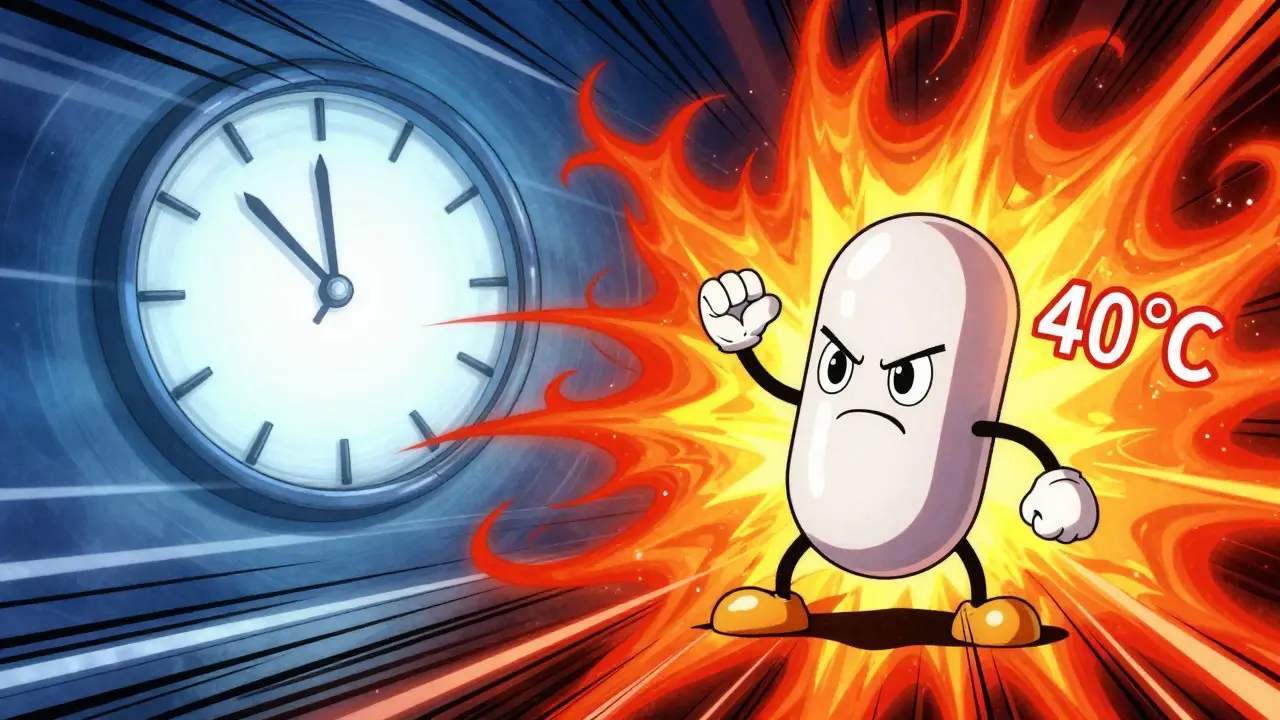
- Accelerated Testing: Designed to force degradation to happen faster, allowing you to predict shelf life without waiting years. The standard condition is 40°C ± 2°C / 75% RH ± 5% RH for 6 months. Dr. John B. Sullivan, former FDA Division Director, noted that this extreme heat was chosen to represent severe shipping excursions while staying below the melting point of most excipients.
- Intermediate Testing: Conducted at 30°C ± 2°C / 65% RH ± 5% RH for 6 months. This is only required if significant change occurs during accelerated testing and your long-term study is set at 25°C.
If you are dealing with refrigerated products, the rules shift. Long-term storage drops to 5°C ± 3°C for 12 months, while accelerated testing moves to 25°C ± 2°C / 60% RH ± 5% RH. These distinctions are critical because cooling systems behave differently than ambient storage units.
Time Parameters and Data Submission
How long do you have to wait before you can submit your application? This depends heavily on where you plan to sell the drug. The FDA mandates 12 months of long-term stability data at the time of submission. However, the European Medicines Agency (EMA) offers more flexibility, allowing either 6 months or 12 months depending on the submission option selected. This difference can create delays for companies trying to launch simultaneously in both regions.
Testing schedules usually follow a pattern of 0, 3, 6, 9, 12, 18, 24, and 36 months. Early intervals are tighter because degradation often happens quickly right after manufacturing. According to industry surveys, 67% of pharmaceutical projects experience delays due to stability issues, often stemming from insufficient early data coverage. To avoid this, ensure your chambers maintain temperature within ±0.5°C and humidity within ±2% RH, as per ISO 14644-1 standards. Even small deviations can invalidate months of work.
Climatic Zones and Global Markets
Not all parts of the world share the same weather patterns, which is why the ICH guidelines define five climatic zones. Your choice of long-term storage condition depends directly on these zones:
| Zone | Climate Type | Temperature | Relative Humidity |
|---|---|---|---|
| Zone I | Temperate | 21°C | 45% RH |
| Zone II | Mediterranean/Subtropical | 25°C | 60% RH |
| Zone III | Hot-Dry | 30°C | 35% RH |
| Zone IVa | Hot-Humid/Tropical | 30°C | 65% RH |
| Zone IVb | Hot/Higher Humidity | 30°C | 75% RH |
Targeting Zone IV markets (like Southeast Asia or Africa) adds complexity. Companies often need separate stability protocols, which can add 4 to 6 months to development timelines. A notable success story involves Merck, which used intermediate condition testing at 30°C/65% RH to identify a hidden polymorphic transition in Keytruda®. This discovery prevented potential bioavailability issues in tropical markets, saving the company from a costly post-launch failure.

Challenges with Modern Therapies
While the ICH framework works well for traditional small-molecule drugs, it struggles with modern biologics. Complex formulations like monoclonal antibodies or mRNA vaccines using lipid nanoparticles face unique challenges. Dr. Lisa M. McLeod, a stability specialist, argues that the current guidelines fail to address freeze-thaw cycles, which cause irreversible degradation not captured by standard constant-condition tests.
In fact, the FDA issued warning letters to major players like Amgen and Roche between 2021 and 2022 regarding stability failures of monoclonal antibody products. These cases highlight a growing gap in the regulatory landscape. As we move toward advanced therapy medicinal products (ATMPs), the industry is pushing for updated guidelines. The ICH Working Group is currently revising Q1A(R2) with a proposed update expected to address antibody-drug conjugates (ADCs) and cell therapies.
Practical Implementation Tips
Setting up a stability program requires more than just buying expensive equipment. You need rigorous chamber qualification following ASTM E1993-19 standards, which typically takes three weeks per chamber. Common pitfalls include temperature mapping errors-large chambers can have variations up to ±1.8°C across different shelves-and humidity control issues in dry climates.
To mitigate these risks, consider implementing dual-loop environmental control systems, which reduce humidity variability significantly. Also, keep detailed documentation. An average stability dossier contains 450 to 600 pages, including raw data archives and annual reports. With outsourcing rates rising to 65% among smaller biotechs, partnering with experienced CROs like WuXi AppTec or Charles River Laboratories can help manage this burden. However, always verify their compliance records, as inconsistent interpretation of 'significant change' thresholds remains a common battleground with regulators.
What is the primary purpose of stability testing?
The primary purpose is to establish the shelf life, storage conditions, and retest periods for drug substances and products. It ensures that the medication remains safe, effective, and of high quality throughout its intended use period by providing evidence of how environmental factors like temperature and humidity affect its integrity over time.
How long does accelerated stability testing take?
Accelerated stability testing typically runs for 6 months. It is conducted at higher temperatures and humidity levels (usually 40°C ± 2°C / 75% RH ± 5% RH) to induce degradation faster than normal storage conditions, allowing manufacturers to predict long-term stability without waiting years for results.
What is the difference between FDA and EMA submission requirements?
The FDA generally requires 12 months of long-term stability data at the time of submission. In contrast, the EMA allows applicants to submit either 6 months or 12 months of data, depending on the specific submission option chosen. This flexibility can speed up approvals in Europe but may complicate simultaneous global launches.
Why are intermediate conditions necessary?
Intermediate conditions (30°C ± 2°C / 65% RH ± 5% RH) are required when significant chemical or physical changes occur during accelerated testing, provided the long-term study is conducted at 25°C. This extra layer of testing helps regulators understand the product's behavior under moderate stress, bridging the gap between normal and accelerated environments.
Do biologics require different stability testing?
Yes, biologics and complex formulations like mRNA vaccines often require additional considerations beyond standard ICH Q1A(R2) protocols. They are more sensitive to factors like freeze-thaw cycles and light exposure, which can cause irreversible degradation. Regulatory agencies are currently updating guidelines to better address these unique challenges.

Recent Posts
-
 How and Where to Buy Lisinopril Online Safely in 2026 July 18, 2026
 -
 How and Where to Buy Bupropion SR Online: A 2026 Guide August 4, 2026
 -
 How to Recognize Unsafe Medication Advice on Social Media December 10, 2025