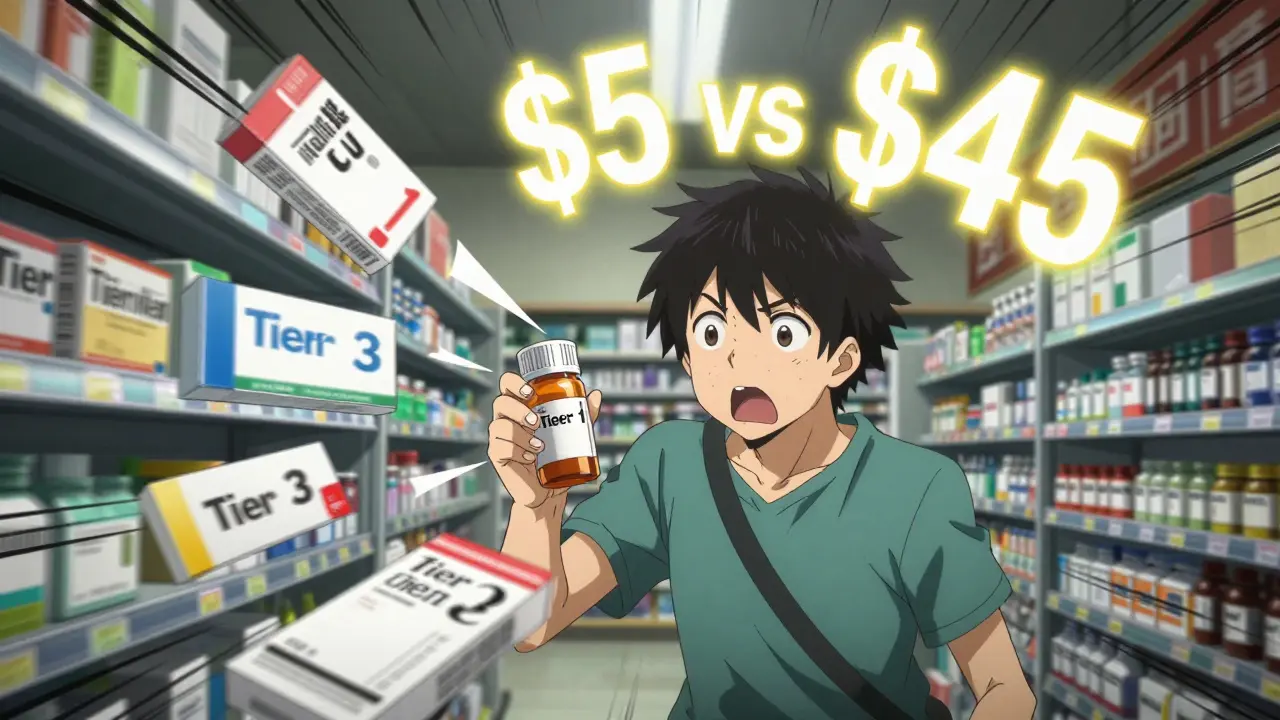
When you’re switching health plans, the biggest mistake most people make is focusing only on monthly premiums. You think you’re saving money - until you get your first prescription bill. That’s when you realize your new plan charges $45 for a generic medication you used to pay $5 for. It’s not a glitch. It’s the formulary.
What Is a Formulary, and Why Does It Matter?
A formulary is just a list of drugs your insurance covers. But it’s not a simple list. It’s broken into tiers, and each tier has a different price. Tier 1? That’s where you’ll find the cheapest generic drugs. Tier 2? Slightly more expensive. Tier 3 and 4? Often brand names or specialty generics. And if your drug isn’t on the list at all? You pay full price.Here’s the reality: 84% of all prescriptions filled in the U.S. are generics, but they only make up 14% of total drug spending. Why? Because they’re cheap - if your plan covers them right. The problem isn’t the drug. It’s how your plan treats it.
Tiered Coverage Isn’t the Same Everywhere
Not all plans are built the same. A Silver Standardized Plan (SPD) on Healthcare.gov, for example, waives your deductible for Tier 1 generics. That means if you take a monthly medication like metformin or lisinopril, you pay a flat $3 to $20 - no matter how much you’ve spent on other medical bills. But a non-standardized plan? You might have to hit a $2,000 deductible before that same $3 generic kicks in.Medicare Part D plans vary too. Some charge $0 for preferred generics. Others charge $10. And if you’re on a Medicare Advantage plan with drug coverage, you’re often better off than if you’re on a standalone Part D plan - but only if your specific drug is in the preferred tier.
State rules add another layer. In New York, many plans cover generics with $0 copay before you even meet your deductible. In California? You pay $85 out-of-pocket first, then 20% coinsurance. That’s $150 for a $750 prescription. In Washington? You might pay $10 flat. It’s a lottery - and you’re the one playing.
Your Medication Might Not Be What You Think
Here’s where most people get burned. You take “metformin.” But there are dozens of versions. Metformin ER made by Manufacturer A? Covered. Metformin ER made by Manufacturer B? Not covered - or bumped to Tier 2 with a $40 copay.That’s not a mistake. That’s standard practice. Insurers negotiate with manufacturers. If Manufacturer A gives a better discount, the plan favors them. If you switch plans, your drug might suddenly be “non-preferred” - even though it’s chemically identical.
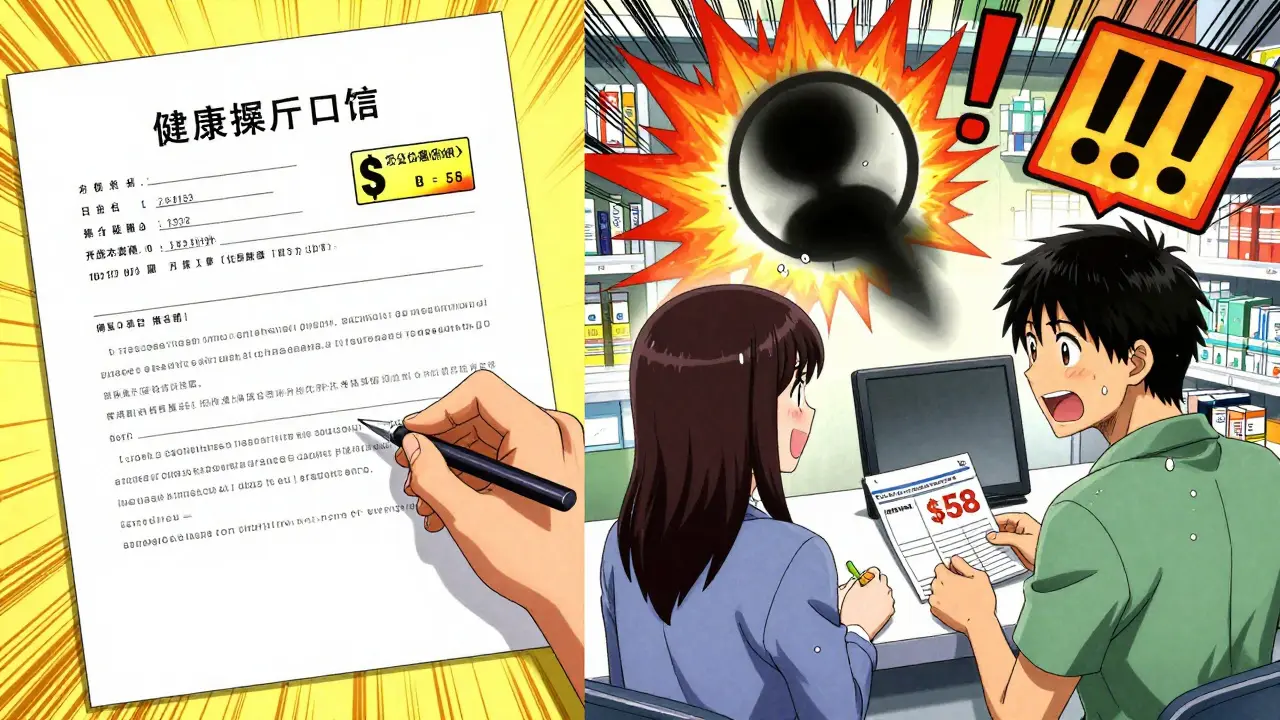
One user on Reddit reported switching plans and suddenly paying $58 instead of $5 for her levothyroxine. Same active ingredient. Same dosage. Different manufacturer. Her new plan didn’t cover the new version. She had no idea until the pharmacy told her at the counter.
Pharmacy Networks Can Double Your Cost
Even if your drug is on the formulary, where you fill it matters. Your plan might cover your generic at $5 - but only if you use a preferred pharmacy. If you go to a non-preferred pharmacy? That $5 becomes $20. Or $30. Or $50.OptumRx data shows some consumers pay 300%-400% more at out-of-network pharmacies for the same generic. That’s not a typo. That’s how pharmacy networks work. And most people don’t check.
How to Check Your Coverage Before You Switch
Don’t guess. Don’t assume. Do this:- Get your current prescription list. Include exact names, strengths, and how often you take them.
- Find the new plan’s full formulary. Not the summary. The full list. Look for each drug by name and manufacturer.
- Check if your pharmacy is in-network. Use the insurer’s tool - don’t trust the pharmacy’s website.
- Use a cost calculator. Medicare.gov’s Plan Finder or Healthcare.gov’s tool lets you plug in your drugs and see real estimates.
CMS data shows people who do all four steps reduce unexpected drug costs by 73%. That’s not a small number. That’s hundreds - sometimes thousands - saved per year.

What’s Changing in 2025 and Beyond
The rules are shifting. The Inflation Reduction Act capped insulin at $35/month starting in 2023. By 2025, Medicare Part D will cap total out-of-pocket drug spending at $2,000. That’s huge. But it doesn’t help if your generic isn’t on the formulary.Also, new plan designs are coming. In 2024, 32 states now offer Silver SPD plans with $10 generic copays before the deductible. More states are expected to follow. Meanwhile, Medicare is splitting generics into two tiers: “preferred” and “non-preferred.” That means even if your drug is generic, it might cost more.
And here’s the kicker: AI tools like the CMS-endorsed “Medicare Plan Scout” are now helping people compare formularies with 44% fewer errors. These tools are free. Use them.
The Bottom Line
Switching health plans isn’t about the premium. It’s about the copay. If you take even one generic medication every month, you’re paying hundreds - maybe thousands - more if you don’t check the formulary. The cheapest plan isn’t always the best. The plan that covers your drugs at the lowest cost? That’s the one that saves you money.Don’t wait until the pharmacy tells you your drug costs $60. Check before you switch. Know your tier. Know your pharmacy. Know your manufacturer. That’s how you win.

Write a comment
Your email address will not be published.
Recent Posts
-
 Annual Savings from FDA Generic Drug Approvals: Year-by-Year Breakdown December 24, 2025
 -
 Benzodiazepines: Memory Loss, Fall Risks, and Safe Tapering Strategies November 14, 2025
 -
 STIs and Public Health Policy: How They Intersect September 28, 2025


14 Comments
I’ve been on the same plan for 8 years. Never checked the formulary. Last month, my metformin went from $3 to $42. Turns out they switched manufacturers and my version got bumped to Tier 3. I didn’t even know that was a thing. Now I’m paranoid every time I refill.
This is such an important post. I used to think premiums were the only thing that mattered until my mom got hit with a $180 bill for a $12 generic. She’s on Medicare and didn’t even know her plan had a preferred/non-preferred split. Took me three calls to her pharmacy and two hours on Medicare.gov to fix it. Please, everyone-check before you switch.
The system is rigged. 💯
As someone from Australia, I find this both fascinating and terrifying. Here, generics are almost always covered at the same rate regardless of brand. We have a PBS list, and if it’s on there, you pay $30. No tiers. No pharmacy networks. No manufacturer drama. I’m starting to wonder if we’re doing it right.
This is the most insane thing I’ve ever seen. You’re telling me that two pills that are CHEMICALLY IDENTICAL can cost 10x more JUST BECAUSE THE MANUFACTURER DIDN’T PAY OFF THE INSURANCE COMPANY?? This isn’t healthcare. This is a casino run by lawyers and corporate lobbyists. I’m not even mad. I’m just disappointed in humanity.
so u saying that if i take a drug that cost 5$ and now its 50$ its becuase the company that makes it didnt give a kickback? lmao. i dont trust any of this. theyre all in on it. pharma, ins, gov. all of em. just wait till they start charging for oxygen.
I paid $85 for my thyroid med last month. The pharmacy said ‘it’s not covered.’ I called my insurer. They said ‘we cover it, but only if you use OptumRx.’ I’ve been using CVS for 3 years. Turns out they’re out-of-network for my plan. No one told me. No one. 😤
i had the same thing happen with my blood pressure med. i switched plans and suddenly it was $35 instead of $5. i didnt even know they had different versions of the same drug. now i just buy it on amazon. cheaper than insurance. lol
I just want to say thank you for writing this. My sister just switched plans and didn’t check anything. She’s now paying $90/month for a drug that used to be $8. She’s crying because she’s skipping doses to make it last. This needs to be common knowledge.
Oh please. You think this is bad? Try living in a state where they don’t even cover generics until you’ve paid $7,000 in deductible. I’ve been on lisinopril for 12 years. Last year I paid $1,200 out of pocket for a $4 pill. And now they want us to believe this is ‘affordable care’? Wake up.
I work in pharmacy benefits management. Let me tell you what no one says: the real issue isn’t the tier system. It’s the lack of transparency. Insurers don’t publish formularies in plain language. They bury them in PDFs with 500 pages of footnotes. And if you ask for a printable version? They say ‘it’s dynamic.’ Meaning: it changes daily. You’re not supposed to understand it. That’s the whole point.
I’m from the UK and we’ve got the NHS. Generics? £1.00. Always. No tiers. No pharmacy networks. No manufacturer politics. It’s not perfect, but at least you don’t need a PhD in insurance jargon just to get your blood pressure pills. I don’t miss the US system. Not one bit.
The deeper issue here is that we’ve turned healthcare into a market transaction rather than a public good. The formulary is just a symptom. The root is the profit motive embedded in every layer of the system. If a drug can be priced at $45 instead of $5 because the manufacturer didn’t negotiate well enough, then the system is fundamentally broken. We need structural reform, not just better checklists.
I am a registered nurse with 18 years of clinical experience. I have seen patients ration insulin, skip antibiotics, and stop their cardiac meds because they couldn’t afford the copay-even though it was a $3 generic. This is not a ‘system flaw.’ This is systemic neglect. The fact that we have to tell people to ‘check their formulary’ instead of guaranteeing access to essential medications is a moral failure. Please, if you can, advocate for policy change. This shouldn’t be on the individual to fix.