
For decades, Africa relied on pills shipped from India and Europe to treat HIV. But in May 2025, something changed. For the first time ever, the Global Fund an international financing organization that supports programs to fight AIDS, tuberculosis, and malaria bought an HIV medicine made entirely in Africa. The drug, called TLD a fixed-dose combination of tenofovir, lamivudine, and dolutegravir, now the global standard for first-line HIV treatment, was produced by Universal Corporation Ltd a Kenyan pharmaceutical company that became the first African manufacturer to receive WHO prequalification for TLD in 2023 and delivered to Mozambique. This isn’t just a symbolic win-it’s the start of a real shift in how Africa gets its life-saving drugs.
Why Local Production Matters More Than Ever
Africa carries 65% of the world’s HIV cases, but for years, it imported nearly 80% of its medicines. That meant long delays when global supply chains broke down-like during the pandemic. A shipment stuck in a port, a factory shutdown in India, or a price hike from a foreign supplier could leave clinics without pills. People stopped treatment. Viral loads spiked. Resistance grew. The system was fragile because it was built on dependence, not resilience.
Now, local manufacturing changes the game. When a country makes its own medicines, it controls the timeline. It can respond faster to outbreaks. It can adjust production if new strains emerge. And crucially, it keeps money circulating within the continent instead of sending it overseas.
The TLD regimen is the backbone of modern HIV treatment. It’s simpler, safer, and more effective than older combinations. It has a high barrier to drug resistance, meaning fewer people develop treatment failure. And because it’s now being made in Africa, the cost per patient per year is dropping further-below $50 in some cases. That’s less than half the price of imported versions just five years ago.
The WHO Prequalification Difference
Not every pill made in Africa can be used by global health programs. To be eligible for procurement by the Global Fund or WHO the World Health Organization, which sets international health standards, a drug must pass something called WHO prequalification. It’s not just a stamp of approval-it’s a full audit of the factory, the testing labs, the quality control, and even the storage systems.
Universal Corporation spent over two years preparing. They upgraded their equipment, trained staff, and submitted thousands of documents. When they passed in 2023, it sent a signal: African manufacturers can meet global standards. That opened the door for the Global Fund to buy TLD from them in 2025. This wasn’t charity. It was a market signal. Buyers were saying: “We’ll pay for quality made here.”
Before this, only Indian manufacturers had the scale and track record to supply African countries at low cost. Now, African companies are proving they can too. And that’s changing the entire supply chain.
From Pills to Injections: The Next Wave
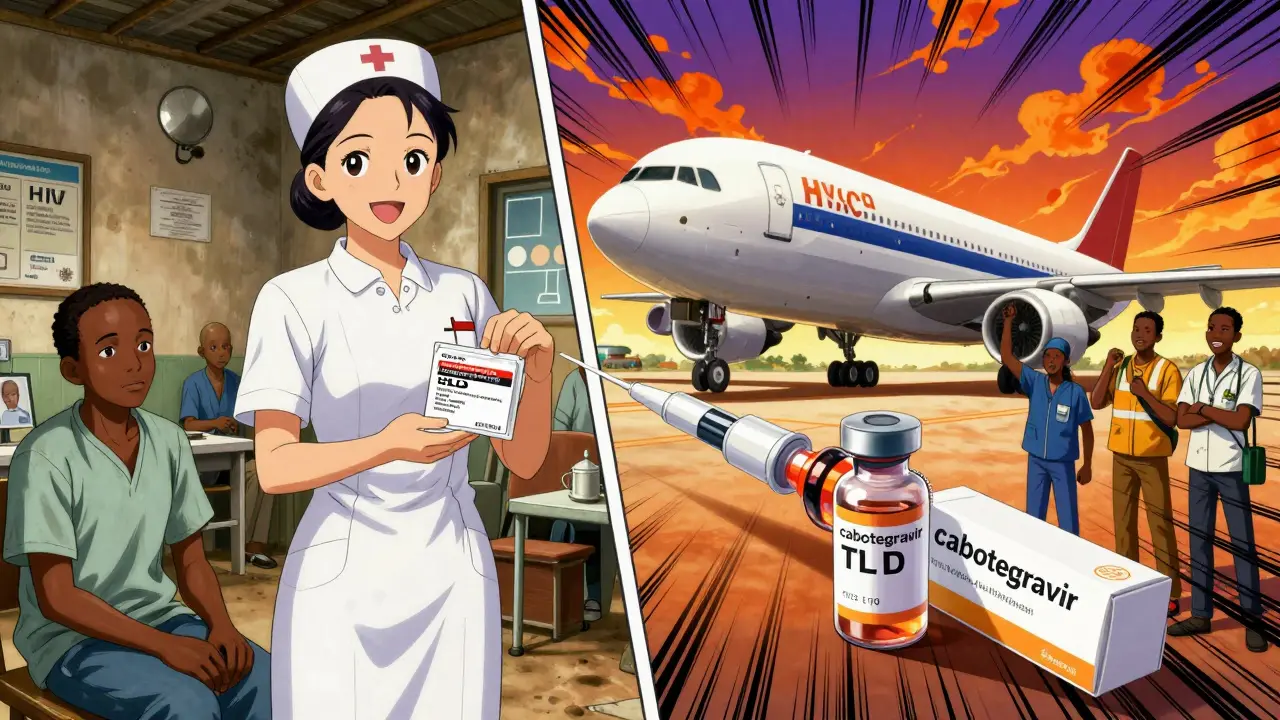
HIV treatment is no longer just about daily pills. In October 2025, South Africa became the first African country to register a long-acting injectable treatment: cabotegravir long-acting (CAB LA) a twice-yearly injection that replaces daily pills for people living with HIV. This is huge. For many, taking a pill every day is hard-due to stigma, work schedules, or lack of privacy. An injection every six months? That’s a game-changer.
Gilead Sciences, the original maker of CAB LA, has already licensed six African manufacturers to produce generic versions. Experts predict prices could drop by 80-90% once generics hit the market. That means this advanced treatment could be available across Africa within two years-not just in wealthy cities, but in rural clinics too.
And it’s not stopping there. Lenacapavir a next-generation antiretroviral used for both treatment and prevention (PrEP) is also entering the scene. Gilead has agreed to supply it at no profit to low-income countries until generics are ready. By the end of 2025, they plan to submit regulatory applications in 18 African countries that together account for 70% of the continent’s HIV burden. This isn’t just about treatment-it’s about prevention, too.
Building the Whole System, Not Just the Pills
Manufacturing pills is only one piece. You also need diagnostics, supply chains, trained health workers, and strong health systems. That’s why companies like Codix Bio a Nigerian diagnostics firm that now manufactures HIV rapid tests under WHO technology transfer are just as important.
Before, many clinics had to send blood samples to distant labs for HIV testing. Results took weeks. People never came back. Now, with locally made rapid tests, a nurse can give a result in 20 minutes. That’s how you find people who don’t know they’re infected. That’s how you get them on treatment fast.
WHO’s Health Technology Access Programme, along with the Medicines Patent Pool an organization that negotiates voluntary licensing agreements to expand access to medicines, has been key in transferring this technology. It’s not about giving away patents-it’s about sharing knowledge so African companies can build their own capacity.
Progress, But Not Enough
By 2025, Africa needed about 15 million person-years of first-line ARV treatment annually. But African manufacturers were only producing enough for 1.2 million people. That’s less than 8% of the need. The gap is still huge.
That’s why the African Union’s Pharmaceutical Manufacturing Plan for Africa (PMPA) a continent-wide strategy to increase local pharmaceutical production from 2-3% to 40% by 2040 exists. It’s ambitious. But it’s necessary. Right now, only a handful of countries-Kenya, South Africa, Nigeria, Rwanda, and Ethiopia-are leading the way. Others lag due to weak regulation, lack of investment, or unstable policies.
And it’s not just about making pills. It’s about African leadership. For too long, HIV research and treatment protocols were designed in labs in the U.S. or Europe. Now, African scientists are pushing for “Africanizing research”-so treatments are tested on African populations, with African strains, and tailored to African lifestyles. That’s how you get real results.
What’s Next? The Road to 2030
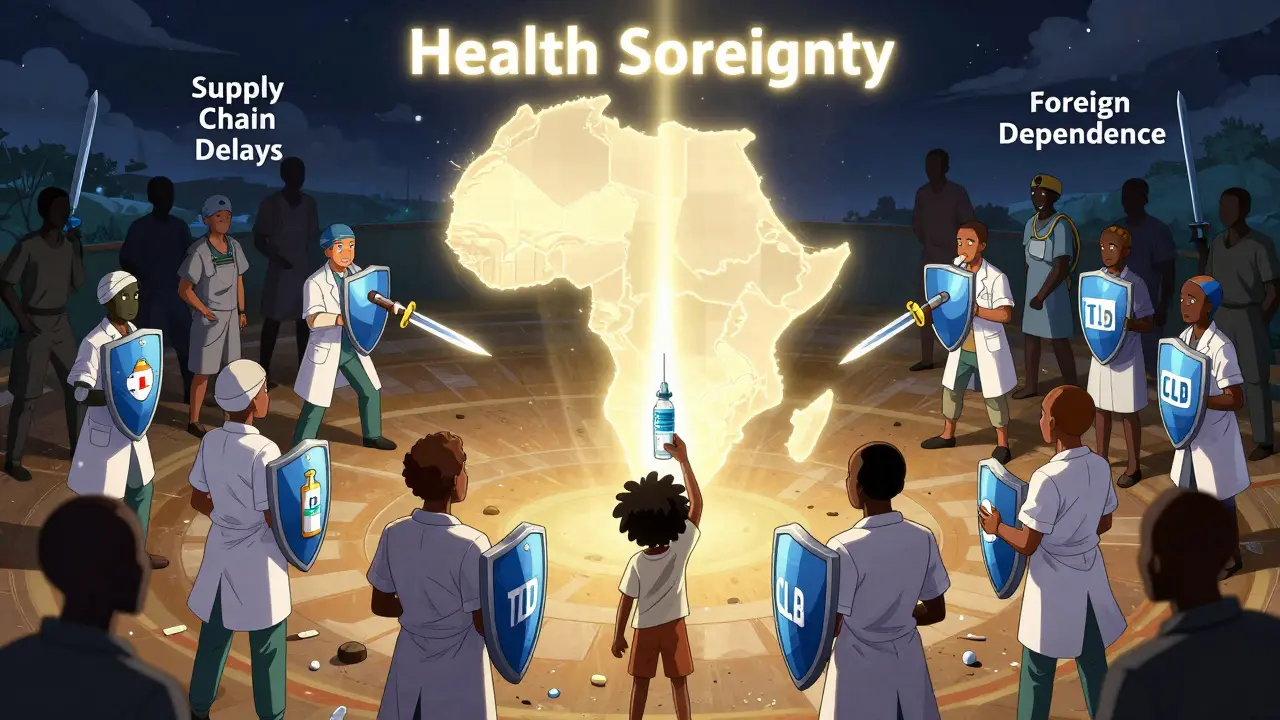
By 2030, experts predict African-made ARVs could supply 20-30% of the continent’s needs. That’s still not enough to replace imports entirely-but it’s enough to break the cycle of dependency. It’s enough to make supply chains more resilient. It’s enough to save lives when the next crisis hits.
Three things will decide if this happens:
- Continued funding-from the Global Fund, Unitaid, Gates Foundation, and African governments themselves.
- Regulatory harmonization-countries need to agree on one set of quality standards so one approved drug can be sold everywhere.
- Market predictability-manufacturers need to know they’ll get orders year after year. That’s why the Global Fund’s procurement model is so smart: it creates guaranteed demand.
South Africa’s record-fast approval of CAB LA shows what’s possible when regulators work fast. Nigeria’s Codix Bio shows how diagnostics can leap ahead. Kenya’s Universal Corporation proves manufacturing can scale. This isn’t a dream-it’s happening, one pill, one test, one injection at a time.
Real Impact, One Country at a Time
In Mozambique, the first shipment of African-made TLD reached 120 clinics. Over 72,000 people started treatment within six months. That’s 72,000 people who didn’t have to wait. 72,000 people who didn’t have to risk a shipment being delayed. 72,000 lives that now have more stability.
Dr. Ussene Hilário Isse, Mozambique’s Minister of Health, put it plainly: “Africa’s growing capacity to locally produce lifesaving medications marks a strategic shift.” It’s not just about HIV. It’s about health sovereignty. It’s about dignity. It’s about saying: “We can do this ourselves.”
Are African-made HIV drugs as safe as imported ones?
Yes. All African-made antiretroviral generics must pass WHO prequalification, which requires the same quality, safety, and efficacy standards as drugs made in the U.S., EU, or India. Universal Corporation’s TLD, for example, underwent rigorous testing in multiple countries before being approved. The Global Fund only purchases drugs that meet these benchmarks. There is no difference in effectiveness between a WHO-prequalified African-made drug and an imported one.
Why did it take so long for Africa to start making its own HIV drugs?
For years, the global market relied on low-cost Indian manufacturers, who could produce drugs at scale. African countries lacked investment in pharmaceutical infrastructure, weak regulatory systems, and limited access to technology transfer. Many also feared that local production wouldn’t meet international standards. The breakthrough came when institutions like the Global Fund and WHO committed to buying African-made products, creating the market pull needed to drive investment and innovation.
Can African manufacturers compete with India on price?
Yes-especially with scale and support. Indian generics brought prices down from $10,000 per patient per year in 2000 to under $100 by 2015. Now, African-made TLD is costing under $50 per patient per year, and prices are expected to drop further as more factories open. Local production cuts shipping costs, import taxes, and middlemen. With guaranteed demand from the Global Fund and other donors, African manufacturers can invest in efficiency and compete effectively.
What about long-acting injectables like cabotegravir? Will they be available in Africa?
Yes, and faster than many expected. South Africa registered the injectable in October 2025. Gilead has licensed six African manufacturers to produce generic versions, and prices are expected to drop by 80-90% within two years. The first generic shipments are expected to reach clinics in 2026. This means people across Africa will soon have access to a treatment that requires only two injections per year, greatly improving adherence and quality of life.
How does this affect HIV prevention efforts like PrEP?
It’s expanding access dramatically. Gilead has partnered with the U.S. State Department and the Global Fund to supply lenacapavir-a powerful PrEP drug-at no profit to low-income countries until generics are available. Regulatory submissions are underway in 18 African countries, with the first supplies expected before the end of 2025. This means millions more people at risk of HIV can now access a long-acting, highly effective prevention tool, and African manufacturers are already preparing to make generic versions once patents expire.

Write a comment
Your email address will not be published.
Recent Posts
-
 Food Labels and Allergies: Hidden Allergens and Safety in 2026 January 4, 2026
 -
 Acetaminophen Safety: How to Avoid Overdose and Protect Your Liver November 14, 2025


9 Comments
Let me tell you, I’ve spent years working in global health logistics, and this is the first time I’ve seen a supply chain shift this fundamentally-and it’s not even close to being over. The fact that a Kenyan company passed WHO prequalification for TLD? That’s not luck. That’s decades of quiet investment, failed trials, and engineers pulling all-nighters while foreign consultants told them it couldn’t be done. Now, the Global Fund is buying from them-not because they’re being charitable, but because the quality is there, and the cost is lower. And yes, it’s still only 8% of demand, but the momentum? It’s real. You can’t unsee what’s happening here. This isn’t about aid anymore. It’s about trade. And Africa is finally negotiating from a position of strength, not begging from weakness. I’m not saying it’s perfect, but the trajectory? It’s beautiful.
As someone from India who’s seen how our generics transformed HIV care in the 2000s, I’m genuinely moved. We didn’t have the luxury of global funding back then-we built it from scratch too. But what’s happening in Kenya and South Africa now? It’s the same fire, just on a different continent. I’ve read the reports. I’ve seen the lab data. The TLD made in Nairobi isn’t just ‘similar’ to the Indian version-it’s identical in pharmacokinetics. That’s not marketing. That’s science. And the fact that African scientists are now designing trials for African strains? That’s the real revolution. We were once the hope for Africa. Now, Africa is becoming the hope for the world.
Just read the Mozambique stats. 72,000 people started treatment in six months. No delays. No port backlogs. No ‘maybe next month.’ That’s not policy. That’s dignity. I’ve worked in clinics where people had to walk 40km for a refill. This? This changes everything. I’m not a doctor, but I know what it means when someone doesn’t have to choose between food and medicine. And now, with injectables coming? Man. I’m just glad I lived to see this.
Okay but let’s be real-this is all nice and warm and fuzzy until some billionaire decides to ‘invest’ and takes over the whole supply chain. I’ve seen this movie before. ‘Empowerment’ turns into ‘foreign-owned subsidiary with a Nigerian logo.’ The Global Fund’s buying now, sure. But what happens when the next donor decides to cut funding? Who’s protecting these factories from being bought out by Pfizer or Novartis? Don’t get me wrong-I’m thrilled. But I’m not naive. This is capitalism with a pretty face.
Y’all. I’m literally tearing up. I grew up in a village where the nearest clinic had one HIV test kit-and it expired in 2018. Now? My cousin in Lagos works at Codix Bio. She’s training nurses to use rapid tests made in Nigeria. She says they call it ‘the miracle paper’ because you get results before your chai cools. And when they started rolling out the injectables? People cried. Not because they were happy. Because they finally felt seen. This isn’t just about pills. It’s about saying: ‘You are not an afterthought.’ And that? That changes the soul of a continent. I’m so proud to be part of this moment.
Let’s not pretend this is some grassroots uprising. The Global Fund paid for every single upgrade at Universal Corporation. The WHO audit? Funded by the Gates Foundation. The licensing deals? Negotiated by U.S. diplomats. So yes, the drugs are made in Africa-but the entire system is still financed, directed, and controlled from the Global North. It’s like giving someone a Ferrari… and then telling them they can’t drive it without your GPS. This isn’t sovereignty. It’s dependency with a different label.
OMG I am SO excited!! This is literally the most hopeful thing I’ve read all year!! 🥹💖 I’ve been following the WHO prequalification process since 2020-and seeing an African manufacturer pass?!! That’s like a Nobel Prize for public health!! And the injectables??!! Cabotegravir??!! Two shots a year??!! That’s not treatment-that’s freedom!! And the diagnostics?? Codix Bio?? I’m crying!! I’ve donated to the Medicines Patent Pool and now I feel like I’m part of history!! We’re not just watching this-we’re living it!! I’m so grateful!! 🙏✨
So we’re celebrating african-made pills now? Cool. Meanwhile, my tax dollars paid for the tech transfer, the audits, the logistics, the R&D, and the lobbying. The real heroes? The white guys in Geneva and DC who decided to buy from them. Africa didn’t ‘build’ this. They assembled it. With help. From us. And now we’re supposed to clap? Please. This isn’t empowerment. It’s a PR campaign with better packaging.
The data presented in this post is largely accurate and reflects a significant shift in global health procurement dynamics. The WHO prequalification process remains the gold standard for ensuring pharmaceutical quality, and the fact that Universal Corporation Ltd met those benchmarks is a critical milestone. However, the claim that African-made ARVs now cost under $50 per patient per year requires contextualization-this figure reflects bulk procurement contracts and does not necessarily reflect retail pricing in all markets. Furthermore, while local manufacturing enhances supply chain resilience, it does not eliminate the need for robust regulatory infrastructure, which remains underdeveloped in many African nations. Continued investment in human capital, not just infrastructure, will be essential for sustainable expansion beyond the current five leading nations.