
As of late 2025, more than 277 drugs remain in short supply across the United States-everything from life-saving antibiotics and chemotherapy agents to basic IV fluids. Hospitals are scrambling. Pharmacists are spending hours each week tracking down alternatives. Patients are skipping doses because the medication they need simply isn’t available. This isn’t a temporary glitch. It’s a broken system, and the federal government is trying to fix it-with mixed results.
What’s Really Causing These Shortages?
The problem isn’t just one thing. It’s a mix of poor planning, economic incentives, and global dependency. About 80% of the active pharmaceutical ingredients (APIs) used in U.S. medications come from China and India. These are the raw chemicals that make drugs work. But APIs are cheap to produce overseas and expensive to make domestically. So companies outsource them-and then build their finished drugs in just a handful of facilities. In fact, 78% of sterile injectables (the most common type of shortage) are made in only five plants nationwide. One machine breakdown. One quality control failure. One natural disaster. And suddenly, half the country is out of a critical drug.The Strategic Active Pharmaceutical Ingredients Reserve (SAPIR)
In August 2025, President Trump signed Executive Order 14178, expanding the Strategic Active Pharmaceutical Ingredients Reserve (SAPIR). This program, first created in 2020, now targets 26 essential medicines-including cancer drugs, anesthetics, and antibiotics. Instead of stockpiling finished pills or injections, the government is storing the raw ingredients. Why? Because APIs cost 40-60% less to store, last 3-5 years longer, and can be turned into finished drugs quickly when needed. The idea sounds smart. But here’s the catch: the 26 drugs on the list make up less than 4% of all shortage-prone medications. Meanwhile, oncology drugs alone account for 31% of all shortages, yet only a few are included in SAPIR. Experts like Dr. Luciana Borio, former FDA Acting Chief Scientist, say this approach is like putting out fires with a squirt gun while the whole building is on fire.What the FDA Is Actually Doing
The FDA handles day-to-day shortage management. They work directly with manufacturers to resolve about 85% of shortages by fast-tracking inspections, allowing temporary imports, or giving companies more time to fix production issues. Their Drug Shortage Database tracks over 1,200 past and current shortages. In 2018-2020, they helped end a nationwide saline shortage affecting 90% of hospitals by coordinating imports and adjusting regulations. But their tools are outdated. Manufacturers are legally required to report potential shortages six months in advance. Yet only 58% comply. Small manufacturers-those with fewer than 50 employees-ignore the rule 82% of the time. And the FDA has issued just 17 warning letters for non-reporting between 2020 and 2024. In the EU, under similar rules, they issued 142. In November 2025, the FDA launched its Enhanced Shortage Monitoring System. It uses AI to predict shortages 90 days ahead by analyzing shipping data, factory output, and hospital purchasing trends. Early results show 82% accuracy. That’s promising. But without mandatory reporting, even the best AI can’t help if the data isn’t there.
Legislation on the Table
Congress is considering two major bills. H.R.5316, the Drug Shortage Act, would allow hospitals to use compounded versions of shortage drugs more easily. The bipartisan Drug Shortage Prevention and Mitigation Act would give Medicare bonus payments to hospitals that keep backup supply chains ready. The Congressional Budget Office estimates H.R.5316 would reduce shortages by 15-20% over five years-at a cost of $740 million. That sounds good until you realize it’s less than 0.1% of total U.S. drug spending. Meanwhile, the American Hospital Association says hospitals are already spending an average of $1.2 million a year just managing shortages. That’s not a cost-it’s a tax on care.Why the U.S. Is Falling Behind
The European Union has a centralized system. All member states report shortages to the European Medicines Agency. They require mandatory stockpiles. And they’ve cut shortages by 37% since 2022. The U.S. has no such system. Funding is another issue. The Biomedical Advanced Research and Development Authority (BARDA), which once funded innovations in continuous manufacturing, saw its budget cut by 22% in 2026. The NIH’s drug development budget dropped 18% from 2024 to 2025. Meanwhile, new U.S. drug manufacturing plants take 28-36 months to get FDA approval. In the EU, it’s 18-24 months. Even when money is spent, it’s not enough. The Department of Commerce announced $285 million in CHIPS Act funding for domestic drug production. But industry analysts say it takes $6 billion to build enough redundancy to make a real difference. That’s less than 5% of what’s needed.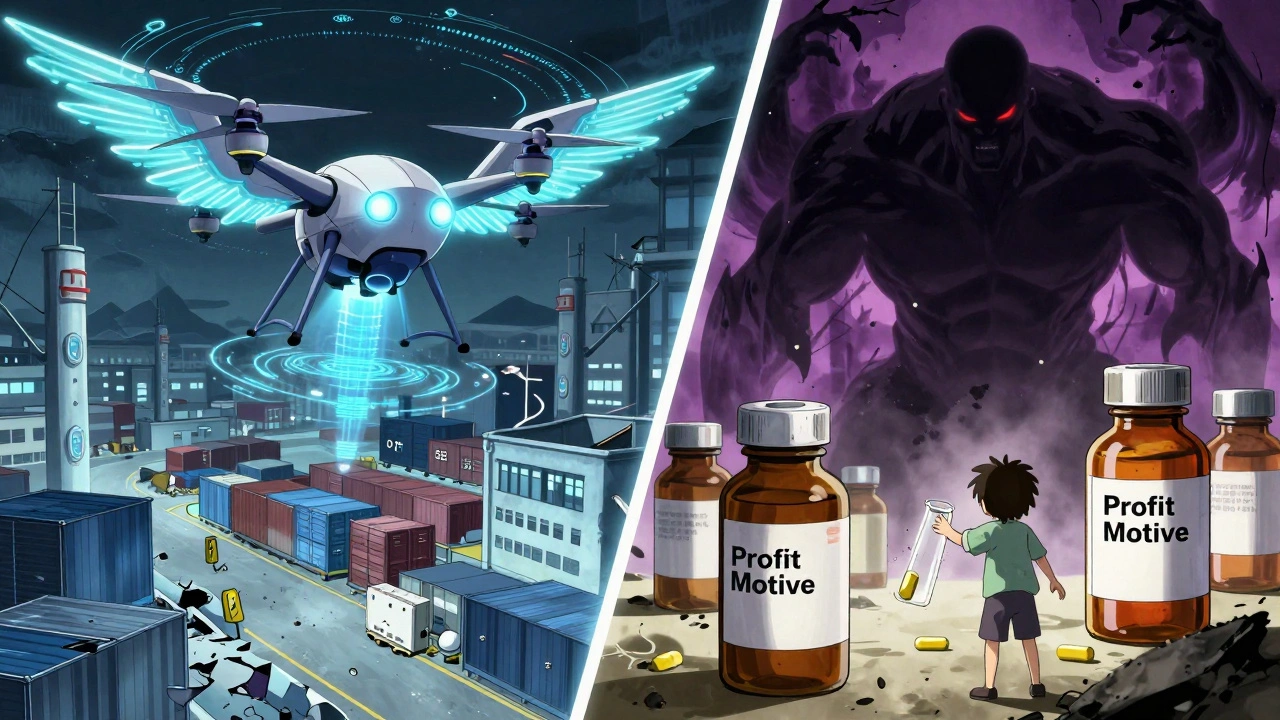
The Human Cost
Behind every shortage is a patient. A cancer patient who gets a less effective drug. A child who gets an adult dose because the pediatric version is gone. A nurse who has to double-check every injection because the label changed. AHA surveys from August 2025 found:- 89% of hospitals had to substitute drugs during shortages
- 63% of those substitutions required extra monitoring
- 68% of hospitals reported treatment delays
- 42% reported medication errors directly linked to substitutions
The Big Missing Piece
No one is talking about the real problem: money. Making low-margin drugs like saline, insulin, or generic antibiotics isn’t profitable. Companies don’t invest in backup lines. They don’t build extra capacity. They don’t diversify suppliers. Why? Because the market doesn’t reward it. The FDA can approve new manufacturers faster. The government can stockpile ingredients. But if the price of a drug stays at 10 cents per vial, no company will risk billions to build a new plant just to make more of it. The most effective intervention we’ve seen? Mandatory shortage reporting. Hospitals that joined the FDA’s Early Notification Pilot Program saw shortages last 28% less time. But the current administration has weakened those rules. That’s like installing smoke detectors and then turning off the alarms.Where Do We Go From Here?
The pieces are there. AI monitoring. API stockpiles. Faster approvals. But they’re scattered. Underfunded. And disconnected. Real progress means:- Making shortage reporting mandatory-with real penalties for non-compliance
- Expanding the SAPIR list to cover the top 100 shortage drugs, not just 26
- Creating financial incentives for manufacturers to build redundant capacity
- Slashing approval times for new domestic plants to match the EU
- Reversing cuts to BARDA and NIH funding for next-gen manufacturing

Write a comment
Your email address will not be published.
Recent Posts
-
 ECG and Stress Tests: What You Need to Know About Heart Diagnostic Tests November 24, 2025



10 Comments
This is why we need to stop outsourcing everything to China. Simple.
The structural fragility here isn’t just logistical-it’s epistemological. We’ve optimized for marginal cost efficiency at the expense of systemic resilience, treating pharmaceutical supply chains like commodity futures rather than lifelines. The SAPIR initiative, while technically elegant, reflects a fundamental misalignment: we’re preserving inputs while ignoring the economic disincentives that make production untenable. Without price floors, volume guarantees, or risk-sharing mechanisms for low-margin generics, we’re just rearranging deck chairs on the Titanic. The AI monitoring is clever, but if the data pipeline is poisoned by non-compliant manufacturers, it’s predictive analytics dressed as a placebo.
It’s kind of wild when you think about it-we’ve got satellites mapping crop yields in real time, algorithms predicting traffic jams down to the second, and yet when it comes to something as basic as insulin or saline, we’re relying on a patchwork of voluntary reports and goodwill from companies that don’t get paid to care. The EU’s centralized system isn’t just more efficient-it’s more humane. We treat healthcare like a market transaction, not a public good, and that mindset bleeds into everything, from manufacturing to regulation. You can’t fix a broken system with better spreadsheets if the underlying philosophy is still ‘profit first, people maybe.’
Let’s be real-this isn’t a shortage crisis, it’s a greed crisis. Companies are making bank on high-margin drugs while letting the cheap, life-saving stuff rot on the vine. You want to fix this? Don’t hand out $285 million like it’s a holiday bonus. Make it illegal to profit off a shortage. Tax the hell out of companies that sit on multiple manufacturing lines and don’t use ‘em. Pay pharmacists overtime just for tracking down meds. And for god’s sake, stop treating FDA inspectors like they’re part-time interns. We’re not running a startup here-we’re keeping people alive. Time to stop treating medicine like a side hustle.
The human cost section hit me hardest. I work in oncology. I’ve seen what happens when the vial is empty.
It’s not rocket science. Mandatory reporting with penalties. Expand SAPIR to cover the top 100 drugs. Fund domestic production properly. Cut approval times. Reinvest in BARDA. These are not radical ideas-they’re baseline responsibilities. The fact that we’re still debating them is a moral failure. We have the tools. We have the data. What we lack is the political will. And that’s the real shortage.
😂 the government is stockpiling chemicals like it’s prepping for a zombie apocalypse but won’t pay for a new factory? 🤦♀️ we’re literally playing Jenga with people’s lives and calling it ‘smart policy.’
...I knew it. I KNEW IT. This is all part of the Great Pharma Globalist Agenda. They want us dependent on China because they’re working with the UN to control the population. The FDA? Complicit. The $285 million? A distraction. They don’t want you healthy-they want you buying their overpriced drugs. The real solution? Buy from Russia. They make better APIs. And stop trusting the FDA-they’re bought off. This is a bioweapon. And they’re letting it happen on purpose. 🔥💣🇺🇸
yo why dont we just make the drugs here like in the good ol days? why is this so hard? they got all the tech and stuff. its just lazy and greedy. also the fda takes forever. my cousin tried to start a med compounding biz and got stuck in paperwork for 3 years. this is bs.
Let’s be honest-America built the modern world. We don’t need to copy the EU’s weak, bureaucratic system. We’ve got innovation, grit, and the best scientists on earth. If we just stopped coddling small manufacturers and let the market decide, we’d have this fixed in 18 months. Stop subsidizing failure. Let the weak companies fail. The strong ones will rise. That’s how capitalism works. Stop whining and start building.