
Imagine spending years in medical school learning the intricate dance of molecular biology and the complex mechanisms of a thousand different drugs, only to reach your residency and realize you can't explain to a patient why a generic pill is the same as a brand-name one. It sounds unlikely, but for many physicians, this is the reality. While we assume that medical school covers the basics of pharmacology, the actual science of generic drug equivalence often gets pushed to the sidelines in favor of brand-name drug mechanisms.
The problem isn't that the science doesn't exist; it's that it isn't being taught effectively. We have a massive gap between what regulatory agencies know and what practicing doctors actually feel confident discussing. When a doctor hesitates to switch a patient to a generic version of a medication, it's rarely because the drug isn't safe-it's usually because their education didn't give them the tools to understand why it's equivalent.
| Metric | Regulatory Standard (FDA/EMA) | Physician Reality (Surveys/Polls) |
|---|---|---|
| Bioequivalence Confidence | Strict 80-125% Confidence Intervals | Only 54% feel completely confident explaining it |
| Prescribing Habit | Encourage INN (Generic Name) | Only 31% regularly use INN in prescribing |
| Education Focus | Science-based equivalence data | 12 hours on brands vs. 30 mins on generics |
What Exactly is Bioequivalence?
To understand why doctors struggle, we first have to define what they are supposed to be learning. Bioequivalence is the absence of a significant difference in the rate and extent to which the active ingredient becomes available at the site of drug action. In simpler terms, it means the generic drug gets into the blood at the same speed and in the same amount as the brand-name version.
Regulatory bodies like the FDA (Food and Drug Administration) and the EMA (European Medicines Agency) don't just take a company's word for it. They require pharmacokinetic studies-usually involving 24 to 36 healthy volunteers. The gold standard is that the 90% confidence intervals for the AUC (Area Under the Curve, which measures total exposure) and Cmax (maximum concentration) must fall between 80% and 125% of the reference drug.
If a drug meets these markers, it's considered therapeutically equivalent. However, this technical jargon rarely makes it from the regulatory handbook into the medical school classroom. When a physician is faced with a patient's concern, "it's FDA approved" often feels like an insufficient answer because the doctor doesn't actually understand the 80-125% rule themselves.
The 'Brand-Name Habit' in Medical Schools
Why is this knowledge gap so persistent? It starts with how we teach. In many medical curricula, case studies and textbooks rely heavily on brand names. A 2023 AAMC analysis found that 78% of case studies use brand names, which subconsciously trains students to think in terms of products rather than molecules. This creates a "brand-name habit" that persists long after graduation.
This is further compounded by the culture of the workplace. Junior doctors often mirror the prescribing styles of their seniors. If a senior consultant always writes prescriptions using trade names, the resident will likely do the same, regardless of what they read in a textbook. This is why some researchers argue for INN Prescribing (International Nonproprietary Name), which is the practice of prescribing by the generic name of the active ingredient. When schools like the Karolinska Institute made INN prescribing mandatory for evaluations, they saw a 47% increase in generic prescribing among their graduates.

When Theory Hits Reality: The 'Concerta' Effect
One reason doctors remain skeptical of generics isn't a lack of textbooks, but real-world anomalies. Take the 2016 situation with generic versions of Concerta (methylphenidate). Even though these products met bioequivalence standards, some clinicians reported a lack of therapeutic effect in certain patients. This created a ripple effect of distrust. When a doctor sees three patients struggle with a generic version, they don't think about "90% confidence intervals"; they think the generic is inferior.
This is especially true for Narrow Therapeutic Index (NTI) Drugs. These are medications where a tiny change in dose or concentration can lead to a failure of therapy or toxicity. On the physician-only network Sermo, a significant number of doctors expressed concerns about generics for drugs like warfarin and levothyroxine. While the FDA maintains that bioequivalence standards apply to all classes, the anxiety around NTI drugs remains a major hurdle that standard medical education fails to address.
Moving Beyond the 45-Minute Lecture
We've tried the quick fix. A study in Malaysia showed that a 45-minute interactive lecture by pharmacists could bump knowledge scores up by about 25%. But here's the kicker: it didn't change how the doctors actually prescribed. Knowing a fact is different from changing a behavior.
The real solution seems to be longitudinal, experiential learning. Research in Nature Scientific Reports suggests that prescription review skills require a high volume of repetition-around 2,000 prescriptions-to reach true competency. One of the most effective tools is the "teach-back" method. This is where a provider asks the patient to explain the concept of generic equivalence back to them. Not only does this ensure the patient understands, but it forces the doctor to simplify and solidify their own understanding of the science.
Integrating this into the digital workflow is the next frontier. Currently, only about 38% of U.S. healthcare systems have electronic health record (EHR) tools that flag generic substitution opportunities and provide immediate bioequivalence data. Imagine a world where a doctor clicks a drug and a small window pops up showing the bioequivalence data for the available generics. That's how you close the gap between education and practice.
The Economic Stakes of Better Education
This isn't just an academic exercise; it's a massive financial issue. Generic drugs make up about 90% of prescriptions in the U.S. but only 22% of the spending. If we can move the needle on physician confidence, the savings are astronomical. Some estimates suggest that comprehensive medical education on generics could save the U.S. healthcare system $156 billion annually by 2030.
But to get there, we need to move away from passive learning. Printed guidelines have shown a measly 7.2% improvement in prescribing rates. We need microlearning-short, 15-minute modules that doctors can consume between patients-and a fundamental shift in how pharmacology is taught in the first year of med school.
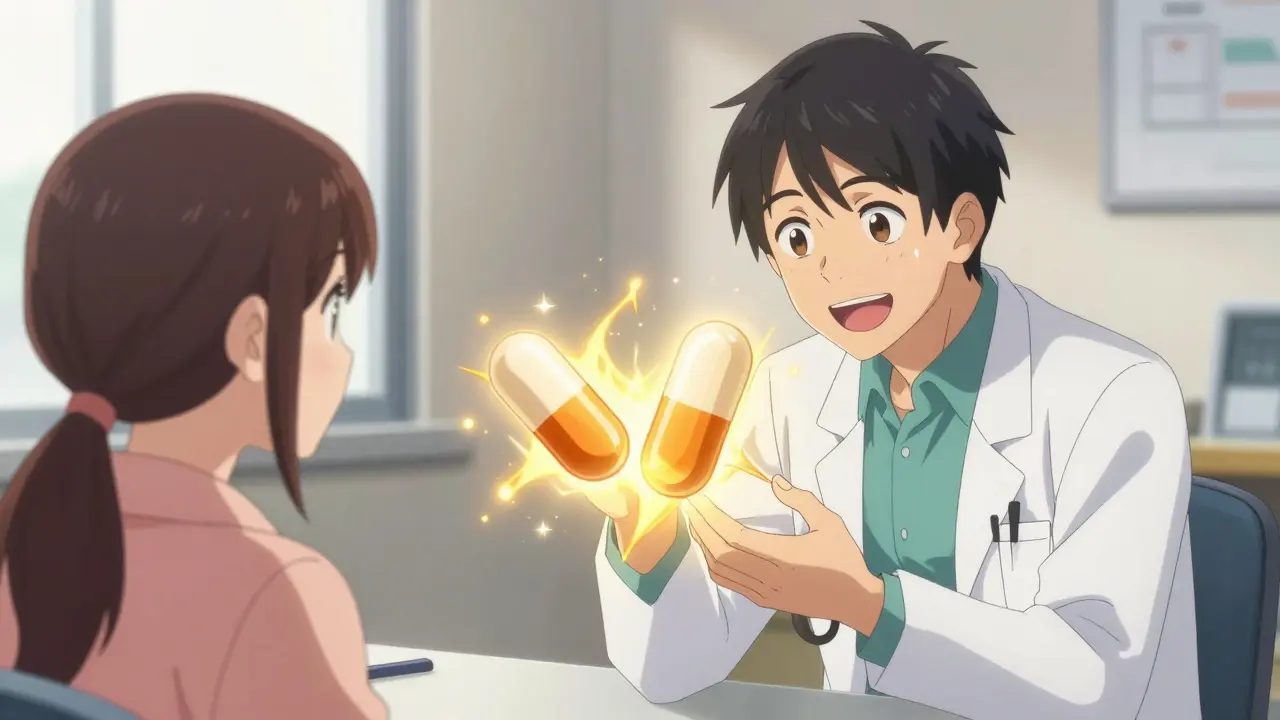
Is a generic drug always exactly the same as a brand-name drug?
Not exactly. While the active ingredient is the same, generic drugs can have different inactive ingredients (excipients) like fillers, binders, or dyes. However, the FDA requires that these differences do not make the drug less safe or effective. The core focus is bioequivalence-ensuring the active ingredient reaches the bloodstream at the same rate and extent.
Why do some doctors avoid generics for certain conditions?
This usually happens with Narrow Therapeutic Index (NTI) drugs, such as certain antiepileptics or thyroid medications. Because these drugs have a very slim window between a therapeutic dose and a toxic dose, some specialists worry that minor variations in generic formulations could cause stability issues, despite regulatory assurances of equivalence.
What is the 80-125% rule in bioequivalence?
This is the regulatory standard used by the FDA and EMA. It means that the 90% confidence interval for the geometric mean ratio of the generic drug's AUC (total exposure) and Cmax (peak concentration) must fall between 80% and 125% of the brand-name drug's values to be considered bioequivalent.
How does INN prescribing help?
INN (International Nonproprietary Name) prescribing means writing the prescription for the generic chemical name rather than the brand name. This removes the "brand-name habit" and encourages the use of more cost-effective, equivalent medications from the start.
Can a short course actually fix a doctor's lack of knowledge?
It can improve knowledge, but not necessarily behavior. Research shows that a 45-minute lecture can increase test scores by about 25%, but without ongoing feedback, prescription review experience, and cultural changes in the hospital, doctors often revert to the prescribing habits of their senior colleagues.
What's Next for Providers?
If you're a practitioner looking to bridge this gap, the best first step is adopting the teach-back method with your patients. Instead of saying "it's a generic," ask your patient to explain what they understand about the difference between brand and generic versions. You'll be surprised how often this reveals holes in your own explanation, which then prompts you to dig deeper into the bioequivalence data.
For those in teaching roles, the goal should be the "de-branding" of the curriculum. Move toward mandatory INN prescribing in evaluations and integrate real-time bioequivalence data into the tools students use for clinical rotations. The bridge between a pharmacy textbook and a patient's prescription pad is built on repetition and evidence, not a single lecture in the second year of med school.

Write a comment
Your email address will not be published.
Recent Posts
-
 How to Use Technology to Track Medication Expiration Dates March 11, 2026




13 Comments
Honestly, most of us just go with what we saw our attendings doing back in the day. it's more about the culture than the science, really. plus, some patients just get weirdly anxious if the pill color changes, so we just stick to the brand to avoid the headache lol
too long didn't read. just sounds like big pharma scamming us again 🙄
The pharmacokinetic parameters-specifically the Cmax and AUC-are merely statistical obfuscations!!! One must wonder why the 80-125% variance is acceptable to the regulatory capture agencies, but totally unacceptable for a precision-engineered biological system... it is a calculated risk imposed by the industrial-medical complex to facilitate profit margins over patient homeostasis!!!
It is quite simply an indictment of the current pedagogicall framework in our medical intuitions, where the sheer paucity of emphasis on pharmacokinetics leads to a lavish reliance on brand nomenclature, though one might argue that the cognitive load of residency is too great to permit such granular distractions anyway, regardless of howeever crucial it might be for the average plebeian patient.
Wake up people! You really think a "confidence interval" means it's the same drug? It's a loophole for the government to let cheap, low-quality fillers into our bodies while the doctors just nod along because they're too arrogant to admit they don't know the basics. This whole system is rigged to keep us sick and dependent on the lowest bidder!
It's interesting how this reflects our need for trust in the systems we build. Maybe it's less about the data and more about the human connection between the provider and the patient during that moment of doubt.
The obsession with closing this "gap" is tedious. If a doctor is incapable of explaining a basic regulatory standard, perhaps the problem isn't the curriculum, but the quality of the individuals entering the profession.
The sheer incompetency of modern medical educashun is frankly appalling... the fact that practitioners rely on the "habit" of their seniors is a systemic failure of the highest order!!!
I wonder if this happens in other countries too? Like, maybe in Europe they're way more chill about generics because the system is set up differently from the get-go.
There is a profound beauty in the attempt to bridge the gap between rigid science and human empathy... we must realize that knowledge is not just data, but the bridge that connects the healer to the healed!!!
The suggestion that a mere 15-minute microlearning module could rectify such a profound intellectual void is utterly laughable. One does not simply "module" their way into pharmaceutical mastery; it requires a rigorous, disciplined immersion that is clearly lacking in contemporary programs.
It's like a kaleidoscope of corporate greed and academic inertia. We're essentially painting over the cracks in the foundation with brand-name gloss while the actual chemistry is just floating in the ether, ignored by the very people who should be guarding the gates of health.
Just use INN and stop overthinkin it! simple as that!