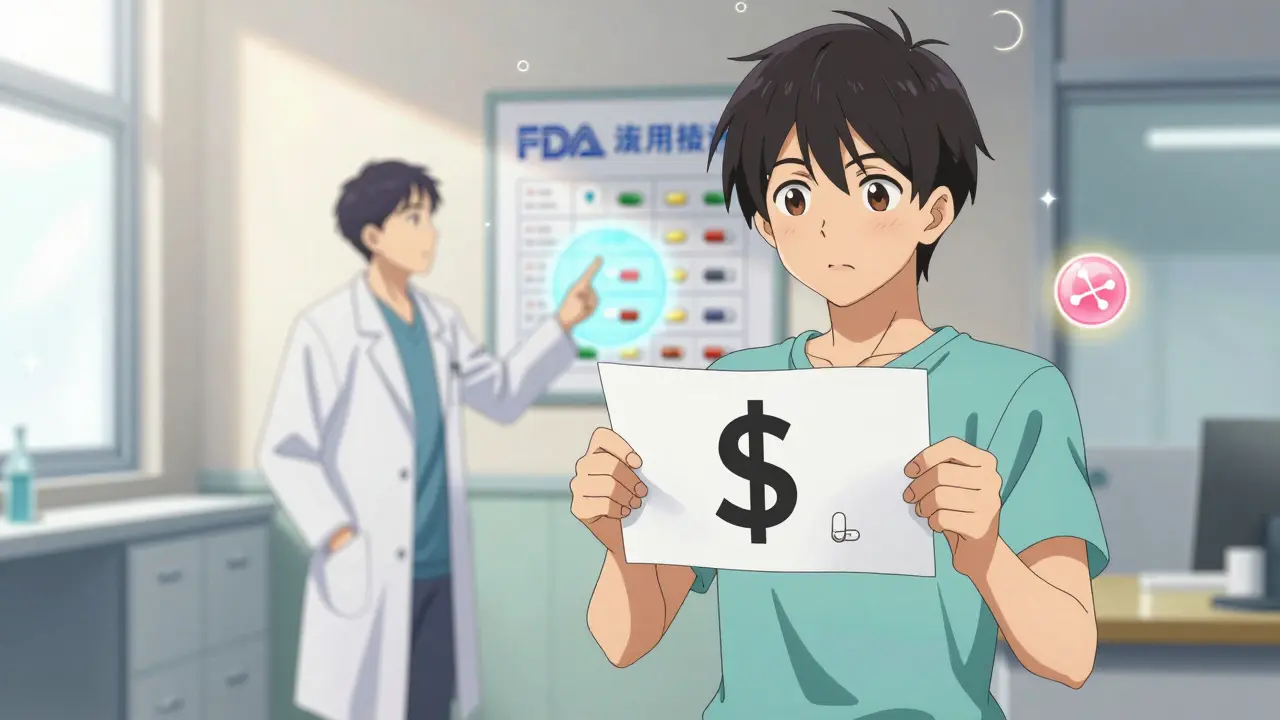
Most people don’t realize that the pill they’re paying $200 for might have a generic version that costs $4. And it’s not just cheaper-it’s just as effective. The FDA requires generic drugs to have the same active ingredients, strength, dosage, and performance as brand-name drugs. The only differences? The color, shape, or inactive ingredients like fillers or dyes. For 95% of medications, generics work exactly the same way. Yet, many patients never ask their doctor about switching-even when they’re struggling to afford their prescriptions.
Why Generics Are Almost Always a Safe Choice
Generic drugs aren’t second-rate. They’re exact copies of brand-name drugs, approved by the FDA after rigorous testing. Before a generic can hit the market, the manufacturer must prove it delivers the same amount of active ingredient into your bloodstream at the same rate as the brand-name version. That’s called bioequivalence. The acceptable range? Between 80% and 125% of the brand’s performance. In plain terms: your body absorbs it the same way.When multiple companies start making the same generic, prices drop fast. The first generic might be 6% cheaper. But after two or three competitors enter, prices often fall 50% to 95%. For example, the brand-name heartburn drug Nexium costs around $284 for a 30-day supply. The generic, omeprazole, runs about $4. That’s not a savings-it’s a revolution.
And you’re not alone in using them. According to Medicare Part D data, 89% of prescriptions filled are for generics. In fact, 90% of all prescriptions in the U.S. are for generic drugs. The only reason you’re still paying full price for a brand is probably because no one ever asked your doctor to switch you.
When You Should Stick With Brand-Name Drugs
There are exceptions. About 5% of medications have what’s called a narrow therapeutic index. That means tiny changes in blood levels can cause big problems. For these drugs, even a small difference in how your body absorbs the medicine can lead to side effects or loss of control.Examples include:
- Warfarin (a blood thinner)
- Levothyroxine (for thyroid conditions)
- Phenytoin and other antiseizure medications
- Cyclosporine (used after organ transplants)
If you’re on one of these, consistency matters. Switching between different generic manufacturers can sometimes cause fluctuations. That’s why your doctor might recommend sticking with one brand or one generic manufacturer. But even here, the issue isn’t that generics are less effective-it’s that switching between different versions might require closer monitoring.
Don’t assume your drug falls into this category. Ask your doctor. If they say, “We need to keep you on the brand,” ask: “Is this because of the narrow therapeutic index? Or is it just because that’s what I’ve always taken?”
How to Start the Conversation at Your Appointment
Most doctors don’t know which generics are available for every drug. Pharmaceutical companies spend millions marketing brand-name drugs. Doctors get samples, newsletters, reps-rarely cost comparisons. So it’s up to you to bring it up.Don’t wait until you’re at the pharmacy and the price shocks you. Bring it up during your appointment. Here’s how:
- Ask directly: “Is there a generic version of this medication?”
- Follow up: “Would it be safe and appropriate for me to use the generic?”
- Ask about timing: “If there isn’t one now, when might a generic become available?”
- Frame it as a shared goal: “I want the most effective treatment at the lowest cost. Can we look at options that fit both?”
Don’t say, “Can I get the generic?” That puts the doctor on the spot. Instead, say: “I want the most effective drug at the best price, and I want prescriptions for generic drugs when possible.” This shifts the conversation from cost-cutting to smart, shared decision-making.

Bring Proof to Your Appointment
Doctors respond to data. If you show them how much you’re spending, they’re more likely to act.Before your visit, check the cash price of your medication on sites like GoodRx or SingleCare. Compare it to the generic. For example:
- Brand-name Humira: $6,300/month
- Generic adalimumab: $4,480/month (with competition)
- Brand-name Synthroid: $60/month
- Generic levothyroxine: $12/month
Print a simple one-page comparison. Or just show it on your phone. A 2023 case study in the American Journal of Managed Care showed a patient saved $1,820 per month by switching from Humira to its generic. That’s $21,840 a year. Your doctor will notice.
Insurance and Pharmacy Rules
Your insurance plan may already be pushing you toward generics. Medicare Part D plans cover generics at much higher rates than brand-name drugs. Commercial insurers cover generics about 72% of the time, compared to 89% for Medicare.Pharmacists can legally substitute a generic for a brand-name drug in 48 states-unless your doctor writes “Do Not Substitute” on the prescription. That means even if your doctor doesn’t mention generics, your pharmacist might already be switching you. But you won’t know unless you ask.
Ask your pharmacist: “Was this switched to a generic? If so, which manufacturer?” If you’re on a narrow therapeutic index drug and you notice a change in how you feel after a refill, it might be a different generic. Tell your doctor. You might need to stick with one brand or one generic maker.
What If Your Doctor Says No?
Sometimes doctors say no because they’re used to prescribing a brand. Or they think you’ll be worse off on a generic. That’s usually wrong.If they say, “I don’t think the generic will work for you,” ask:
- “Is there any clinical reason, based on my health, that I shouldn’t use the generic?”
- “Can we try the generic for one refill and see how I do?”
- “Can you check if this drug is on the narrow therapeutic index list?”
Studies show that 78% of patients who switched from brand to generic for common drugs like lisinopril or sertraline reported no difference in effectiveness. Only 12% noticed minor side effects-often from different inactive ingredients, not the active drug.
If your doctor still refuses, ask for a written reason. That’s your right. Then consider getting a second opinion. A 2022 American Medical Association policy update encourages doctors to routinely discuss generics because the evidence of equivalence is overwhelming.
Real People, Real Savings
AARP surveyed 12,500 seniors who asked their doctors about generics. Two out of three successfully switched. On average, they saved $427 a year. One woman on high blood pressure medication dropped from $150/month to $8/month. Another switched from a $220 antidepressant to a $5 generic and felt just as good.It’s not about cutting corners. It’s about using proven science to save money without sacrificing health. The FDA, Mayo Clinic, Cedars-Sinai, and the American Medical Association all agree: for most drugs, generics are just as safe and effective.
You’re not asking for a discount. You’re asking for a smarter, more affordable way to stay healthy.
What to Do Next
1. Make a list of all your current prescriptions.If you’re on a long-term medication-blood pressure, cholesterol, diabetes, depression-there’s a very good chance a generic exists. And it’s probably saving you hundreds, maybe thousands, every year.
Don’t wait for your bill to arrive. Ask now. Your wallet-and your health-will thank you.
Are generic drugs really as effective as brand-name drugs?
Yes, for about 95% of medications. The FDA requires generics to have the same active ingredients, strength, dosage form, and bioequivalence as brand-name drugs. That means they work the same way in your body. The only differences are in color, shape, or inactive ingredients-which don’t affect how well the drug works.
Why are generic drugs so much cheaper?
Brand-name drugs are expensive because the manufacturer paid for research, clinical trials, and marketing. Once the patent expires (usually after 17 years), other companies can make the same drug without those upfront costs. When multiple companies start making the same generic, competition drives prices down-often by 80% to 95%.
Can I switch from a brand-name drug to a generic anytime?
For most drugs, yes. But if you’re taking a medication with a narrow therapeutic index-like warfarin, levothyroxine, or certain seizure drugs-switching between different generic manufacturers can sometimes cause changes in your blood levels. Talk to your doctor before switching. If you’re stable on your current drug, it’s often best to stick with the same version (brand or generic) unless your doctor says otherwise.
What if my doctor says there’s no generic available?
Ask when one might become available. Many brand-name drugs get generics within a few years after patent expiration. You can also check the FDA’s Orange Book online or ask your pharmacist. Sometimes, a generic exists but your doctor doesn’t know about it. Bring up the name of the drug’s active ingredient-like “omeprazole” instead of “Nexium”-and ask if that’s available.
Will my insurance cover the generic?
Almost always. Insurance plans, including Medicare Part D, encourage generics because they’re cheaper. Many plans have lower copays for generics-sometimes as low as $5. Some even require you to try the generic first before covering the brand-name version. Always check your plan’s formulary or call your insurer to confirm.
Can I ask my pharmacist about generics instead of my doctor?
Yes, but with limits. Pharmacists can tell you if a generic is available and may even suggest alternatives. In 48 states, they can automatically substitute a generic unless your doctor says “Do Not Substitute.” But only your doctor can change your prescription. So if you want to switch, you still need to talk to your doctor first.

Write a comment
Your email address will not be published.
Recent Posts
-
 MedWatch System Explained: How FDA Tracks Drug and Device Safety February 7, 2026
 -
 How to Create a Medication Schedule That Minimizes Interactions November 20, 2025

13 Comments
Just switched my blood pressure med to generic last month and saved $180 a month. My doctor was surprised I even knew to ask. Turns out he prescribes generics to 90% of his patients but never tells them. We’re all just paying full price because no one ever brings it up. Seriously, if you’re on a long-term med, check GoodRx before your next refill.
I didn’t know generics were this common. I thought they were like knockoffs. This changed everything.
Oh sweet celestial bureaucracy, the FDA has approved this? How quaint. You know, in ancient Greece, Hippocrates would weep to see us reduce medicine to a cost-benefit spreadsheet. The soul of healing is not in chemical equivalence, but in the sacred trust between patient and practitioner-something lost when we commodify the body into a series of bioequivalent units. Do you even know what ‘active ingredient’ means beyond the label? Or are you just another consumer in the pharmacological dystopia, happy to swallow the algorithm’s verdict?
This is exactly the kind of info people need to hear. Don’t wait until your bill hits. Bring a printout of the price difference to your next appointment. Doctors aren’t mind readers. You have to advocate for yourself. I’ve helped three friends switch to generics-total savings: over $12,000 in one year. You’re not being cheap. You’re being smart.
Generic drugs are a socialist plot disguised as fiscal responsibility. The FDA’s ‘bioequivalence’ standards are a joke-80% to 125%? That’s a 45% swing! How is that safe? We used to trust American medicine. Now we’re told to swallow Chinese-made generics with no oversight. This isn’t progress. It’s surrender.
They’re lying. The generics are just as bad as they say. My cousin took the generic version of his antidepressant and went into a spiral. They don’t tell you that. The pharma companies make the brand name and the generic. They’re all connected. You think you’re saving money? You’re just being fed poison by the system.
In India, we’ve been using generics for decades and it’s saved millions. My uncle took generic metformin for diabetes for 15 years, never had an issue. The brand-name version? We couldn’t even afford it. But here in the US, people think generics are ‘cheap’ like they’re second-class. That’s the real problem-not the medicine, but the mindset. Why pay $300 for something that works just as well for $5? It’s not about being poor. It’s about being wise.
Just want to say thank you for writing this. I’ve been nervous about switching my thyroid med, but now I feel empowered. I’m printing out the GoodRx prices for my next appointment. You’re right-it’s not about cutting corners. It’s about using science to live better. You made me feel like I’m not being greedy for wanting to save money.
Here’s the thing no one says: pharmacists are the real heroes. In 48 states, they can swap your brand for generic without telling you. I didn’t realize my levothyroxine had changed manufacturers until I started feeling jittery. Called my doc-turned out the new generic had a different filler. Switched back. Now I always ask my pharmacist: ‘Which company made this?’ If they hesitate? That’s your cue. Knowledge is power. And power is cheap.
They’re tracking you. Every time you switch to a generic, your data gets fed into a government algorithm that decides your insurance premiums. The FDA doesn’t care if you get sick-they care about the bottom line. Your doctor? Paid by Big Pharma. Your pharmacist? A corporate drone. This whole ‘save money’ thing is a trap. They want you dependent on cheap meds so they can monitor your every heartbeat. You think you’re saving? You’re being watched.
It is, without a doubt, a matter of profound public health significance that the American populace remains largely unaware of the extraordinary efficacy and regulatory rigor underpinning the generic pharmaceutical industry. The Food and Drug Administration, in its meticulous and scientifically grounded oversight, has established criteria for bioequivalence that are not only statistically robust but clinically validated across millions of patient-years. It is, therefore, both a civic and moral imperative to advocate for generic substitution-not as an act of cost-cutting, but as an affirmation of rational, evidence-based medical practice.
Everyone says generics are fine. But have you ever seen the factory where they’re made? Dirty floors. No gloves. Workers coughing. The active ingredient is the same? Maybe. But the fillers? Who knows what’s in them. You think your body doesn’t notice? You’re just lucky so far. One day your kidneys will thank you. Or maybe not.
Wait, so you’re telling me the entire healthcare system is built on a lie? That doctors are just too lazy to ask about generics? That patients are paying $200 for pills that cost $4 because no one ever said ‘what’s the generic?’ And now you want us to believe this is a revolution? Nah. This is just the system working exactly as designed-exploiting ignorance so the rich can keep profiting. The real solution? Single-payer. Not ‘ask your doctor.’ That’s just putting the burden on the patient so the system doesn’t have to change.