
When a panic attack hits, time doesn’t slow down - it vanishes. Your heart pounds like it’s trying to escape your chest. Your breath turns shallow, your vision blurs, and your mind screams that something awful is about to happen. But here’s the truth: panic attacks are not dangerous. They’re your body’s alarm system going off when there’s no fire. The trick isn’t to fight it - it’s to outsmart it.
What Happens During a Panic Attack?
A panic attack isn’t just feeling nervous. It’s a full-body surge of adrenaline triggered by your fight-or-flight system, even when there’s no real threat. You might feel dizzy, numb, or like you’re choking. Some people think they’re having a heart attack. Others fear they’re losing control or dying. These sensations are terrifying - but they’re also temporary. Most panic attacks last between 5 and 20 minutes. And the good news? You can learn to stop them from taking over.Research from the National Institute of Mental Health shows that about 4.7% of U.S. adults experience panic attacks at some point. That’s nearly 1 in 20 people. And while the fear feels isolating, the tools to manage it are well-tested, proven, and accessible. You don’t need to wait for a therapist to start using them.
Step 1: Breathing to Reset Your Nervous System
When you panic, you hyperventilate. You breathe fast and shallow, mostly from your chest. This drops carbon dioxide levels in your blood, which tricks your brain into thinking you’re suffocating - making the panic worse. The fix? Slow, deep breathing that brings your body back to balance.One of the most effective methods is the 2-2-6 technique: inhale through your nose for 2 seconds, hold for 2 seconds, then exhale slowly through your nose for 6 seconds. Pause for a second, then repeat. This isn’t just a trick - it’s science. A 2021 study in the Journal of Anxiety Disorders found that people who practiced this for 15 minutes a day over eight weeks cut their panic attacks by 47%.
Another option is diaphragmatic breathing. Place one hand on your belly. Breathe in through your nose so your hand rises - not your chest. Exhale slowly through your mouth. Feel your belly fall. Do this for just 5 minutes a day, even when you’re calm. It trains your body to respond differently when panic strikes.
Don’t wait until you’re in the middle of an attack to try this. Practice when you’re relaxed. Make it part of your morning routine or before bed. The more familiar your body is with calm breathing, the easier it will be to access during a crisis.
Step 2: Grounding to Pull Yourself Back to Reality
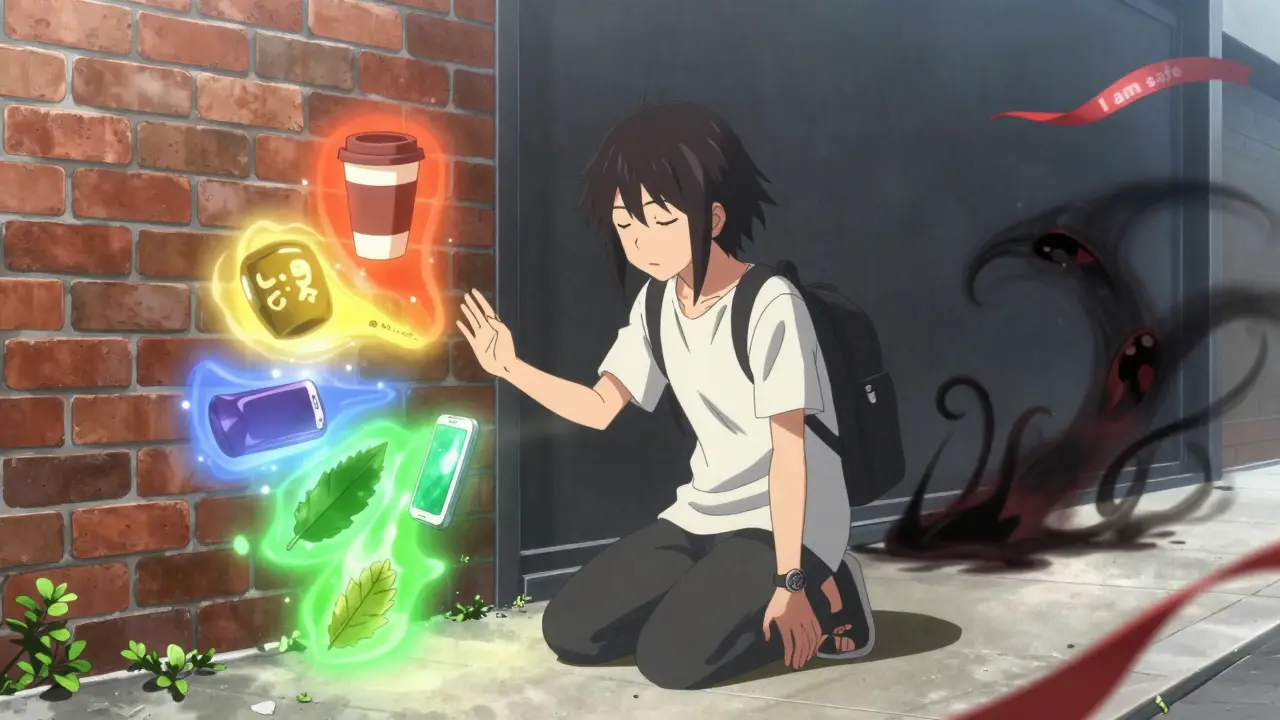
Panic attacks pull you into your head - into thoughts like “I’m going to die” or “I can’t handle this.” Grounding techniques help you step out of that spiral by forcing your attention into the present moment.One powerful method is using your five senses. Look around and name:
- 5 things you can see
- 4 things you can touch
- 3 things you can hear
- 2 things you can smell
- 1 thing you can taste
This isn’t just a distraction - it’s a neurological reset. It activates the parasympathetic nervous system, the part of your body that says, “We’re safe now.”
Another simple trick? Close your eyes. Reducing visual input can cut panic intensity by 32% within 90 seconds, according to the Anxiety and Depression Association of America. You don’t need to see the world to know you’re still here.
Write down a few calming phrases and keep them handy. Something like: “This is panic, not danger.” “I’ve felt this before. It will pass.” “I am safe.” Record them on your phone or write them on a card. When your mind is racing, you won’t be able to think clearly - but you can read.
Some people use physical cues too - like snapping a rubber band on their wrist while saying “stop” to interrupt catastrophic thoughts. It sounds simple, but it works. The tactile sensation breaks the mental loop.
Step 3: Medication - When and How to Use It
Medication isn’t a crutch. It’s a tool. And like any tool, it’s most effective when used correctly.For long-term management, antidepressants called SSRIs - like sertraline (Zoloft) or paroxetine (Paxil) - are the first-line treatment. They don’t work right away. It takes 8 to 12 weeks to reach full effect. But once they do, they reduce panic attack frequency by 60 to 70%. About 79% of people who stick with them for six months report major improvement, even if they had nausea or insomnia at first.
Benzodiazepines - like alprazolam (Xanax) or clonazepam (Klonopin) - work fast. They can calm a panic attack in 15 to 30 minutes. But here’s the catch: they’re not meant for daily use. The FDA warns that 23% of people who take them daily for more than 4 to 6 weeks develop tolerance or dependence. That’s why experts call them “rescue meds.” Use them only when the attack is overwhelming and you’re not able to use breathing or grounding techniques.
The American Psychological Association gives CBT-based plans - which include breathing and grounding - an “A” rating. That’s the highest possible. Studies show 70 to 80% of people respond well to CBT alone. Medication helps, but combining it with behavioral tools gives you the best shot at long-term freedom from panic.
Dr. David Barlow, a leading expert in anxiety treatment, says: “The most effective plans don’t just stop the attack - they change how you relate to it.” That means using medication to create space to learn, not to avoid the experience entirely.
Putting It All Together: Your Personal Action Plan
Here’s how to build your own plan - step by step.- Choose one breathing technique (2-2-6 or diaphragmatic) and practice it daily for 5 minutes. Increase to 15 minutes after two weeks.
- Write down three grounding statements that feel true to you. Save them on your phone or carry them in your wallet.
- Decide with your doctor if medication is right for you. If yes, understand the difference between daily SSRIs and emergency benzodiazepines.
- Track your attacks for two weeks. Note the time, location, thoughts, and what helped. Patterns will emerge - like stress at work or caffeine triggering episodes.
- Use a reminder: set a daily phone alert labeled “Breathe.” Or wear a bracelet as a physical cue to pause and check in with yourself.
Most people need 8 to 12 weeks of consistent practice before these tools become automatic during an attack. Don’t get discouraged if it doesn’t click right away. This isn’t about perfection - it’s about progress.
Common Mistakes and How to Avoid Them
- Mistake: Only using techniques during an attack. Solution: Practice daily, even when calm. Your brain learns faster when you’re not scared.
- Mistake: Relying on benzodiazepines too often. Solution: Use them only when breathing and grounding fail. Keep a log of how many times you use them each month.
- Mistake: Waiting until you’re overwhelmed to start. Solution: Start small. One minute of breathing a day is better than zero.
- Mistake: Thinking you have to do it alone. Solution: Use free resources like the ADAA’s webinars or the Panic Relief app from UCSF. You’re not broken - you’re learning.
What Works for Others
A 2023 survey of 1,243 people on Reddit’s r/anxiety found that 78% found breathing techniques most helpful when practiced daily. The 4-7-8 method (inhale 4, hold 7, exhale 8) was the most popular - even though it’s not in clinical guidelines. That’s okay. What matters is what works for you.Another study by Mental Health America showed that people who used personalized grounding statements reduced panic attack duration from an average of 22 minutes to 14 minutes in just eight weeks.
And here’s something powerful: 57% of people who started SSRIs had side effects at first - nausea, trouble sleeping - but 79% kept going because they saw results. You don’t have to love the process. You just have to stick with it long enough to see change.
Final Thought: You Are Not Your Panic
Panic attacks don’t define you. They’re a signal - not a sentence. You can learn to hear that signal without letting it control you. Breathing brings your body back. Grounding brings your mind back. Medication gives you the space to heal. Together, they form a plan that’s not just effective - it’s empowering.The goal isn’t to never feel panic again. The goal is to know you can handle it - and that you already have the tools inside you.
Can breathing really stop a panic attack?
Yes - but not always instantly. Breathing doesn’t erase panic, but it interrupts the feedback loop that makes it worse. By slowing your breath, you lower your heart rate and restore carbon dioxide levels, which calms your nervous system. Studies show that people who practice breathing daily reduce panic attacks by nearly half over eight weeks. During an attack, even a few slow breaths can reduce intensity.
Is grounding just distraction?
No. Grounding isn’t about avoiding the feeling - it’s about shifting your brain’s focus away from fear circuits and into sensory awareness. This activates the parasympathetic nervous system, which tells your body it’s safe. Research shows that using the 5-4-3-2-1 method reduces panic symptoms faster than trying to reason with yourself during an attack.
Are benzodiazepines safe for panic attacks?
They’re safe for occasional use under medical supervision, but not for daily or long-term use. Benzodiazepines like Xanax work quickly - within 15 to 30 minutes - and can reduce symptoms by 75% in an hour. But they carry a high risk of dependence. The FDA reports that 23% of daily users develop tolerance in 4 to 6 weeks. Use them only as a rescue tool, not a crutch.
How long does it take for SSRIs to work?
SSRIs like Zoloft or Paxil take 8 to 12 weeks to reach full effect. Many people feel worse at first - nausea, insomnia, or increased anxiety. But 79% of users continue because they see major improvement after the first few months. Don’t quit too soon. Talk to your doctor before making changes.
Can I use these techniques without therapy?
Yes - many people successfully manage panic using breathing, grounding, and medication alone. But therapy, especially CBT, significantly improves long-term outcomes. If you can access it, do. If you can’t, use free resources like the ADAA’s webinars or the Panic Relief app. Consistency matters more than perfection.

Write a comment
Your email address will not be published.
Recent Posts
-
 Mail-Order Pharmacy Cost Savings: Pros and Cons You Need to Know February 17, 2026
 -
 Adverse Drug Events: Definition, Types, and Prevention Strategies February 24, 2026



15 Comments
bro i had a panic attack in the middle of a grocery store last week and i just started breathing like a dragon while holding a frozen pizza. nobody said anything. i felt like a wizard. also the 2-2-6 thing actually worked? i thought it was just yoga nonsense.
lol the 4-7-8 method is everywhere on reddit but nobody tells you it makes you lightheaded if you do it too fast. tried it during a panic and ended up dizzy and holding onto a shelf like i was on a rollercoaster. still works though. just don’t inhale like you’re trying to suck the air out of the room.
you say SSRIs work but you dont mention the 3 months of feeling like a zombie with a side of nausea and existential dread. also, 79% improved? what about the 21% who quit because their brain turned into a glitchy video game? this post is like a pharmaceutical infomercial with a yoga twist.
there’s something so gentle about the way you framed this - like you’re not telling people to fix themselves, but reminding them they already have the tools. i used to think grounding was fake until i started naming things in my apartment during panic attacks. ‘blue lamp, cold mug, cat purring, cinnamon candle, taste of last night’s tea.’ it sounds silly, but it’s like your body remembers safety before your mind does. thank you for writing this like a friend, not a textbook.
the government and pharma companies want you to believe breathing works. they don’t want you to know panic attacks are caused by 5G towers and fluoride in the water. the 2-2-6 method? a distraction tactic. real healing comes from detoxing your aura and avoiding electromagnetic pollution. also, SSRIs are mind-control drugs. i’ve been off meds for 12 years and i haven’t had a panic attack since i started sleeping on a crystal mattress.
omg this is exactly what i needed. i’ve been practicing the 2-2-6 breathing every morning with my coffee and it’s changed everything. i still get anxious but now i don’t feel like i’m drowning. also, i made a little card with my grounding phrases and i keep it in my wallet. it’s kinda cute. 🥹
breathing helps. grounding helps. meds help. done.
i tried the 5-4-3-2-1 method during a panic in a train station. noticed the smell of wet wool, the sound of a kid crying, the texture of my coat sleeve, the taste of stale gum, and the color of a red backpack. felt like i was playing a detective game. weirdly calming. didn’t stop the panic, but it didn’t swallow me whole either.
you know what’s interesting? i’ve been doing this for years - breathing, grounding, journaling - and what i’ve realized is that panic doesn’t come from the event, it comes from the story you tell yourself about the event. like, it’s not the crowded room that’s dangerous, it’s the thought that ‘everyone is judging me’ that triggers the flood of adrenaline. and once you start noticing that narrative - ‘oh, there’s that old story again’ - you can gently say, ‘not today, brain.’ it’s not about stopping the panic, it’s about changing your relationship to it. and honestly, that’s the most powerful thing anyone can learn. it takes time, patience, and a lot of self-compassion, but you’re not broken. you’re just learning a new language - the language of your own nervous system.
start small. one minute of breathing a day. that’s it. no pressure. just breathe. you got this.
the 4-7-8 method is the OG, but honestly, the 2-2-6 is more neurobiologically aligned with vagal tone modulation. also, benzodiazepines should be reserved for acute episodes - they’re not for chronic regulation. CBT is first-line, no question. but the real kicker? consistency > intensity. daily micro-practices > occasional heroic efforts.
why are you telling people to use medication like it’s a normal thing? you make it sound like popping a vitamin. SSRIs mess with your libido, your sleep, your emotional range. and you just say ‘79% improved’ like that’s a win. what about the people who feel emotionally numb for a year? you’re not helping - you’re normalizing chemical suppression.
let me tell you something: I’ve been through 17 panic attacks in one week. I tried everything - breathing, grounding, yoga, CBD, crystals, you name it. Nothing worked until I started journaling after each attack. Not just ‘I felt scared’ - but ‘what thought came first? what did my body feel like? who did I blame?’ I started seeing patterns. Caffeine at 3 p.m. triggered 80% of mine. Loneliness after work triggered the rest. I stopped drinking coffee after noon. I called a friend every day at 6. My attacks dropped by 90%. You don’t need a miracle. You need to pay attention. And you’re not weak for needing help. You’re brave for trying.
just wanted to say thank you. i’ve been struggling for years and this is the first time i’ve read something that didn’t make me feel like a broken machine. you didn’t preach. you didn’t judge. you just showed up with the facts and the kindness. i’m printing this out and putting it on my fridge. maybe one day i’ll believe i’m not broken.
i used to think grounding was dumb until i started doing it with my toddler. she’d point at things and say ‘red!’ or ‘loud!’ and i’d copy her. suddenly, i wasn’t trying to fix my panic - i was just noticing the world. it’s like my brain forgot how to be present, but my kid remembered. now i do the 5-4-3-2-1 thing and i feel like i’m playing a game with a 4-year-old. weirdly, it works better than all the apps.