
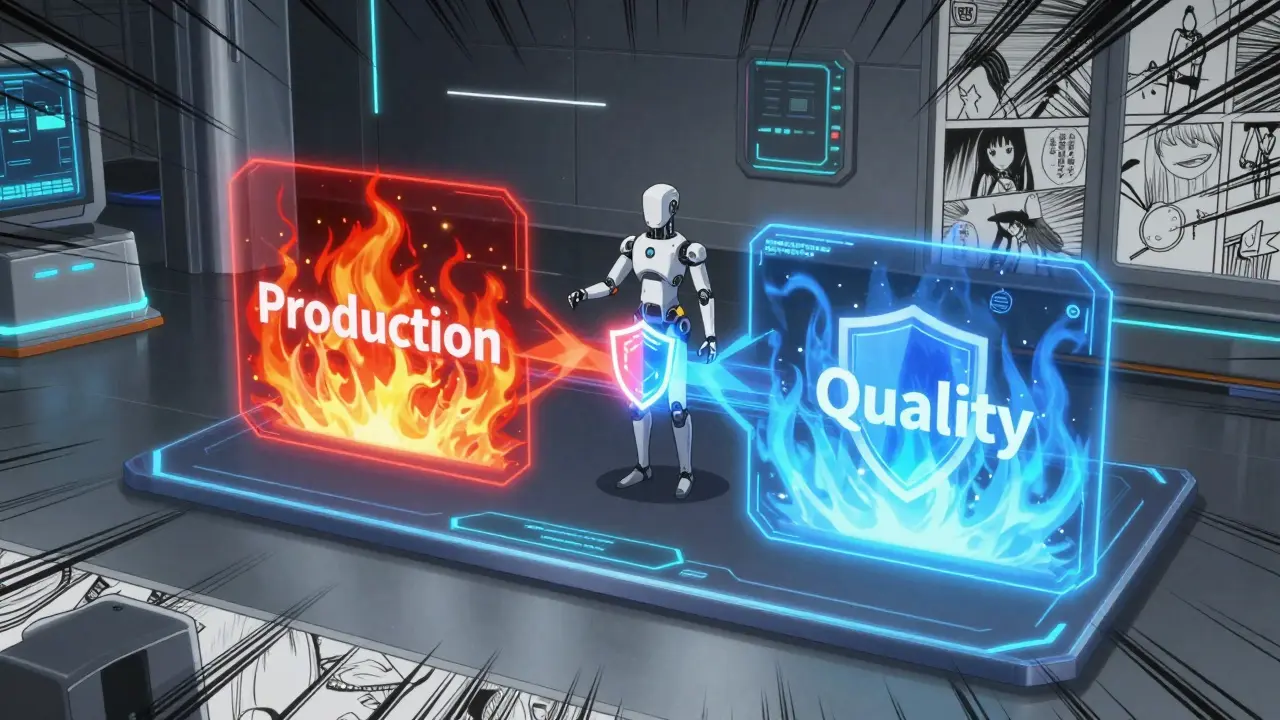
Imagine you are running a factory that makes life-saving medicine. The production manager is under immense pressure to meet quarterly targets. A batch of pills looks fine, but the data logs show a tiny temperature fluctuation during mixing. Do you ship it to save time and money, or do you hold it back for investigation? If your quality team reports directly to that same production manager, the answer might be biased. This is why independent oversight isn't just corporate jargon; it is the safety net that prevents bad products from reaching patients.
Quality Assurance Units (QUs) are formally designated structures within organizations, mandated by regulatory authorities to keep production processes honest. They act as the conscience of the factory floor. In highly regulated industries like pharmaceuticals and nuclear energy, this independence is not optional. It is a legal requirement designed to prevent conflicts of interest where efficiency metrics could compromise human safety.
What is the core purpose of an independent Quality Assurance Unit?
The primary purpose is to ensure that quality decisions remain objective. By separating the QU from production management, companies prevent production pressures from influencing critical safety checks, batch releases, and compliance audits.
The Regulatory Backbone: Why Independence is Non-Negotiable
The concept of the independent Quality Unit was cemented in modern law by the U.S. Food and Drug Administration (FDA). In their 2006 guidance document titled 'Quality Systems Approach to Pharmaceutical Current Good Manufacturing Practice Regulations,' the FDA made it clear: product development, manufacturing, and the QU must remain separate entities. This rule has roots going back further, including frameworks from the International Council for Harmonisation (ICH) Q10 and nuclear safety protocols developed after the Three Mile Island incident in 1979.
Why is this separation so strict? Because when quality teams report to production leaders, batch release decisions often suffer from subtle bias. Dr. Jane Smith, former director of the FDA’s Office of Compliance, noted in the 2024 Journal of GMP Compliance that this structural flaw creates systemic risk. When the person approving the product also cares about hitting production quotas, data integrity violations become more likely.
Recent enforcement actions prove this point. Between 2023 and 2025, the FDA issued numerous warning letters citing failures in QU independence. In many cases, warehouse managers or production supervisors were contacting the quality unit directly to bypass proper escalation protocols. The data is stark: 68% of FDA warning letters in 2024 included citations related to these independence failures. For context, that number was only 29% in 2020. Regulators are watching closely, and they expect the QU to have the authority to say "no" without fear of reprisal.
Defining the Scope: What Does a Quality Unit Actually Do?
To understand the weight of this role, you need to look at the specific responsibilities outlined in 21 CFR 211.22. This regulation grants the Quality Control (QC) unit the authority to approve or reject everything from raw components to final drug products. But the broader Quality Assurance (QA) function goes even deeper.
While QC focuses on testing individual batches-assessing incoming materials, evaluating process performance, and determining if a specific batch can be released-QA looks at the system as a whole. According to GMP Trends analysis, QA primarily involves:
- Reviewing and approving all procedures related to production and maintenance.
- Auditing records to ensure they match reality.
- Performing trend analyses to spot potential issues before they become crises.
In nuclear facilities, the stakes are similarly high. The Independent Oversight Working Group (IOWG) specifies that oversight personnel must be free to raise challenging observations without fear of sanctions. They should never have responsibility for the areas they are assessing. This ensures that the people checking the work aren’t the same ones who did the work.
Structural Requirements: Reporting Lines and Authority
Independence isn’t just a mindset; it requires physical and organizational separation. A compliant Quality Unit needs distinct reporting lines. The International Atomic Energy Agency (IAEA) stipulates that independent oversight functions should report directly to the Board of Directors or the organization’s most senior officers. This bypasses the production hierarchy entirely.
Consider the difference between two scenarios:
- Integrated Model: The Quality Manager reports to the Plant Manager. The Plant Manager wants to hit a shipping deadline. The Quality Manager feels pressure to sign off on a borderline batch.
- Independent Model: The Quality Unit Head reports to the CEO or Board. Their budget and job security depend on compliance, not output volume. They can halt production without asking permission from the factory floor.
This structural change yields results. Data from 2024 shows that organizations with truly independent QUs resolve critical quality deviations 28% faster. Why? Because there is no bureaucratic tug-of-war over whether a problem is "real" or just an excuse to slow down production. The QU has the authority to act immediately.

Industry Variations: Pharma vs. Nuclear vs. General Manufacturing
Not all industries implement oversight in the same way. In pharmaceuticals, the FDA demands complete separation. However, the European Medicines Agency (EMA) allows for slightly more integrated structures, provided there are effective mechanisms to ensure decision independence. Even here, the line is thin. The EU GMP Guide (Annex 1, 2024) mandates that quality units shall not be organizationally subordinate to production departments under any circumstances.
Nuclear facilities take a multi-layered approach. The IAEA WANO Guideline (September 2020) describes four layers of oversight:
- In-process line organization (peer checking).
- Functional oversight by senior managers.
- Independent internal oversight.
- External oversight by regulators and bodies like WANO.
General manufacturing certified under ISO 9001 sometimes limits the QU’s authority to advisory recommendations. This is a dangerous gap. Without the explicit power to reject batches or halt lines, the "assurance" in Quality Assurance becomes theoretical rather than practical.
The Small Business Dilemma: Resource Constraints vs. Compliance
For large corporations, hiring a dedicated, independent Quality Unit is easier. They typically comprise 8-12% of total manufacturing staff, according to ISPE benchmarks. But what about smaller manufacturers? Here, the tension between cost and compliance is highest.
FDA data reveals that 42% of warning letters issued to facilities with fewer than 50 employees cite QU independence failures. Compare that to 18% for larger facilities. Small teams often try to multitask. A single individual might handle both production scheduling and quality reviews. The FDA allows this only in "very limited circumstances," and only if another qualified individual, not involved in production, conducts periodic reviews of those activities.
This "one-person shop" model is risky. On Reddit’s r/PharmaEngineering, a user shared a 2024 story where their company combined production and QA roles during restructuring. Within three months, two critical deviations went uninvestigated before batch release. The lack of a second pair of eyes led to immediate compliance breaches.
To solve this, many small businesses are turning to third-party quality oversight services. This market segment is growing at 14.2% annually. Outsourcing the QU function allows small manufacturers to maintain independence without the overhead of a full-time executive hire.
Cultural Challenges: Overcoming Resistance to Oversight
Establishing an independent QU is not just about org charts; it’s about culture. Merck’s 2023 case study documented a six-to-nine-month learning curve for cultural change. Initial resistance from production leadership is common. Managers may view the QU as a roadblock rather than a partner.
Success depends on clear communication and conflict resolution protocols. Eli Lilly’s 2024 case study showed a 40% improvement in quality culture when they implemented "quality ambassadors." These were manufacturing staff who received QU training. They understood the "why" behind the rules, which reduced friction while maintaining the separation of duties.
However, beware of "rubber stamping." This happens when QU staff are too busy or understaffed to properly review documents, so they sign off without looking. FDA data shows that facilities with a QU-to-production staff ratio below 1:15 experience 3.2 times more repeat deviations. You cannot outsource diligence.
Future Trends: AI and Digital Manufacturing
As factories become smarter, the definition of independence evolves. The FDA released draft guidance in January 2025 on 'Quality Unit Independence in Digital Manufacturing Environments.' In AI-driven systems, real-time quality decisions happen instantly. Who oversees the algorithm?
MIT’s 2025 pharmaceutical manufacturing roadmap suggests a shift toward "algorithmic decision separation." Instead of relying solely on organizational charts, future systems will use code to ensure that production parameters cannot override quality limits without explicit, logged approval from an independent digital entity. The principle remains the same: the judge cannot be the jury. Whether human or software, the oversight must be blind to production pressure.
Key Takeaways for Implementation
If you are building or auditing a production system, keep these points in mind:
- Direct Reporting: Ensure your QU head reports to the CEO or Board, not the Plant Manager.
- Clear Authority: Document the QU’s right to halt production and reject batches.
- Adequate Staffing: Aim for a ratio that prevents rubber-stamping. 1:15 is a dangerous lower limit.
- Training: Invest in statistical process control and conflict resolution skills for QU staff.
- Documentation: Maintain clear org charts and procedures for "quality holds" that bypass production management.
Can one person serve as both Production Manager and Quality Assurance Manager?
Generally, no. The FDA states this is allowed only in very limited circumstances for small facilities, and only if another qualified individual, not involved in production, periodically reviews the QU's activities. For most regulated industries, this dual role is a major compliance violation.
How does independent oversight impact production speed?
While some argue it slows things down, data suggests the opposite. Organizations with independent QUs resolve critical deviations 28% faster because decisions are made objectively without political negotiation. Long-term, it prevents costly recalls and shutdowns.
What is the difference between Quality Control (QC) and Quality Assurance (QA)?
QC is operational and product-focused, involving testing batches and materials. QA is systemic and process-focused, involving auditing procedures, reviewing records, and ensuring the overall quality system works correctly. Both require independence from production.
Why are FDA warning letters citing QU independence failures increasing?
Regulatory scrutiny has intensified. From 2020 to 2024, citations for independence failures rose from 29% to 68%. Inspectors are now actively looking for signs that production pressure influenced quality decisions, such as improper escalation paths or combined roles.
How can small manufacturers afford independent oversight?
Small businesses often use third-party quality oversight services. This outsourced model provides the necessary independence and expertise without the cost of a full-time executive hire. This market is growing rapidly as small firms seek compliance solutions.

Recent Posts
-
 Edema and Sleep: Why Swelling Disrupts Rest and How to Fix It September 5, 2025
 -
 Aurogra (Sildenafil) vs Other ED Meds: In‑Depth Comparison October 8, 2025