Your eye is red, itchy, or painful. Your doctor prescribes a bottle of steroid eye drops, which are potent anti-inflammatory medications used to treat serious ocular conditions like uveitis and severe allergies. They work fast. Often within hours, the swelling goes down and the discomfort fades. But there is a catch. These powerful drugs carry risks that can permanently damage your vision if you aren’t careful.
Steroid eye drops are not just for minor irritations. They are heavy artillery in ophthalmology. While they save sight by controlling inflammation, prolonged use can raise eye pressure and cloud your lens. Understanding how to use them safely requires knowing exactly what they do, who is at risk, and how to monitor your eyes during treatment.
How Steroid Eye Drops Work and When They Are Needed
To understand the benefits, you need to know the mechanism. Steroids, specifically corticosteroids, block the body’s inflammatory response. They inhibit enzymes like phospholipase A2, which stops the production of prostaglandins-chemicals that cause pain, redness, and swelling.
You might be prescribed these drops for conditions where inflammation threatens your vision. Common uses include:
- Uveitis: Inflammation inside the eye that can lead to permanent damage if untreated.
- Severe Allergic Conjunctivitis: When standard antihistamines fail to control intense itching and swelling.
- Post-Surgical Inflammation: After cataract surgery or other eye procedures to prevent scarring and speed healing.
- Chemical or Thermal Burns: To reduce tissue reaction after injury.
The most common types you will encounter are prednisolone acetate (sold as Pred Forte, Pred Mild, or Omnipred), dexamethasone, and loteprednol etabonate. Prednisolone is considered high-potency, meaning it penetrates the eye deeply but carries higher risks. Loteprednol is often called "soft" because it breaks down quickly in the eye, potentially offering fewer side effects while still reducing inflammation.
Dr. Daniel Bintz, an optometrist with the American Optometric Association, notes that patients with uveitis typically respond very well to these treatments. The key is using them when necessary and stopping when safe. For acute issues, the benefit of saving your vision from inflammatory damage far outweighs the risks of short-term use.
The Hidden Danger: Steroid-Induced Glaucoma
The biggest risk with steroid eye drops is elevated intraocular pressure (IOP). This condition is known as steroid-induced glaucoma, which is a type of secondary glaucoma caused by increased resistance to fluid drainage in the eye due to corticosteroid use.
Here is why this happens. Your eye produces a fluid called aqueous humor. It drains out through a mesh-like structure called the trabecular meshwork. Steroids can cause cells in this meshwork to change shape and function, effectively clogging the drain. Fluid builds up, pressure rises, and the optic nerve gets squeezed.
This doesn’t happen to everyone, but it happens to enough people to make monitoring critical. Studies suggest that about 30% to 40% of the general population will see some rise in IOP with steroid use. More worryingly, 4% to 6% of people are "steroid responders." For these individuals, pressure can spike dramatically-often more than 15 mmHg above normal levels.
The scary part? You usually feel nothing. High eye pressure is silent. By the time you notice blurry vision, tunnel vision, or eye pain, significant damage to your optic nerve may have already occurred. This damage is irreversible. That is why regular checks are non-negotiable.
| Risk Factor | Impact on IOP | Monitoring Frequency |
|---|---|---|
| General Population | Mild elevation possible | Every 2-4 weeks |
| Steroid Responders (4-6%) | Significant spike (>15 mmHg) | Every 1-2 weeks |
| Pre-existing Glaucoma | High risk of worsening | Every 1-2 weeks |
| Diabetes or Family History | Moderate to High Risk | Every 1-2 weeks |

Cataracts: The Long-Term Threat
If you use steroid eye drops for more than two weeks, another risk enters the picture: cataracts. Specifically, posterior subcapsular cataracts. These form at the back of the lens, right in the center of your visual axis.
Unlike age-related cataracts that develop slowly over years, steroid-induced cataracts can appear much faster. Research indicates that prolonged use-typically defined as 10 days or longer-increases the likelihood of development. Using them for three to six months significantly raises the odds.
These cataracts cause glare, especially when driving at night, and blur central vision. If left untreated, they can lead to blindness. The good news is that cataract surgery is highly effective, with a 95% success rate according to the American Academy of Ophthalmology. However, no one wants to undergo surgery earlier than necessary. Some studies suggest steroid use can bring forward the need for cataract surgery by five to ten years.
Infection Risk: Suppressing the Immune System
Steroids suppress the immune system. In your eye, this means fewer white blood cells rushing to fight off invaders. If you have an underlying viral infection, like herpes simplex, steroids can let it run wild. This can lead to corneal ulcers or fungal keratitis, both of which are medical emergencies.
This is why doctors almost always rule out infections before prescribing steroids. If you have a history of eye herpes, tell your doctor immediately. Using steroids on an infected eye without antiviral coverage can result in permanent scarring and vision loss.
Monitoring Protocol: What to Expect
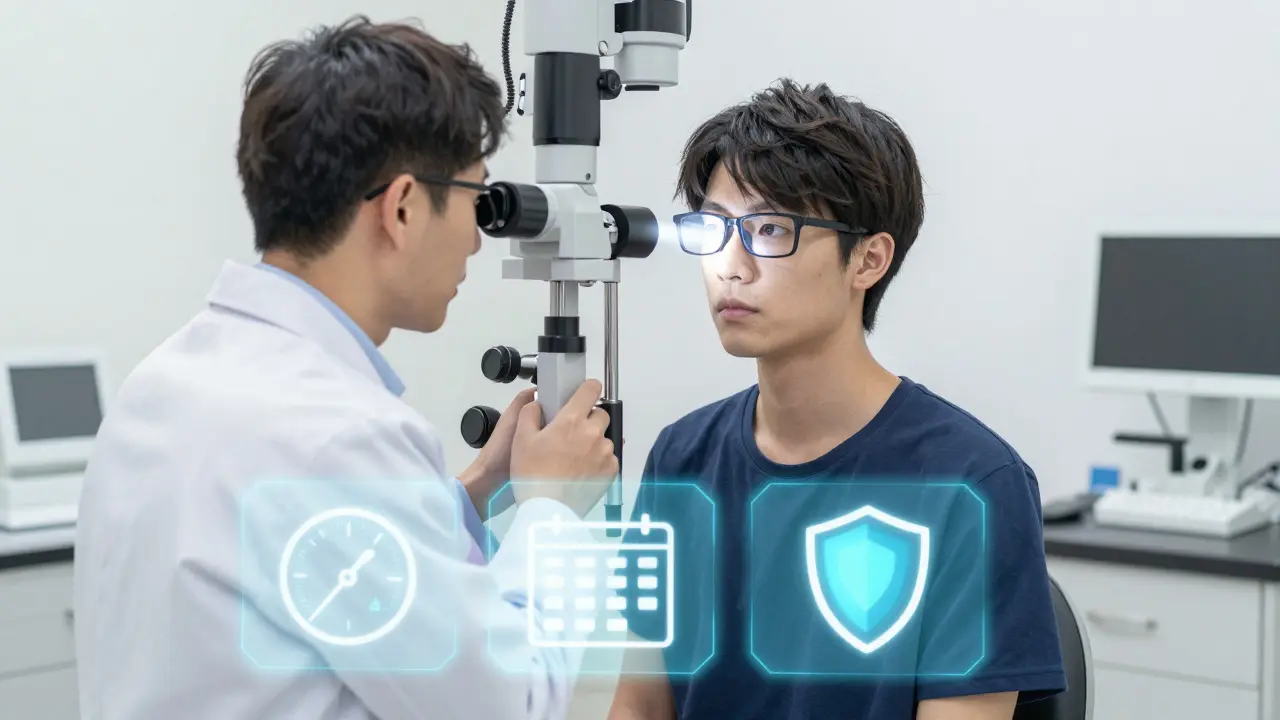
You cannot monitor your own eye pressure. You need professional tools. The gold standard is Goldmann applanation tonometry, which measures the force required to flatten a small area of your cornea. Slit-lamp exams allow doctors to look for early signs of cataracts and check the health of your optic nerve.
Here is the standard monitoring schedule recommended by eye care professionals:
- Baseline Exam: Before starting drops, your doctor must measure your IOP and examine your lens and optic nerve.
If you are low-risk and using low-potency steroids, a follow-up in two weeks is usually sufficient. - Medium-term Use (2-4 Weeks): Check every two weeks. If pressure rises, your doctor may add a glaucoma drop to counteract the steroid effect.
- Long-term Use (Over 4 Weeks): Check every week or two. Consider switching to a lower-potency steroid or adding nonsteroidal anti-inflammatory drugs (NSAIDs) to taper off the steroids.
If you fall into a high-risk category-such as having diabetes, pre-existing glaucoma, or a family history of glaucoma-you need tighter monitoring. Don’t skip appointments. Silent damage is the enemy here.
Safety Tips and Best Practices
Using steroid eye drops safely comes down to discipline and communication. Follow these rules to protect your vision:
- Never Stop Suddenly: If you’ve been using them for more than a few days, taper off. Stopping abruptly can cause rebound inflammation, making your original problem worse.
- Use the Lowest Effective Dose: If your doctor prescribes four times a day, don’t take five. If symptoms improve, ask if you can reduce frequency.
- Avoid Contamination: Never let the tip of the bottle touch your eye or fingers. Bacteria can grow in the bottle and cause serious infections.
- Watch for Symptoms: Report any new blurry vision, halos around lights, eye pain, or nausea to your doctor immediately. These could be signs of acute pressure spikes.
- Know Your Alternatives: For chronic conditions, ask about nonsteroidal options. They may be less potent but carry fewer long-term risks.
Steroid eye drops are invaluable tools. They have saved countless pairs of eyes from inflammatory destruction. But they demand respect. Treat them like prescription medication, not over-the-counter relief. Monitor closely, communicate openly with your eye doctor, and never ignore the warning signs. Your vision is worth the extra caution.
How long is it safe to use steroid eye drops?
For most people, short-term use of less than two weeks carries relatively low risk. However, any use beyond 10 days increases the chance of side effects. Prolonged use of more than four weeks significantly raises the risk of glaucoma and cataracts. Always follow your doctor's specific timeline and never extend use without consultation.
Can steroid eye drops cause permanent blindness?
Yes, indirectly. If steroid-induced glaucoma goes undetected, the high pressure can damage the optic nerve permanently, leading to vision loss. Similarly, advanced cataracts can cause blindness if not treated. Regular monitoring prevents these outcomes by catching problems early.
What are the symptoms of high eye pressure from steroids?
Often, there are no symptoms until damage occurs. When symptoms do appear, they may include blurry vision, eye pain, headaches, seeing halos around lights, and nausea. Because it is frequently silent, regular pressure checks are essential rather than relying on symptoms.
Is loteprednol safer than prednisolone?
Generally, yes. Loteprednol is a "soft" steroid that breaks down quickly in the eye, resulting in less systemic absorption and potentially lower risk of raising eye pressure compared to high-potency steroids like prednisolone acetate. However, individual responses vary, so monitoring is still required.
Do I need to stop steroid eye drops suddenly?
No. Stopping suddenly can cause rebound inflammation, where the original condition flares up worse than before. Your doctor will likely create a tapering schedule, gradually reducing the dose over several days or weeks to ensure a smooth transition.

Recent Posts
-
 How to Buy Cheap Generic Clomid Online Safely October 12, 2025
 -
 Fluoroquinolones and Delirium in Older Adults: What You Need to Know January 23, 2026